Toolformer
Self-supervised candidate generation and no-call/masked-call filtering.
Paper information
| Field | Details |
|---|---|
| Paper | Paper or original source |
| Institution | Meta AI Research / Universitat Pompeu Fabra. |
| First public release | 2023-02-09 |
| Author code | No official training code released; public GitHub implementations are third party. |
| Local adapter or method key | toolformer |
| Local reproduction code | src/auto_research/agent_research/ |
Paper method and evidence
Sample candidate API calls from few-shot examples. Compare downstream token losses for real tool results, masked results and no call, and keep only helpful calls for continued training.
flowchart LR
  A[Propose API calls] --> B[Compare real masked and no-call losses]
  B[Compare real masked and no-call losses] --> C[Keep calls with sufficient gain]
Original paper figure
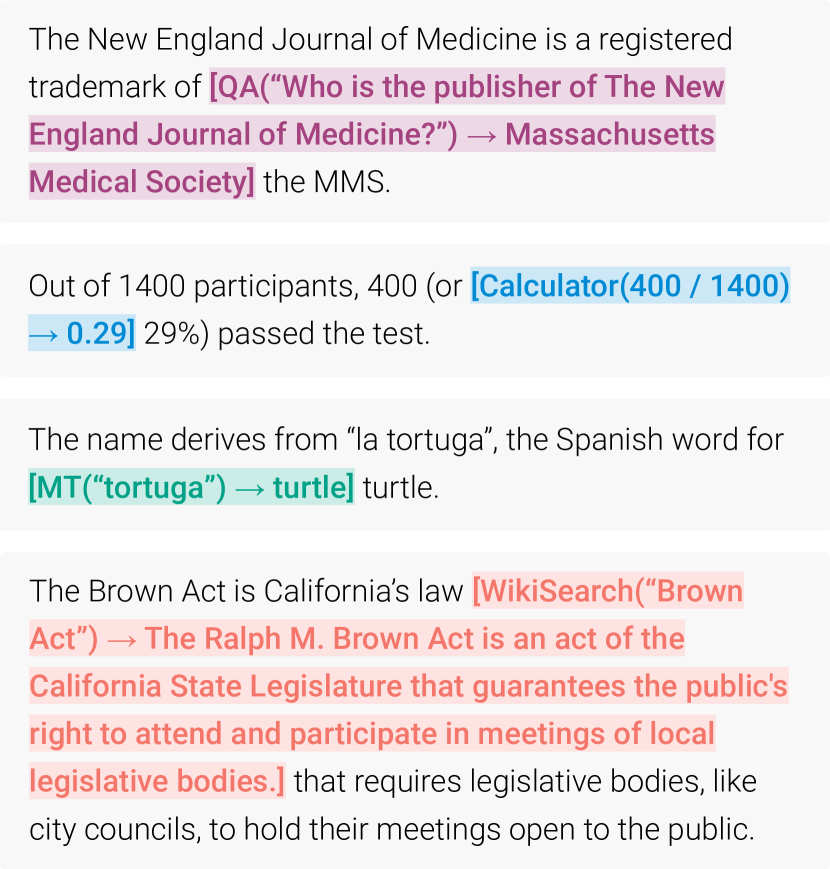
Figure shows candidate filtering by predictive utility. From the original paper; copyright remains with the authors.
Core equation
Only calls with \(\Delta_i\) above threshold enter training data.
Reported results
6.7B GPT-J improves on multiple zero-shot tasks over vanilla GPT-J and sometimes exceeds larger GPT-3 while retaining general language modeling. No production A/B.
Local reproduction
ScaleMCP mini proposes required and distracting calls; only calls reducing loss relative to no-call pass. Joint success 1.0000, mean cost 3.0000, candidate/accepted calls 540/360. Metrics. Loss is deterministic tool utility, not GPT-J token loss. No 6.7B continued training or five real API classes.