HuggingGPT: Orchestrate expert models with an LLM controller
Four-stage planning, capability matching, dependency execution and aggregation.
Paper information
| Field | Details |
|---|---|
| Paper | Paper or original source |
| Institution | Zhejiang University / Microsoft Research Asia. |
| First public release | 2023-03-30 |
| Author code | microsoft/JARVIS. |
| Local adapter or method key | hugginggpt |
| Local reproduction code | src/auto_research/agent_research/ |
Paper method and evidence
ChatGPT decomposes requests into a dependency graph, selects experts by their Hugging Face descriptions, executes in topological order, and synthesizes outputs.
flowchart LR
  A[Plan dependent subtasks] --> B[Match expert descriptions]
  B[Match expert descriptions] --> C[Execute topologically]
  C[Execute topologically] --> D[Synthesize outputs]
Original paper figure
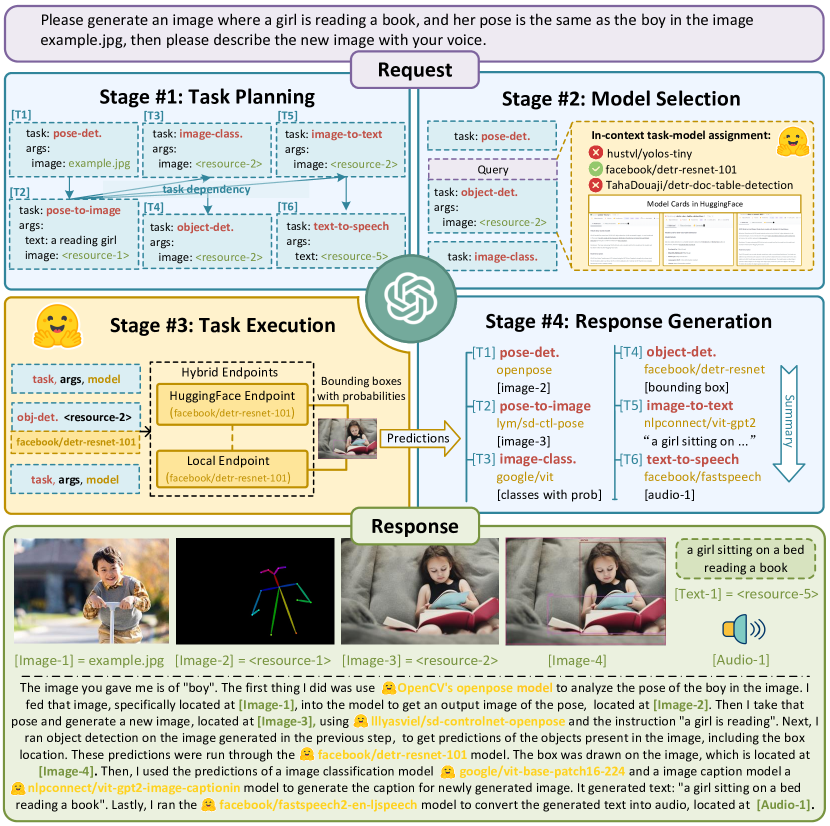
Figure shows task planning and model orchestration. From the original paper; copyright remains with the authors.
Core equation
Reported results
The paper gives language, vision, speech and cross-modal system cases and qualitative evaluation; no production A/B.
Local reproduction
PlanBench mini, 120 episodes, seed 42. Tool descriptions proxy model capabilities and each subtask keeps its dependencies. Baseline vs HuggingGPT: joint success 1.0000/1.0000, mean cost 64.5000/2.3500, model matches/edges 0/0 vs 360/240. Metrics. No ChatGPT or hundreds of actual experts; the perfect score measures orchestration only.