Self-Refine: Iteratively improve answers with the model's own feedback
Explicit draft, critique, revision and stopping, not a full LLM benchmark.
Paper information
| Field | Details |
|---|---|
| Paper | Paper or original source |
| Institution | Carnegie Mellon University / Allen Institute for AI / University of Washington / NVIDIA / UC San Diego / Google Research. |
| First public release | 2023-03-30 |
| Author code | madaan/self-refine. |
| Local adapter or method key | self-refine |
| Local reproduction code | src/auto_research/agent_research/ |
Paper method and evidence
One LLM writes a draft, produces actionable task-specific feedback, and revises until feedback says the constraints are met. No weight updates, extra training data, human feedback or external reward model.
flowchart LR
  A[Draft] --> B[Generate constraint-specific feedback]
  B[Generate constraint-specific feedback] --> C[Revise or stop]
Original paper figure
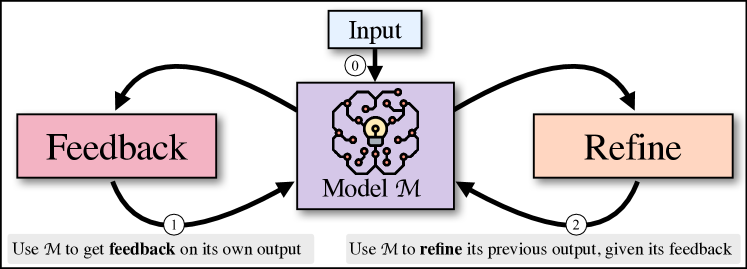
Figure shows generate–feedback–refine. From the original paper; copyright remains with the authors.
Core equation
Reported results
The paper reports up to about 40 percentage points over one-shot generation across seven tasks, including human preference evaluation. No production A/B.
Local reproduction
PlanBench mini, 120 episodes: joint success 1.0000, mean cost 2.0000, 120 feedback and 120 revision calls, 240 reasoning steps.
Stable metrics. A deterministic critic verifies transitions; no general-purpose LLM or seven-task reproduction.