CRITIC
Use tool feedback to verify and revise a first draft.
Paper information
| Field | Value |
|---|---|
| Paper | CRITIC: Large Language Models Can Self-Correct with Tool-Interactive Critiquing |
| Affiliations | Microsoft / Tsinghua University |
| First public release | 2023-05-19 |
| Authors' code | Author code. |
| Adapter / method | critic |
| Local code | src/auto_research/agent_research/ |
Original paper
Background and contribution
Pure reflection can repeat a model's original mistake. CRITIC adds observable evidence from external tools, such as search and code execution, to each critique-and-revision iteration.
flowchart LR
  D[First draft] --> T[External tool check] --> F[Errors and test feedback] --> C[Tool-based critique] --> R[Revision] --> T
Key figure from the paper
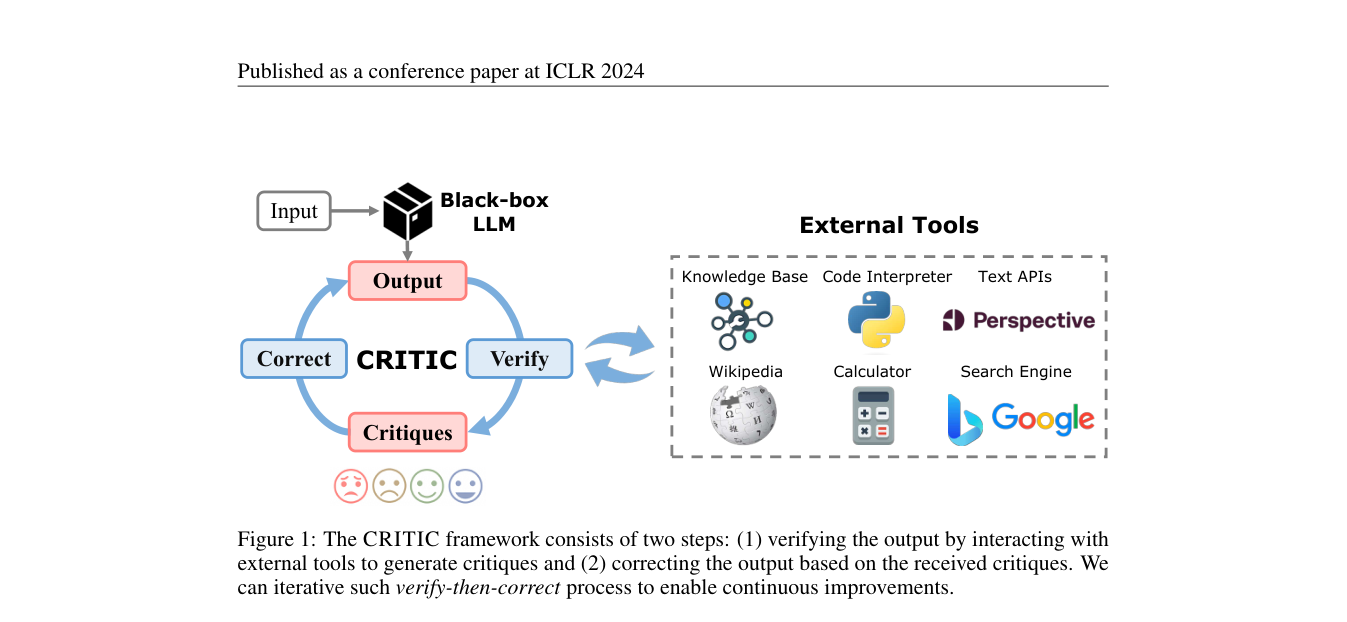
Original Figure 1: CRITIC. From the paper; copyright belongs to the authors. Not a local result.
Core mechanism
\[
y^{(t+1)}=\operatorname{Revise}\!\left(
x,y^{(t)},\operatorname{Tool}(y^{(t)})\right).
\]
Paper results
The paper reports consistent gains in open QA, math program synthesis, and toxicity reduction. No production A/B.
Local reproduction
Write a defective patch, run actual unittest, then revise and retest from the traceback. Record edit, command, status, and output. See stable metrics.
Reproduction limits
The environment actually executes feedback and edits, but is a controlled code test. No search engine, toxicity classifier, or general LLM critic.