MLE-STAR: Retrieve Models, Then Refine the Code Blocks That Matter
Historical autonomous-ML research backfill;
deferred_high_cost. Not reproduced because of high cost; review DONE. No local agent, training result, executable operator, or Evolve integration.
Paper Information
| Field | Value |
|---|---|
| Paper | arXiv 2506.15692v1; fixed text |
| Company / institution / university | First author Jaehyun Nam, Google Cloud and KAIST; PDF page 1 states that the work was done during a Google Cloud student-research placement. Jinsung Yoon, Jiefeng Chen, Sercan Ö. Arık, and Tomas Pfister are affiliated with Google Cloud |
| First public release | 2025-05-27 18:11:25 UTC, cross-checked against arXiv submission history, citation_date, and the v1 PDF. Do not infer the month from identifier 2506 |
| Author source code | jaehyun513/MLE-STAR exposes generated solutions and intermediate artifacts, not proof of a complete controller release. The official Google blog also links an ADK sample; its exact raw README path returned 404 in this check, so a current complete implementation was not independently verified |
| Local adapter | None; literature key mle-star; adapter: null |
| Local reproduction code | None: this write-up, bilingual learning questions, and catalog metadata only. An upstream sample is not a locally executed implementation |
Original Paper Summary
Key Figure from the Paper
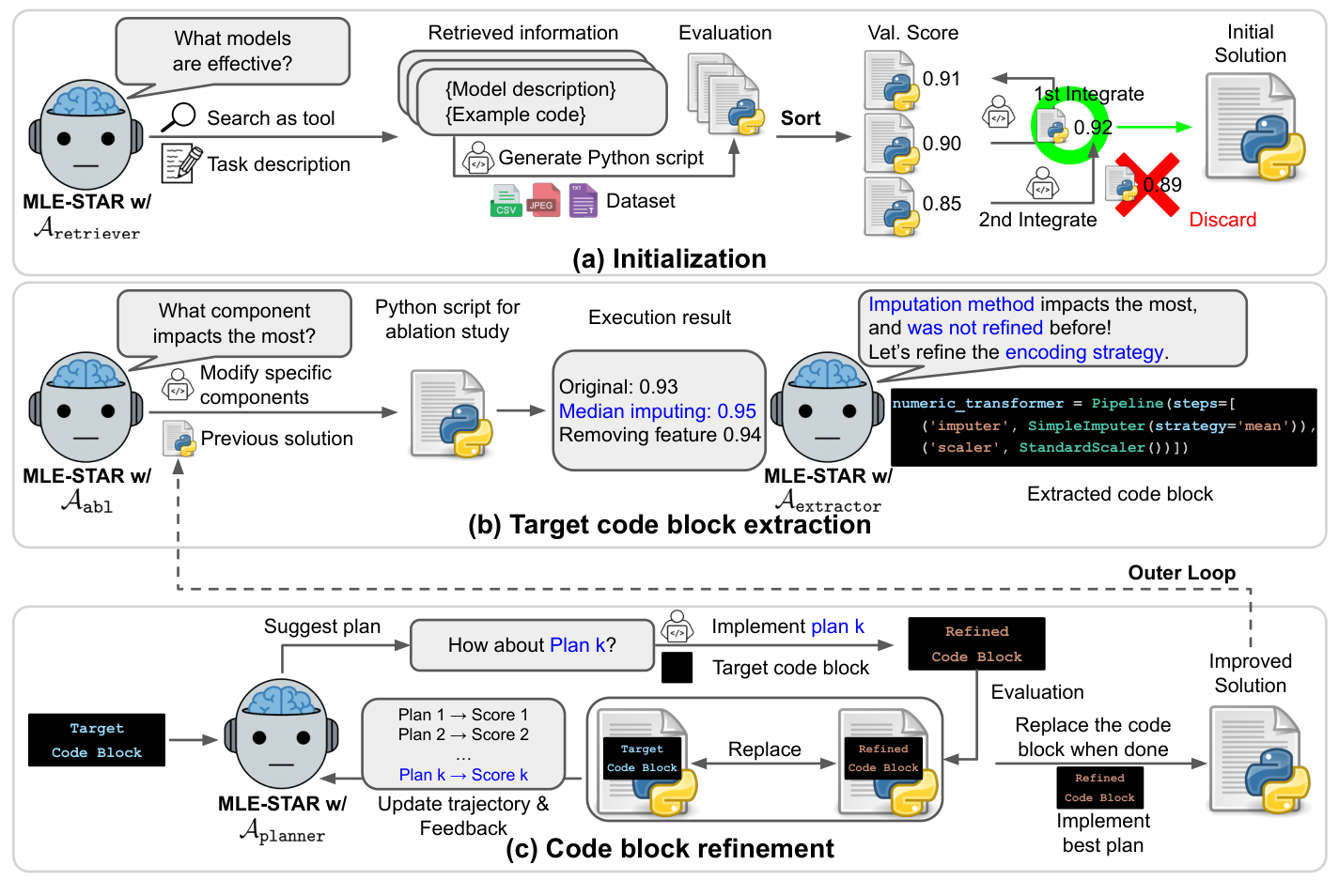
Source: v1 PDF, page 4, Figure 2, cropped from the original, not redrawn. Training, validation, and code edits shown belong to the authors' system, not a local execution trace.
Image from the original paper; copyright belongs to its authors. Full-system or experimental results shown are not local component results.
Background and Main Changes
Whole-script rewriting can keep an LLM tied to familiar models and make it switch prematurely between preprocessing, model choice, and tuning. MLE-STAR retrieves task-specific models and example code, trains candidates, ranks validation performance, and retains a merge only when it improves the solution. Executed ablations then identify a high-impact block not already targeted. Inner loops plan, rewrite, and evaluate that block; an outer loop chooses the next block. Ensemble search and leakage/data-use checks are separate agents. Sections 3.1–3.4
flowchart LR
  T[Task and training data] --> W[Retrieve models and examples]
  W --> V[Train and rank validation scores]
  V --> M[Retain beneficial merges]
  M --> A[Execute ablations and choose block]
  A --> P[Plan and rewrite that block]
  P --> E[Execute and validate]
  E --> B[Keep best replacement]
  B --> A
  B --> O[Search ensemble strategies]
Core Formula
Section 3 and Appendix B evaluate complete candidate solutions, not the plausibility of descriptions. With fixed validation procedure \(h\), the greedy retention rule can be summarized as:
Block \(b\) comes from executed ablations and plan \(p_k\) uses prior execution feedback. The inequality assumes a higher-is-better metric. Inner comparisons change the selected block; outer iterations choose another. Fixed scripts, hand-entered scores, or text similarity in place of training do not execute the defining algorithm.
Original Offline and Online Results
Fixed v1 Section 4.1/Table 1 reports 43.9% Any Medal for MLE-STAR with Gemini-2.0-Flash versus 25.8% for same-model AIDE across 22 MLE-bench Lite Kaggle competitions and three independent trials. These are authors' offline results, not local scores or production A/B evidence. The later official blog's approximately 63% belongs to a subsequent version/configuration and does not overwrite v1.
Local Review and Boundaries
Source Verification
We reviewed v1 methods, algorithms, and resource configuration, checked the original affiliation/date, and retained the original figure. The author repository's example_final_solutions and example_intermediate_outputs are generated artifacts; their presence does not establish release of the complete orchestration/search/auditing controller. No Kaggle data, external LLM calls, or example executions were used.
High-Cost Full Experiment
Appendix F specifies 96 vCPUs, 360 GB RAM, and eight 16 GB V100 GPUs, a 24-hour task cap, and 14.1 hours on average per final solution across 22 competitions and three trials. Retrieval, repeated model training, and ensembling add work. These are published configurations and measurements, not local timings. One A100/A30 or Mac should not launch this matrix merely to demonstrate its cost.
The full experiment is therefore not reproduced because of high cost; review DONE. No automatic retry, fabricated metrics, or executable Evolve operator is added. Any future small controller must separately state missing real training, ablations, and semantic decisions rather than claim MLE-STAR reproduction.