BATS: Making Tool Budgets Visible to Search Agents
CPU / L1 only: Budget Tracker, unified-cost arithmetic, and state transitions driven by explicit external verifier decisions. No search agent, real browsing, semantic planning/verification, or answer judge. Full experiments are not reproduced because of high cost; review DONE. Google's page uses the older CATS description; the formal v2 calls the method BATS. First publication was in 2025, not November 12, 2026.
Paper Information
| Field | Value |
|---|---|
| Paper | Budget-Aware Tool Use Enables Effective Agent Scaling; reviewed v2 |
| Company / institution / university | First author Tengxiao Liu: UC Santa Barbara; work done during a Google Cloud AI Research internship. Original bylines include Google Cloud AI Research, Google DeepMind, New York University, and UC Santa Barbara, visually checked on PDF page 1 |
| First public release | 2025-11-21 07:18:55 UTC, arXiv v1; reviewed v2 released 2026-08-17 07:14:22 UTC, COLM 2026 |
| Author code | Public Apache-2.0 google-research/budget-aware-agent; README read without cloning or running |
| Local adapter / key | None (adapter: null); component key bats |
| Local code | src/auto_research/agent_research/bats.py; tests/agent_research/test_nov12_agent.py |
Original Paper Summary
Background and Main Changes
More tool allowance does not necessarily change a ReAct agent's strategy. Budget Tracker continuously exposes each tool's used and remaining calls. BATS combines that signal with planning, constraint-by-constraint self-verification, and repeated attempts. It does not simply spawn a fixed number of parallel agents: remaining resources inform whether to continue a direction or pivot.
flowchart LR
    Q[Public Question and Per-Tool Budgets] --> B[Live Budget Tracker]
    B --> P[External Model Planning and Tool Actions]
    P --> T[Actual Counts and Public Observations]
    T --> V[Explicit External Verifier Enum]
    V -->|CONTINUE| P
    V -->|PIVOT| S[External Summary and Raw-History Reset]
    V -->|SUCCESS| A[Record Accepted Candidate and Start New Attempt]
    S --> B
    A --> B
    B -->|Any Tool Exhausted| J[External Judge Selects from Accepted Candidates]
Key Figure from the Original Paper
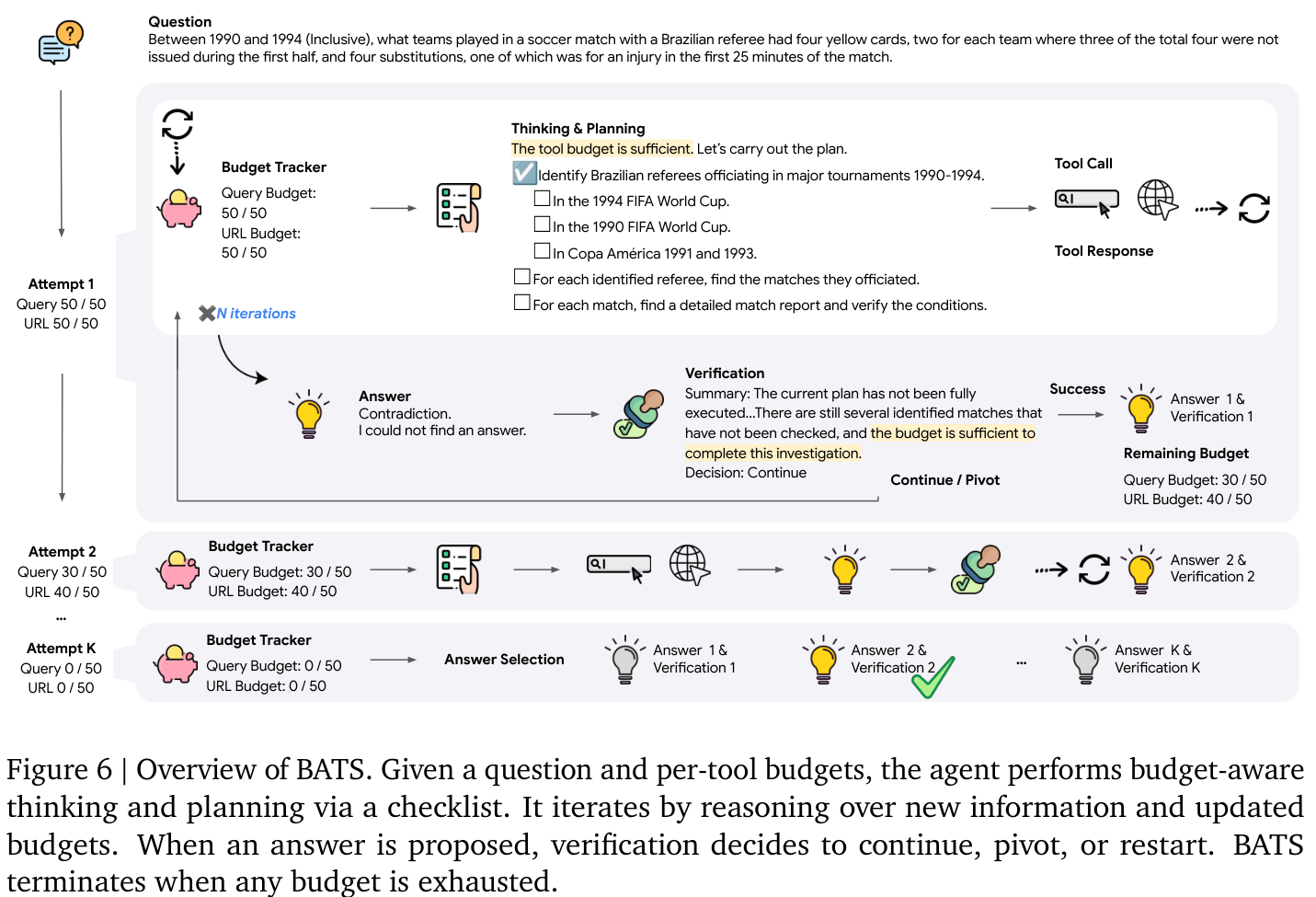
Figure 6, v2 PDF page 7. The image comes from the original paper; copyright belongs to the authors. Original diagram and caption are cropped without scientific redrawing. Source hashes and crop coordinates are in assets/provenance.json. Model planning, browsing, self-verification, and answer selection were not executed locally.
Core Equations
Per-tool usage satisfies \(u_i\le b_i\), but Appendix B starts another iteration only while every tool still has budget: \(\bigwedge_i(u_i<b_i)\). Exhausting search ends the loop even if nine browse calls remain; it does not wait until all tools are exhausted.
Budget is an advance limit; cost is realized consumption. Equation 2 is
The local counting contract includes cached input inside total input: \(C_{token}=(n_{in}-n_{cache})p_{in}+n_{cache}p_{cache}+n_{out}p_{out}\). Prices are explicit caller inputs, not current vendor quotes; cached input is not charged twice.
SUCCESS adds the candidate to the external verifier-accepted set, summarizes, and starts another attempt. PIVOT summarizes, clears the raw trajectory, and changes direction. CONTINUE keeps the current direction, compressing only when an external context-threshold decision requests it. None resets budget. The final judge selects only from accepted candidates; if none exist, the last candidate is returned, possibly None. Self-verification SUCCESS does not establish agreement with hidden gold.
Reported Offline and Online Outcomes
The paper reports cost/performance curves on BrowseComp, BrowseComp-ZH, HLE-Search, and supplementary conversational/coding tasks, not production A/B. The full method requires real search/browsing, Gemini/Claude, self-verification, and a final judge. Local tests do not repeat its accuracy, cost-Pareto advantages, or reasoning capability.
Local Component
Data Protocol and Code Mapping
BudgetTracker actually charges per-tool counts and rejects overruns, unknown tools, and invalid counts; status_block() exposes used/remaining values. TokenUsage and unified_cost() implement Equation 2 for explicit finite nonnegative prices, rejecting cache counts above total input, unpriced tools, and NaN.
BATSState contains a public question, budget, public trajectory, and external summaries, with no gold/reference field. apply_external_verdict() requires the Verdict enum and does not generate semantic decisions. SUCCESS/PIVOT require external summaries and clear raw history while preserving counts; CONTINUE does not automatically pivot. Final selection opens only after budget termination and requires an external selector returning a member of the accepted set. No heuristic majority vote or gold-matching substitute is supplied.
PYTHONPATH=src python -c 'from auto_research.agent_research.bats import diagnostic; print(diagnostic(42))'
PYTHONPATH=src python -m pytest -q tests/agent_research/test_nov12_agent.py
Local Results and Negative Controls
The three-seed diagnostics run an explicit control sequence: one search and two browse calls, PIVOT followed by SUCCESS, retaining two attempt summaries and total usage. The illustrative prices yield cost 0.27, a constructed accounting value rather than an API bill. External-verifier-accepted counts are not accuracy.
Tests check that pivoting preserves counts and reject overspending, premature finalization, non-enum verdicts, and out-of-set selector results; they check cached-input pricing and input/summary isolation. This is not a sandbox against a caller mutating Python internals. Model-generated tree plans, actual tools, semantic constraint verification, summary quality, and final-answer correctness are not implemented. promotion_eligible=false and evolve_integrated=false; CUDA is rejected.
High-Cost Full Experiments
Section 5 and Appendix A use Gemini-2.5-Flash / Pro and Claude-Sonnet-4, up to 64K–65,536 generated tokens, BrowseComp's 1,266 questions (the released code also provides a 200-question subset), 289 Chinese questions, 200 HLE-Search questions, multiple budget curves, and final judges. Tools include Google Search/SERPER and Jina/Crawl4AI. The paper's unified USD 0.001/tool-call rate is its post-hoc experimental average, not today's quote.
The full multi-model, multi-budget, long-page and repeated-verification matrix exceeds this affordable control-kernel scope and cannot be replaced by a single-card fixture. It is not reproduced because of high cost; review DONE. No benchmark questions are downloaded/decrypted, no gold is accessed, no API access is requested, and no real search retries or automatic Evolve jobs are launched.