CoReflect: A Reflective Co-Evolution Framework for Improving Conversational Evaluation
Literature and cost record only. No executable capability adapter or heuristic substitute. Full experiment not reproduced due to cost (review complete); no weight/data downloads or automatic retry. This is a user-selected historical conference catch-up.
Paper information
| Field | Details |
|---|---|
| Paper | Original arXiv v1 |
| Organization | First author Yunzhe Li lists University of Illinois Urbana-Champaign first. Richie Yueqi Feng and Chin-Chia Hsu list Google DeepMind. |
| First public release | 2026-01-18 00:56:06 UTC, arXiv v1. |
| Authors' code | No author implementation is verifiable from pinned v2 or its abstract. Exact-title search found only third-party commentary, not source evidence. Code license and pinned SHA are not applicable; the paper and figure are CC BY 4.0. |
| Adapter / method | coreflect; adapter=null; promotion_eligible=false; evolve_integrated=false. |
| Local reproduction code | None; no capability entry point. |
| Pinned method | v2 text; original publication remains the v1 date. |
| Local validation | Not applicable; review and documentation only, without training, GPU receipts, or fabricated metrics. |
A dialogue planner drafts per-turn templates from personas and scenarios. A user simulator interacts with the evaluated model; a judge scores it. A reflective analyzer clusters rationales and updates both the rubric and planner so that difficulty and diagnostic standards co-evolve over three rounds.
Original paper
Motivation and method
Sections 2.1–2.5 and Appendix G use 953 persona–scenario pairs filtered by real LLM consistency checks. Planner, simulator, evaluator, and analyzer are core semantic models. A JSON state machine, arithmetic means, or manual rubric edits do not reproduce them, so no cheap heuristic adapter is offered.
Key figure from the paper
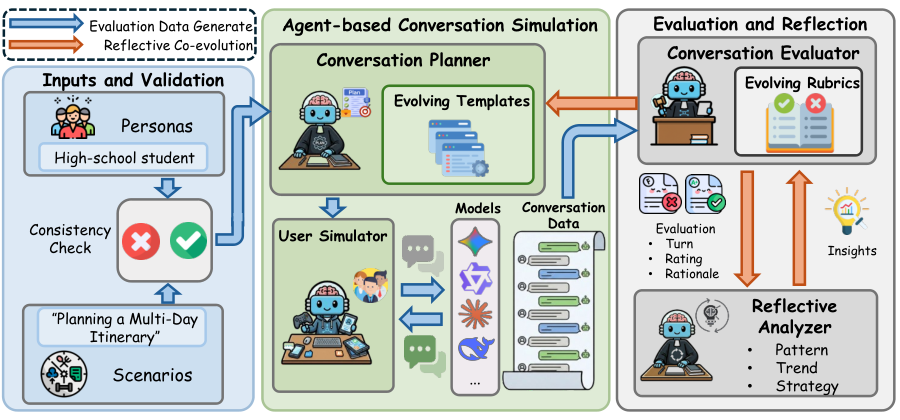
Original PNG from pinned v2, not redrawn. Copyright remains with the authors; CC BY 4.0. Source, SHA-256, and visual verification: assets/provenance.json.
Core equations
These equations explain the original method, not an implementation of the training or semantic models.
Paper results
After three rounds the authors report more discriminative rubrics and human–judge alignment, checked on 40 pairs by three human annotators. There is no closed-form substitute for LLM reflection here. No production online A/B is reported; offline results and local arithmetic are not online gains.
Local status
No model, loss wrapper, or proxy capability tests. Existing generic KL/RL/statistical utilities do not implement this workflow. Manual rules do not substitute for API-driven multiround generation or large-scale training. Only the verified method, resource and code status, and original figure are retained as not_reproduced_high_cost. Do not automatically requeue for training.
High-cost full experiment
Section 3.1 and Appendix G filter 30 personas × 40 scenarios to 953 pairs, average 6.85 turns, T=3, and roughly seven large evaluated models. Gemini2.5Flash serves as simulator/judge and Gemini2.5Pro as reflective analyzer via AIStudio/VertexAI. The full multiround API matrix exceeds the budget of a single A100/A30 or Mac. No full run or large download was started to demonstrate cost. These are paper settings, not measured local timings, and no unreported accelerator or runtime is inferred.