简体中文 · English
LifeAgentBench: Evidence reasoning over long-term heterogeneous life logs
Research material only. Neither LifeAgent nor its benchmark runs locally. The full experiment is too costly; not reproduced (review DONE). This is not a clinical diagnosis, treatment, or medical decision system.
Paper information
| Field | Details |
|---|---|
| Paper | arXiv 2601.13880v1; v2 used for local review |
| Institution | First author Ye Tian's first affiliation is UC San Diego; coauthor Xiaoran Fan is at Google Research |
| First public release | 2026-01-20 11:51:58 UTC (v1); method and cost reviewed against v2 dated 2026-08-31 |
| Author code | gdfwj/LifeAgentBench, official project page, pinned to cfc227736965f4cd42261ee780f41050ae44cc67 |
| Author code license | No LICENSE at the pinned root; GitHub license=null. Appendix F explicitly limits use to research and noncommercial settings, not an MIT grant or permission to redistribute data. |
| Local adapter or method key | Research reference lifeagentbench; no executable adapter; evolve_integrated=false |
| Local reproduction code | None. Documentation, original figure, and source records only; no model calls or evaluation scores. |
Original paper summary
Background and main changes
LifeAgentBench uses executable SQL or programs to derive deterministic answers from diet, sleep, activity, and mood records. It covers long windows, cross-dimension tasks, and cross-user tasks. LifeAgent is a separate tool-reasoning baseline: decompose questions, maintain an evidence cache and intermediate statistics, revise plans based on new evidence, and synthesize answers. A benchmark scorer is not this agent.
Key figure from the paper
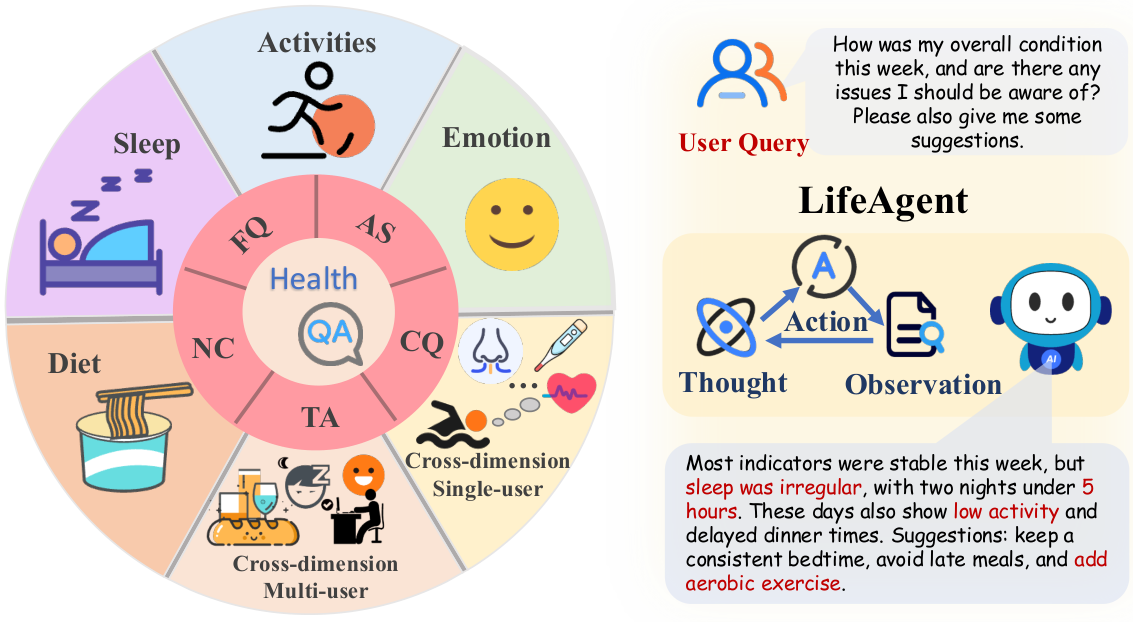
Original PNG of Figure 1 from pinned v2, not redrawn. From the paper, copyright the authors. The paper uses arXiv perpetual non-exclusive licensing, with no inferred CC license. See assets/provenance.json. Health examples are from the original paper, not local medical advice.
Core protocol
Context Prompting filters evidence by user before passing it to the model. Database-augmented Prompting first generates read-only SQL and executes it, then returns results for the answer. Executable gold references remain in the evaluator and are not given to the predictor beforehand.
Section 5 distinguishes answer Acc, executable-SQL VA, complete evidence EX conditioned on VA, and Acc|EX conditioned on complete evidence. SQL execution success does not imply full evidence retrieval. Yes/No and short text use exact match. Numbers use the paper's piecewise tolerance. Multi-item answers require matching cardinality and correct matching; loose substrings are not equivalent.
Offline and online results
Across 22,573 questions and 13 models, Qwen2.5-7B overall CP / DP accuracy is 40.45% / 21.45%. On the hard subset, LifeAgent averages 40.16%, versus CP 7.74% and DP 9.43%. The hard subset and overall dataset are not one leaderboard. These are author results, not production A/B or local scores.
Local reproduction and cost
Appendix E reports about 300–500 GPU hours for open-model inference. Larger models including 70B use 4×A6000, with additional closed APIs and multi-turn tool baselines. A single small inference sample cannot reproduce the comparison. Full experiment too costly; not reproduced (review DONE). No life logs, weights, or large datasets are downloaded. There are no inference runs, local metrics, GPU receipts, or automatic retries.