简体中文 · English
ConvApparel: Distribution alignment and counterfactual validation for conversational user simulators¶
The local CPU
evaluation_protocol_interfaceis not a full simulator reproduction. Fixed public stimuli test only the L0 interface. The full experiment is too costly; not reproduced (review DONE).
Paper information¶
| Field | Details |
|---|---|
| Paper | ConvApparel; checked against v1 §§4, 6, and Appendix B.2 |
| Institution | First author Ofer Meshi, Google |
| First public release | 2026-02-18 23:00:21 UTC (arXiv v1) |
| Author code | No algorithm source found in the paper or Google paper page. Official data is not source code. |
| Local adapter or method key | No adapter; standalone component convapparel |
| Local reproduction code | src/auto_research/agent_research/google16_convapparel.py; scripts/run_google16_evaluation.py |
Original paper summary¶
Background and main changes¶
A simulated user who completes a shopping goal does not necessarily behave like a real one. The paper uses three complementary forms of evidence: PLSA compares behavior distributions, HLS checks whether a trained discriminator can distinguish human and simulated conversations, and counterfactual validation places a simulator trained under one recommendation policy under a different policy. PLSA stands for Population-Level Statistical Alignment, not the topic model with the same abbreviation. See paper §4.
flowchart LR
    A[Human training conversations and source policy] --> S[External user simulator]
    B[Unseen target policy] --> S
    S --> T[Simulated target-policy conversations]
    H[Human target-policy conversations] --> P[PLSA distribution comparison]
    T --> P
    H --> D[Independent discriminator validation and HLS]
    T --> D
Key figure from the paper¶
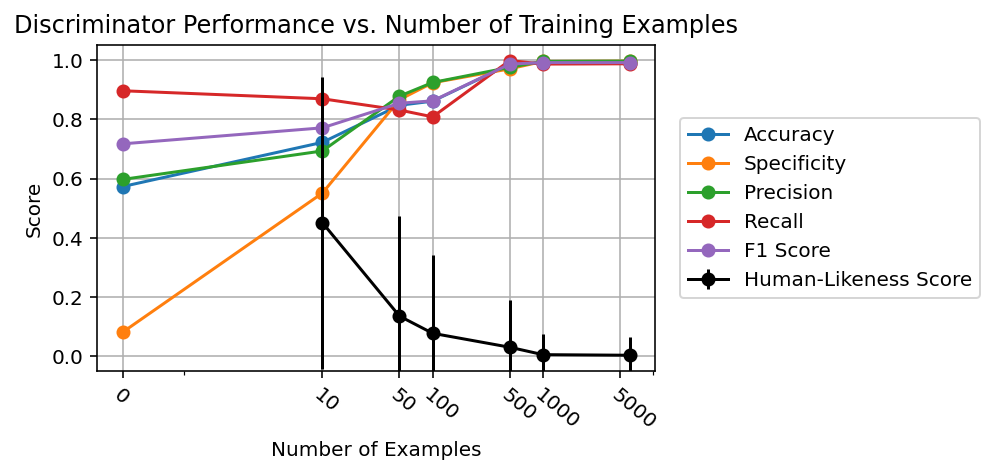
From Figure 3 of the original paper, copyright the authors. Discriminator performance and HLS as a function of training volume were checked.
Core equations¶
The empirical KS distance and MWU with half-weighted ties are:
HLS is the probability that the conversation is human, not task success:
The local run uses exact permutation tests for small samples. Above the enumeration limit, it uses seeded Monte Carlo permutation with a +1 correction. This is an explicit statistical implementation choice, not a claim about the authors' testing library.
Offline and online results¶
The trained Gemini discriminator reaches about 0.99 held-out accuracy while simulated conversations average about 0.004 HLS. High discrimination exposes the realism gap rather than indicating an excellent simulator. The paper does not report production online A/B; collecting human experiments is not evidence for industrial recommendation eligibility. See paper §6.
Local reproduction¶
Runnable component¶
PYTHONPATH=src python scripts/run_google16_evaluation.py \
  --component convapparel --fixture-demo --seed 42 \
  --output runs/google16/convapparel.json
Replace --fixture-demo with --input conversations.json to provide your own data. The top-level JSON has train and heldout arrays. Each row contains session_id, participant_id, policy, user_turns, a Boolean is_human, and optional annotations. Simulated rows for the target policy also need simulator_training_sessions listing the source-policy human training sessions.
The first argument to counterfactual_validation is the manifest of human data used to train the simulator, not the HLS discriminator's training set. The function checks provenance and compares caller-supplied trajectories. It does not train or run a user simulator or claim to verify remote training.
Data protocol and information isolation¶
Train/held-out overlap is rejected by session and participant. Only an explicitly specified source policy and unseen target policy are accepted. DiscriminatorView includes user text only, not the human label, policy ID, participant identity, or experience score. Satisfaction, frustration, dialog acts, and other annotations must come from a trusted external annotator; the component does not fabricate them from keywords.
Results and scope¶
Stable interface metrics use hand-authored style stimuli, not public ConvApparel data. The CPU unigram/bigram logistic discriminator optimizes binary BCE, but is a runnable low-cost control, not a replacement for the paper's fine-tuned Gemini. Fixture discriminator accuracy of 1 only means the two artificial styles are easy to separate. It is not evidence of human fidelity, agent capability, or Evolve promotion.
| Implementation | Location |
|---|---|
| PLSA, KS/MWU, exact/sampled permutation | google16_convapparel.py / plsa, alignment_test |
| HLS, probability validation, identity isolation | evaluate_hls, DiscriminatorView |
| Cross-policy trajectory provenance checks | counterfactual_validation |
| Actual CPU diagnostic discriminator | train_logistic_discriminator |
The full experiment collects over four thousand human conversations, runs multiple Gemini SFTs, and generates hundreds of multi-turn conversations per good and bad policy for each simulator. It is not a short-budget task on one A100/A30; no download or trial was made. The CPU statistics interface claims no CUDA behavior and does not require a GPU receipt. A real CUDA discriminator would need separate A100/A30 acceptance.