LEAP: persistent AND–OR proof memory between informal planning and Lean
review_only: historical Google-priority revision backfill. The complete campaign is too costly and not reproduced (review DONE). No Lean proof/model execution occurred; generic DAG code is not a formal-math agent.
Paper information
| Field | Value |
|---|---|
| Paper | LEAP, reviewed fixed v3, retaining the v1 record |
| Institution | First author Po-Nien Kung lists Google Cloud AI Research first and UCLA additionally; collaborators include Google Cloud and DeepMind |
| Original publication | 2026-06-02 08:16:42 UTC; reviewed v3 2026-11-12 18:13:31 UTC. Historical recall through a revision, not a November first release |
| Authors' code | The official leap directory releases Lean4 proof results/paper, with Apache2.0 software and CC-BY4.0 other materials. No verifiable general agent/harness release was found; results are not system code |
| Local adapter / key | leap-formal-math; adapter=null; no executable operator or Evolve integration |
| Local code | None; method record at src/auto_research/paper_specs/catalog/agent-research/leap-formal-math.json and documentation |
Original paper
Motivation and changes
Plausible informal reasoning does not guarantee a complete Lean-checked proof. LEAP first attempts informal proof→Lean→compiler-feedback revision, then decomposes failures through blueprints in a persistent AND–OR DAG. OR goals admit alternative strategies; AND decompositions require every necessary child lemma. Verified lemmas are reusable across branches.
Compilability alone does not establish useful decomposition. Sketches permit sorry only for proposed lemmas, not the parent theorem body, and graph updates must remain acyclic. An LLM reviewer separately checks relevance, simplification and a plausible route, avoiding renamed copies of the original goal. DFS/backtracking organizes search; the reviewer is a heuristic, not the formal kernel.
Architecture
flowchart LR
  G[Lean goal and DAG] --> P[Informal proof to Lean]
  P --> C[Compiler-feedback revision]
  C --> D[Failure triggers blueprint decomposition]
  D --> L[Formal sketch and usefulness review]
  L --> A[Acyclic AND-node commit]
  A --> G
  C --> M[Persistent verified lemmas]
  M --> G
Key original figure
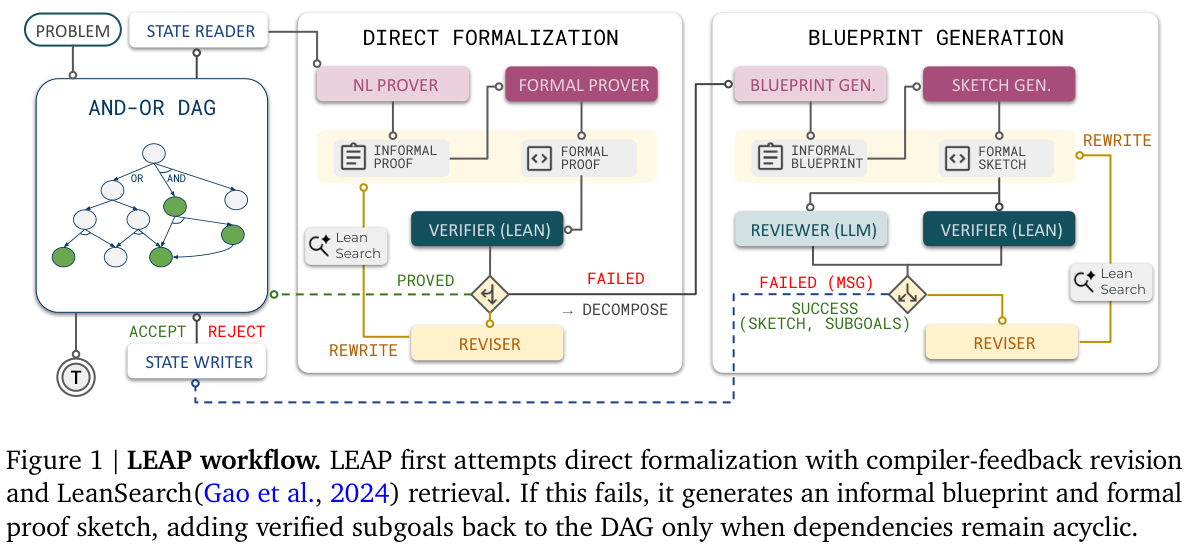
From fixed v3 PDF page4 Figure1, cropped with PyMuPDF while preserving the entire caption without redrawing. Provenance records the PDF hash/point coordinates; copyright remains with the authors. LeanSearch, model, compiler and proof-state components are not locally implemented.
Core equations
The following summarizes graph semantics, not a substitute for semantic search:
A verified sketch and all required children resolve the parent. Anticipatory auxiliary lemmas need not be required by the current AND node. Acyclicity cannot replace semantic duplicate detection or useful simplification.
Author results
Fixed v3 reports12/12 Putnam2025,83.3% Basic and56.7% Advanced on Lean-IMO-Bench; the tree ablation obtains73.3%/40.0%. Direct formalization uses pass@128 while full LEAP uses two rollouts, not identical single-attempt accuracy. Headline proving receives Lean statements without reference informal proofs; translation baselines separately receive references. No production A/B is reported and no tasks ran locally.
Local reproduction
Protocol and code mapping
Only fixed-v3 methods, the original-v1 date, figures and learning material are collected. Official solutions contain answers and must not be injected into actor observations. No model, LeanSearch/compiler bridge, proof DAG agent, evaluator, selection, runtime, capability metrics or GPU receipt is supplied.
Full experiment and limits
Section4.1 Table3 reports822 aggregate per-problem minutes and about28M tokens for Putnam's twelve tasks alone. The wider matrix adds60 Lean-IMO tasks, pass@128/two-rollout comparisons, up to20 compiler-feedback revisions and ablations. Gemini3.1Pro and differing systems make reported aggregate runtimes neither a controlled architecture comparison nor a local single-GPU estimate. Too costly; not reproduced (review DONE). No paid APIs, models/data or probes. Public proof artifacts do not establish an open full harness or local reproduction.