CAM-DF
Core mechanism evidence. Paper and local evaluations are separate.
Paper information
| Field | Value |
|---|---|
| Paper | arXiv 2607.27083 |
| Affiliations | Peking University / McGill University / Shanghai University of Finance and Economics / Tsinghua University |
| First public release | 2026-07-29 (arXiv v1) |
| Authors' code | The paper mentions cached artifacts and evaluation scripts but no public repository was found. |
| Adapter / method | cam-df |
| Local code | src/auto_research/agent_research/methods.py |
Original paper
Background and contribution
Router rank alone does not tell how many tools to expose. Virtually traverse ranked prefixes before any tool execution. Payoff is sufficiency less heterogeneous cost; compare stopping with the best future prefix to label each decision and weight errors by regret.
flowchart LR
  R[Ranked tools] --> P[Enumerate prefixes] --> U[Sufficiency minus cost] --> G[Regret-weighted stop] --> T[Expose selected tools]
Key figure from the paper
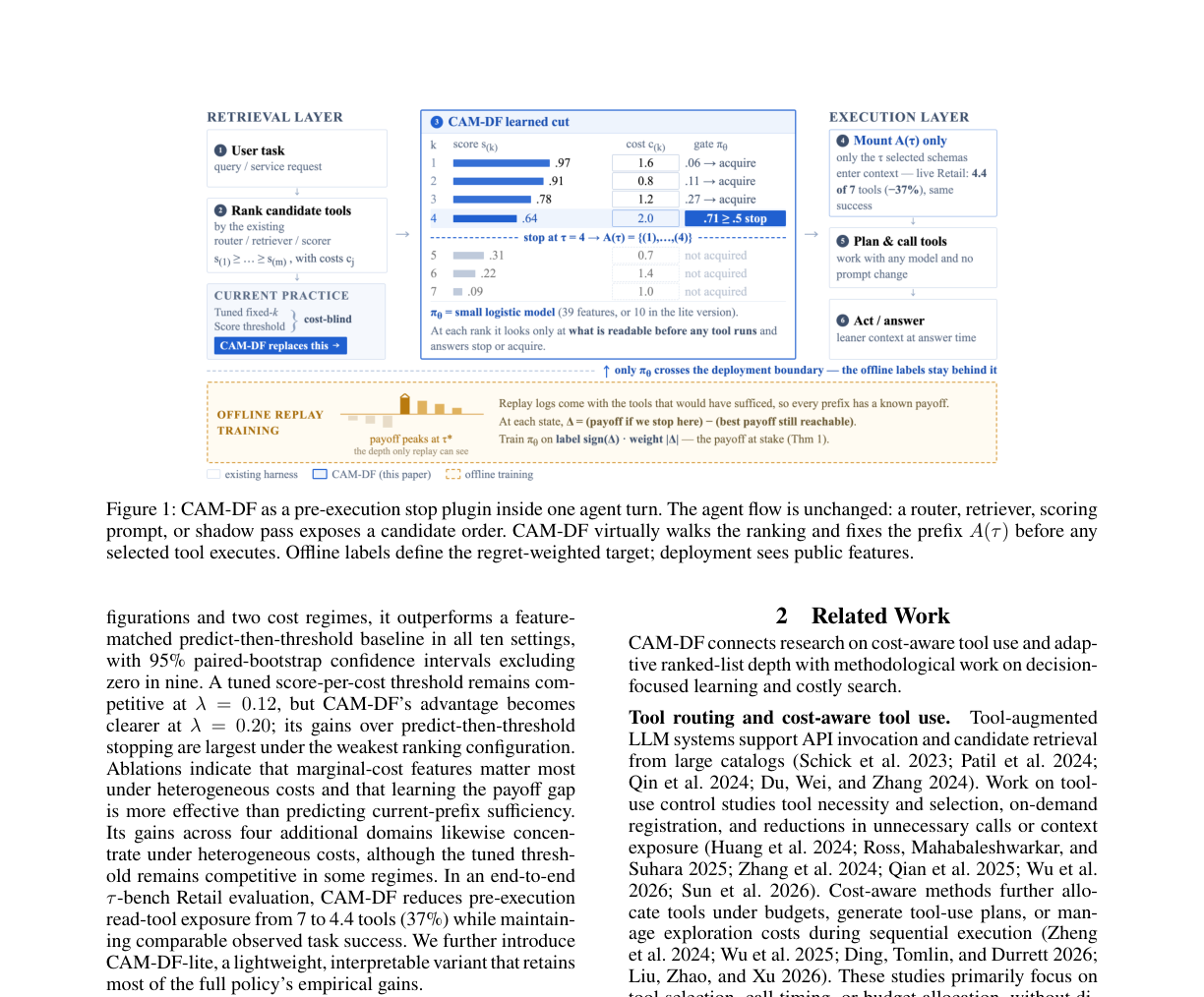
Original CAM-DF figure. From the paper; copyright belongs to the authors. Not a local result.
Core mechanism
Paper results
1,343 tasks over five tool domains; on live τ-bench Retail, exposed tools fall from 7 to 4.4 (−37%) at similar task success. No production A/B.
Local reproduction
ScaleMCP mini freezes ranks/costs and evaluates all prefixes. Joint success 1.0000, 480 of 980 tools exposed (−51.02%), early stops 120/120. Metrics.
Reproduction limits
Deterministic mini-suite, not live Retail; sufficiency comes from auditable required-tool fixtures, not a learned scorer.