Multi-Harness RL: Does the training gain come from the policy or the harness?
Fidelity: CPU group-credit and differentiable training operators. Computes task-by-harness and task-level normalized advantages on identical rollouts. It does not include held-out harness transfer for a real coding agent.
Paper information
| Field | Value |
|---|---|
| Paper link | arXiv 2609.04518 |
| Organization | New York University (first listed affiliation of the first author) |
| First published | 2026-09-03 (arXiv v1) |
| Original author code | The paper says result artifacts were released, but no verifiable public repository link was found (checked 2026-09-07). |
| Adapter / method | multi-harness-rl |
| Local reproduction code | src/auto_research/agent_research/latest_20260907.py |
Original paper summary
Background and main changes
Multi-harness RL changes both execution-environment diversity and GRPO grouping, making gains hard to attribute. The study freezes the same task–harness trajectories and compares only within- and cross-harness advantages. It evaluates transfer on a minimal harness not used during training.
flowchart LR
  T[Same tasks] --> H[Aider/OpenHands/Qwen Code/SWE-agent]
  H --> F[Frozen trajectories and rewards]
  F --> W[Within-harness GRPO]
  F --> C[Cross-harness GRPO]
  W --> O[Source and unseen harnesses]
  C --> O
Key figure from the paper
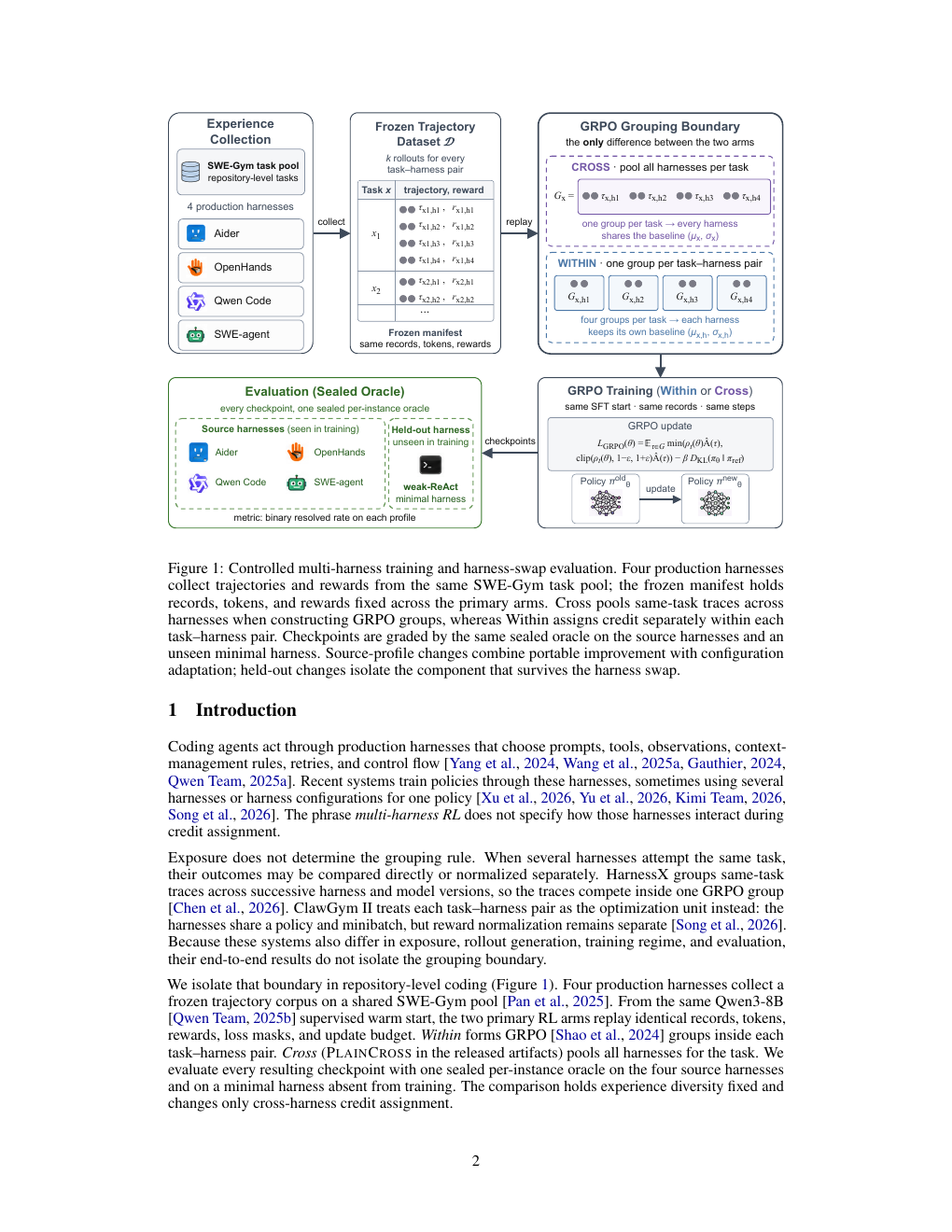
Original Figure 1: Frozen experience, two credit groupings, and sealed held-out evaluation. Image from the original paper; copyright belongs to the authors. Click the image for its source.
Core equation
Within normalizes rewards separately for each \((task,harness)\). Cross normalizes over different harnesses on the same task. Report actual transfer as \(\Delta=R_{cross}-R_{within}\) on unseen harnesses with confidence intervals.
Offline and online results in the paper
Across 24,000 sealed SWE-bench Verified evaluations, changing the evaluation harness shifts average resolution rate from 2.14% to 9.27%; the training recipe matters substantially less. Held-out Cross–Within is only +0.25pp, with a 95% CI of [-0.48,+1.02].
Local reproduction
2026-09-08 fidelity correction
The old path returned evaluation labels directly. Its accuracy and plan success rates are withdrawn. The entry point now accepts only task_id, intent, and context. Regression tests fail on reading answer, plan, or hidden required_tools. New legacy results only diagnose public text formatting; a score of 1 is not agent capability. Cost counts records read, not tool fees.
The actual operator is in sep7_mechanisms.py. Run python -m pytest tests/test_sep7_fidelity.py -q for memory paths, private skill edits, unchanged state after rejection, cross-group credit differences, and backpropagation. Standalone operators do not demonstrate an integrated LLM, live tool environment, or end-to-end Evolve workflow.
See metrics/mini-suite-seeds42-44.json for within/cross grouping, held-out audit, rolewise update, and cost at seeds 42/43/44.
Control: The local experiment validates the protocol and counters, not SWE-bench Verified, Aider, or OpenHands integration.
Reproduction limits
The real coding harnesses, Qwen3-8B RL, and sealed oracle are not reproduced. The operator is intended to prevent future Evolve experiments from mistaking harness differences for model capability.