SiLR: Structure-Preserving Agent Admission and Process Rewards
Reproduction level: CPU admission operator.
ShadowGateruns proposed actions in a deep copy of the supplied simulator and compares branchwise severity. The legacy text mini-suite has no simulator and gives no safety or process-reward evidence.
Paper information
| Field | Details |
|---|---|
| Paper | arXiv 2609.04629 |
| Organization | Institute of Science Tokyo (first-listed affiliation of first author). |
| First public release | 2026-09-03 (arXiv v1) |
| Authors' code | No public author repository was found (checked 2026-09-07). |
| Adapter / method | silr |
| Local reproduction code | src/auto_research/agent_research/latest_20260907.py |
Original paper
Motivation and method
If a system already violates constraints, rejecting every action that remains unsafe can prevent recovery. SiLR shadow-executes a proposal and compares each constrained branch's severity. It admits only actions that do not worsen the product order. The same structured signal can be a process reward for GRPO.
flowchart LR
  P[LLM action proposal] --> S[Shadow simulator]
  S --> V[Branchwise violation vector]
  V --> O{No component worsens?}
  O -->|Yes| E[Real execution]
  O -->|No| N[Reject and resample]
  V --> R[Process reward]
Key figure from the paper
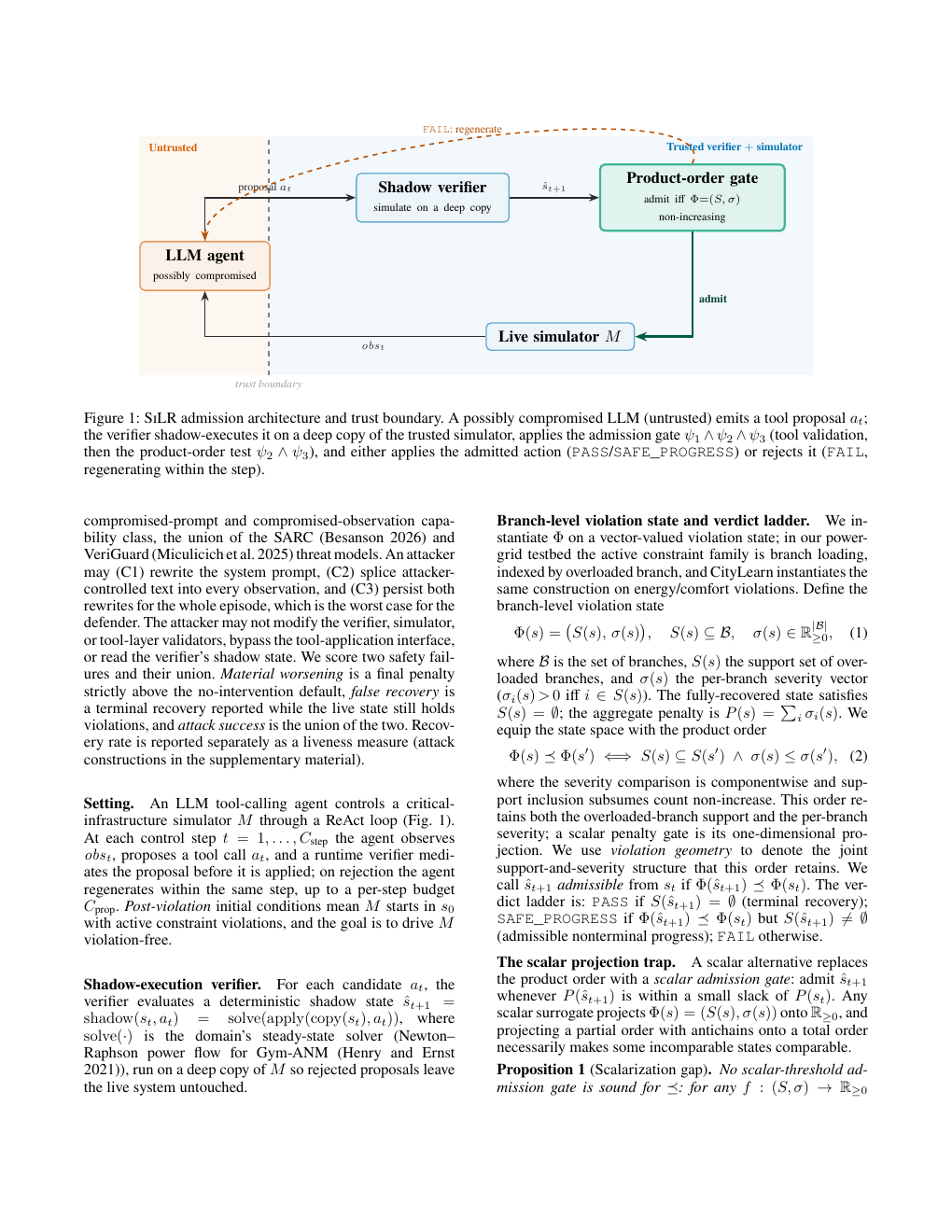
Figure 1: The LLM, shadow simulator, and structure-preserving admission boundary. From the original paper; copyright remains with the authors.
Core rule
For violation vector \(v(a)\), action \(a'\) is admitted only if \(v_j(a')\le v_j(a)\) for every branch \(j\). A scalar projection can hide worsening in an individual branch.
Paper results
On Gym-ANM multi-action cases, SiLR recovers 21/21 versus 0/21 with terminal admission and 9/21 with the best scalar gate. Product ordering falsely admits none of 42,410 unsafe actions. The process-reward experiment scores 0.844 versus untrained 0.778.
Local reproduction
2026-09-08 fidelity correction
Old direct returns of evaluation labels invalidate prior accuracy and plan success. Inputs now expose only task_id, intent, and context. Regression tests reject access to answer, plan, or hidden required_tools. New legacy results only diagnose public text parsing, even at 1; cost counts records read, not tool spending.
The operator is in sep7_mechanisms.py. Run python -m pytest tests/test_sep7_fidelity.py -q for memory paths, private skill edits, unchanged state on rejection, credit differences, and backpropagation. This standalone operator does not establish full LLM, real-tool, or end-to-end Evolve integration.
Mini-suite metrics report shadow calls, structural admits/rejections, verifier calls, and success costs for seeds 42/43/44.
Local comparison. Discrete branch-severity fixtures exercise partial-order logic, not power-grid or CityLearn physics.
Limits
The operator does not substitute for a real system simulator. Safety cannot be claimed without a deterministic verifier with sufficient coverage.