HCRG: Build Dependency Context Before Migrating Code
component_only/ L0: Python AST graph subsystem only, not the Java tree-sitter pipeline or actual LLM migration. Full study too costly; not reproduced (review DONE).
Paper information
| Field | Value |
|---|---|
| Paper | arXiv 2609.12464, v1 Sections 3–5 |
| Affiliation | First author Nilesh Jaiswal: Google Cloud, supported by the affiliation and Google email in the paper |
| First public release | 2026-09-11 05:54:41 UTC (arXiv v1); April 6 on the first page is not the arXiv submission date |
| Authors' code | No pipeline found in the paper or Google entry; spring-petclinic is input, not author implementation. |
| Adapter | None; standalone hcrg component |
| Local code | src/auto_research/agent_research/google16_hcrg.py |
Original paper
Background and contribution
HCRG extracts INHERITS/CALLS/IMPORTS from ASTs, caches the architectural skeleton, migrates parent dependencies first, and retrieves up to three hops of structured context. The vector-RAG control uses 800-character chunks, 150 overlap, top five. See Sections 3–4.
flowchart LR
 C[Explicit Python module sources] --> A[Python AST, not tree-sitter]
 A --> G[Resolved and unresolved edges]
 G --> S[Structural and signature skeleton]
 G --> T[SCC condensation and dependency order]
 G --> R[Up to three retrieval hops]
 S --> I[Future actual migration agent]
 T --> I
 R --> I
Key figure from the paper
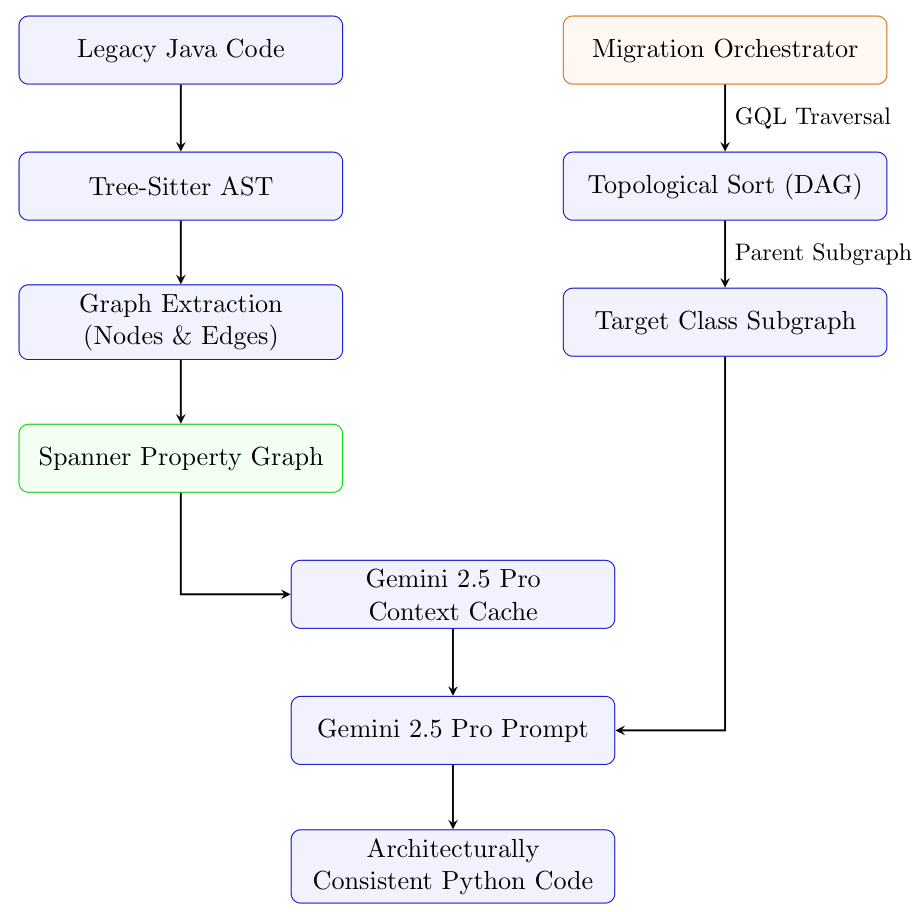
v1 Figure 2, page 5, from the paper; copyright belongs to the authors. Local Python does not reproduce tree-sitter, Spanner, or Gemini cloud paths. See capture provenance.
Structure and results
Context is \(N_{\le3}(v)\). For resolved edge \(v\to p\), place \(p\) before \(v\). Cycles remain strongly connected groups, not a claimed internal topological order; the paper does not specify a complete cycle breaker.
For one Java→Python repo, DRQ rose 34.8%→65.9% and PCC 26.7%→45.5%, while complexity consistency fell 71.6%→46.7%. No live A/B or multi-repo/multi-seed generalization was reported. See Section 6.
Local reproduction
Eight Python mechanism tests cover cross-module inheritance, hop bounds, signature skeleton, dependency order, explicit cycles, caching and partial metrics, and preservation of ambiguous, external, same-name unimported, and shadowed dependencies. See diagnostics.
extract_python_graph never executes or imports input; at most 64 modules, 100,000 characters each. Resolve only top-level dependencies in the module or through explicit imports. Parameter/local shadows do not map to global same-name symbols. Unresolved symbols are retained; method signatures enter the skeleton but dynamic calls, reflection, and Java syntax do not. dependency_order retains SCCs, retrieve caps at 3 hops, and SkeletonCache is local content hashing, not Vertex AI Context Cache.
static_metrics supplies Python→Python PCC/THC, controlled import DRQ, parsing, and docstring presence. Not implemented: Java complexity, pyflakes, full API hallucination or MQ, LLM migration, cloud services, vector fallback, end-to-end rebuild, GPU, or Evolve.
Cost decision
The full tree-sitter Java, Spanner, Vertex embedding/one-hour cache, and Gemini2.5Pro repo migration is not cheaply verifiable within the short single-card budget; upstream implementation is unavailable. Not reproduced for cost (review DONE). Graph tests are not end-to-end reproduction.