AgentX-Model: Use experiment results to drive ongoing model research
Public-data concept demo: deterministic roles and a result-blind dependency replay over six genuinely trained MovieLens-1M model nodes. Not the private 473-node graph, LLM agents, or online A/B.
Paper information
| Field | Details |
|---|---|
| Paper | arXiv 2609.30001 |
| Institution | Kuaishou (paper copyright attribution; first author Shuang Yang). |
| First public release | 2026-09-24 (arXiv v1) |
| Author code | No public AgentX-Model implementation, production code, experimental graph, or logs found as of 2026-09-28. |
| Local adapter or method key | agentx-model-replay, independent public evaluation; not a generic agent-eval method or Evolve operator. |
| Local reproduction code | agentx_model.py, agentx_model_public.py |
Paper method and evidence
Rather than a single loop from idea to evaluation, AgentX-Model studies how to choose the next experiment. A Research Agent combines papers and known experiment paths, proposes and independently reviews changes. A Model Agent iteratively edits, trains, and measures a fixed business prediction task, returning the best intermediate implementation, negative results, and unresolved questions. The roles exchange proposals, not full work logs.
flowchart LR
  E[Papers, feedback, and revealed experiments] --> R[Research Agent proposal and review]
  R --> P[Question, starting code, change, and evaluation]
  P --> M[Model Agent iterates and measures]
  M --> B[Keep best round, evidence, and open questions]
  B --> E
  B --> G[Action dependency graph]
Original paper figure
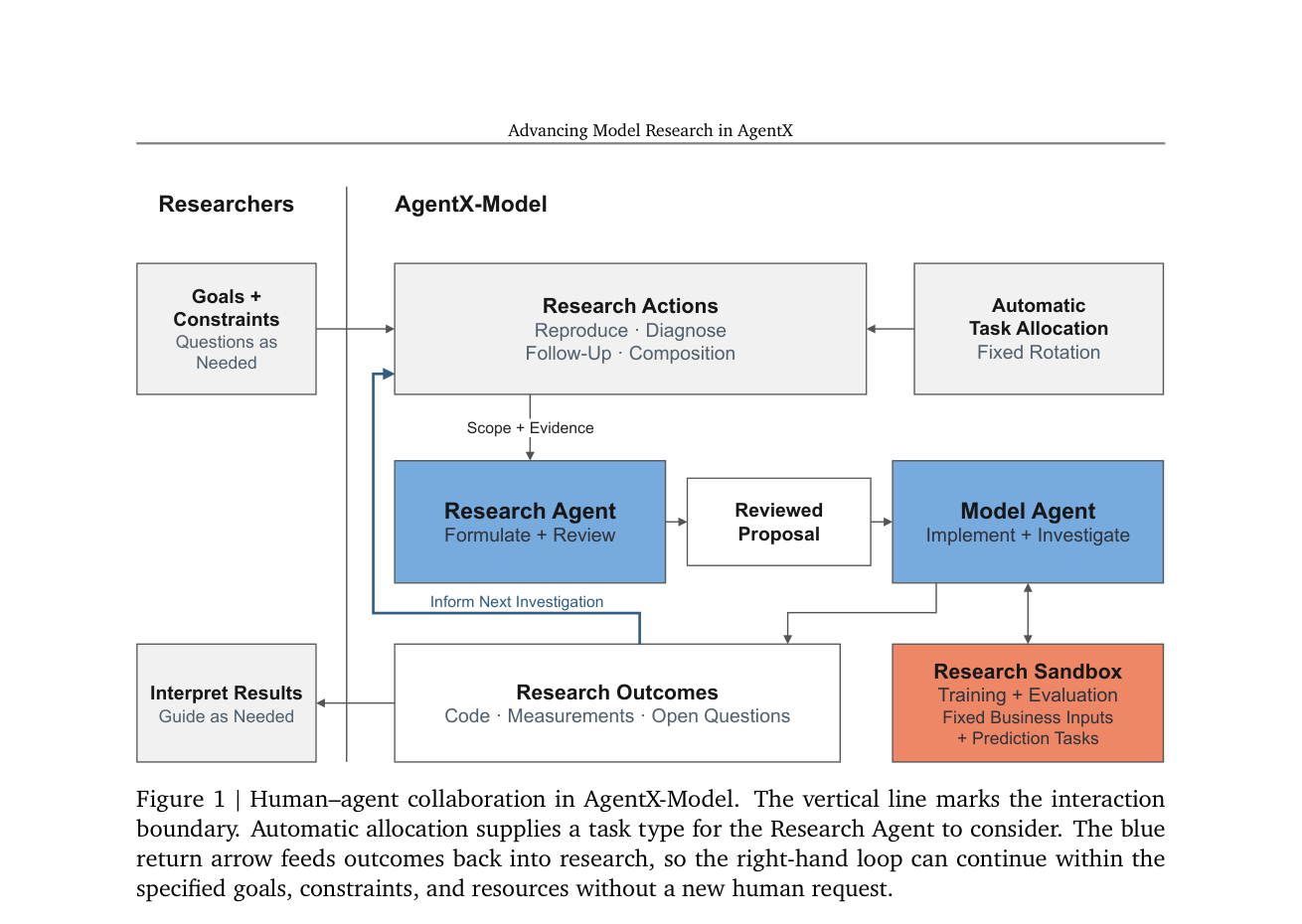
Figure 1 shows the two roles and research loop. From the original paper; copyright remains with the authors.
Core equation
A proposal \(P_t=(q_t,s_t,\delta_t,v_t)\) specifies question, starting implementation, change, and evaluation. Research state \(S_t=(\mathcal I_t,\mathcal E_t,\mathcal Q_t)\) holds implementations, conditional evidence, and unresolved questions. Best valid AUC is \(b_i=\max_{r\in\mathcal V_i}\operatorname{AUC}_{i,r}\). Compare against both the parent and best comparable ancestor; recovery from a bad parent is not a new path best.
Reproduce adds a paper method; Follow-up extends a result; Composition resolves conflicts before testing complementarity; Diagnose uses observation and intervention, not immediate AUC. Replay requires parents to be selected first and hides candidate results until selection.
Reported results
In about 25 days the paper reports 636 experiments, 560 above corresponding business-baseline AUC. Five recent production A/B tests include acquisition-efficiency, target-audience advertising spend, and watch-time improvements. The authors compare task allocation across six environments and 473 private nodes, with no uniformly best complex strategy.
Local reproduction
- For each MovieLens-1M user, retain the last two time-ordered interactions for validation/test. Use at most 18,000 training records, fit statistics on train only, and use leave-one-out user/item rating-rate features.
- Predict rating ≥ 4 with a fixed logistic-regression budget. Reproduce candidates add user×item rating-rate interaction or history-genre matching; Follow-up adds second-order interaction; Composition joins features; Diagnose fits calibration on train and checks validation PCOC.
- Research sees actions, dependencies, changes, and revealed parent results only. Review rejects baseline, split, or starting-reference changes. Model receives recorded 40/80-step trajectories only after legal selection; retain best and final rounds.
- Fixed rotation, uniform random, and revealed-parent greedy each get two picks from five AUC candidates. Diagnose runs outside AUC routing. Selection uses public rules, not an LLM.
- Choose champions on validation only; compute their test AUC afterward. There is no future-node oracle or online traffic.
python scripts/run_agentx_model_public.py \
  --dataset-dir data --seeds 42,43,44 --budget 2 \
  --output runs/agentx-model/public-replay.json
| Seed | Baseline validation AUC | Fixed / random / greedy best validation AUC | Corresponding test AUC | Diagnostic PCOC before → after |
|---|---|---|---|---|
| 42 | 0.71415 | 0.71415 / 0.71458 / 0.71458 | 0.70729 / 0.70524 / 0.70524 | 1.0173 → 0.9941 |
| 43 | 0.71648 | 0.71648 / 0.71648 / 0.71648 | 0.66524 / 0.66524 / 0.66524 | 1.0500 → 1.0242 |
| 44 | 0.72085 | 0.72290 / 0.72219 / 0.72219 | 0.72188 / 0.72229 / 0.72229 | 1.0435 → 1.0220 |
Two picks produce different paths, but three seeds and one preset graph do not rank allocation strategies. All seed-44 strategies exceed baseline +0.001, fixed at pick 1 and others at pick 2. Test does not influence selection; closer-to-one PCOC does not imply online calibration benefit. Deterministic roles are not Pi/Claude Code/GLM, independent LLM review, or autonomous coding; candidates are preset. Rating is not industrial exposure, click, or conversion. This verifies orchestration and replay, not productivity, gain, or Evolve integration.