Harness Learning: Executable Scaffolds for Test-Time Adaptation
L1 mechanism diagnostic without gold. Execution feedback drives multi-round harness revisions with a frozen task policy.
Paper information
| Field | Value |
|---|---|
| Paper | Harness Learning Enables Generalizable Test-Time Adaptation |
| Affiliations | Johns Hopkins University / Carnegie Mellon University |
| First public release | 2026-09-28 (arXiv v1) |
| Authors' code | No public author code found as of 2026-09-30. |
| Adapter / method | harness-learning |
| Local code | src/auto_research/agent_research/latest_20260930.py |
Original paper
Background and contribution
Adapt the executable harness rather than weights at test time. A proposer uses actual execution feedback to revise validation, interpretation, retrieval, or retries. The task model remains frozen and the loop retains better scaffolds after several rounds.
flowchart LR
  H[Current harness] --> E[Frozen model and environment] --> R[Public execution report] --> P[Revision proposer] --> N[New harness] --> E
Key figure from the paper
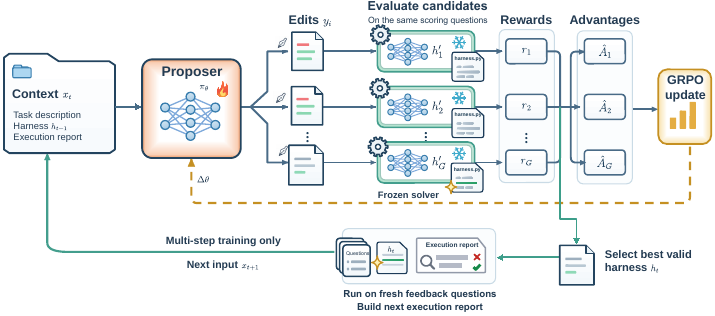
Original overview of the proposer, executor, and revision loop. From the paper; copyright belongs to the authors. Not a local result.
Core mechanism
The categorical proposer uses group-centered \(A_i=r_i-\bar r\) and REINFORCE on revision logits. Inputs are execution-report score and failure type, never gold answers, plans, or hidden verifier fields.
Paper results
The paper's cross-task generalization is not a local result. Local tests check multi-round revision, execution feedback, and gold isolation.
Local reproduction
HarnessProposer and adapt_harness accept a real external execution callback. See three-seed diagnostics and aggregate results.
Reproduction limits
No general Agent runner or Evolve integration: those paths cannot yet safely execute arbitrary harnesses and validate them in isolation. Rule-based mini-suite success is not capability gain.