简体中文 · English
ActiveSaddler: Automated Curriculum Learning for Agent Harness Optimization
L1 core mechanism diagnostic. Dynamic failure arms and exploration/exploitation scheduling run without calling AutoSaddler or real GAIA2/Terminal-Bench environments.
Paper information
| Field | Details |
|---|---|
| Paper | arXiv 2610.00906 |
| Institution | POSTECH (first author affiliation) |
| First public release | 2026-10-01 (arXiv v1) |
| Original source code | Yes: microsoft/AutoSaddler, ActiveSaddler branch |
| Adapter | active-saddler |
| Local reproduction code | src/auto_research/agent_research/latest_20261002.py |
Original paper summary
Background and main changes
Recurring failure patterns become dynamic, nonstationary bandit arms. A curriculum controller discovers new scenarios or revisits known weaknesses, updating priorities as harness repairs succeed or fail.
flowchart LR
  I[Input and current state] --> M[ActiveSaddler core mechanism]
  M --> A[Auditable intermediates]
  A --> O[Output or state update]
Key figure from the paper
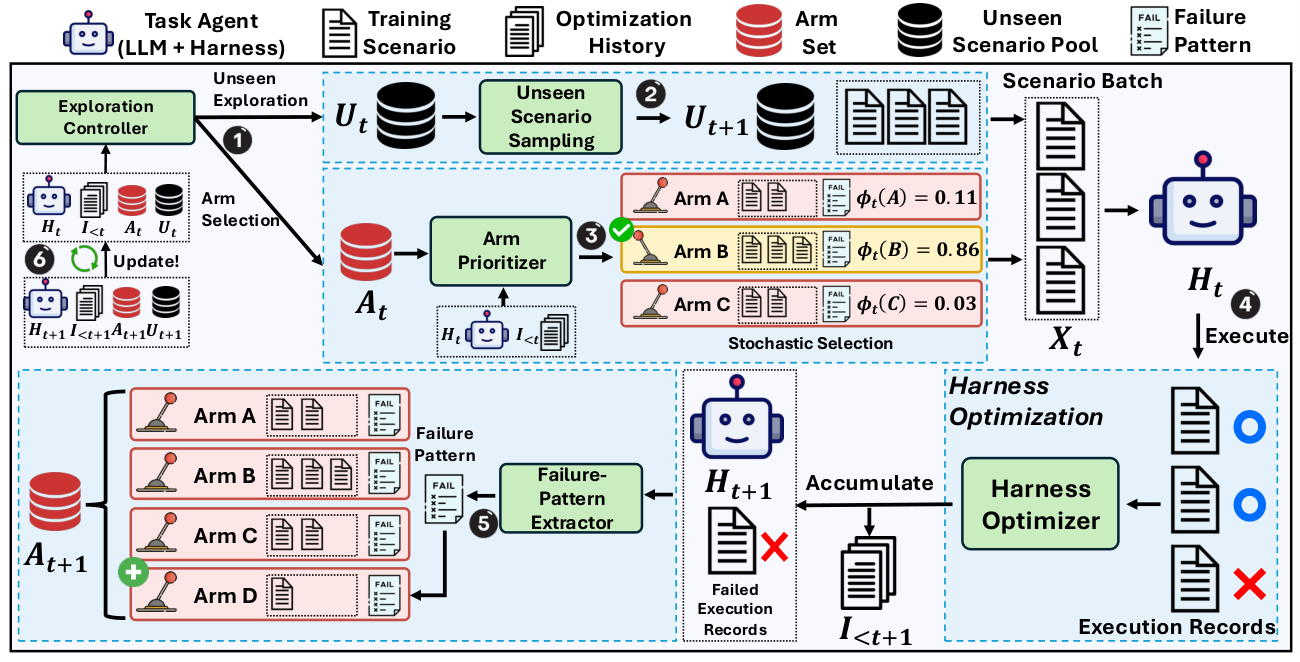
Paper figure: Core architecture, training flow or protocol. From the paper; copyright belongs to the authors. Click for the source.
Core equation
\(a_t=argmax_a[\hat v_a+c\sqrt{\log(t)/(n_a+1)}]\), with periodic Draw of unseen scenarios.
Offline and online results
With the same harness optimizer and rollout budget, the paper reports GAIA2 Pass@1 +4.4 points and Terminal-Bench 2.0 +7.5 points.
Local reproduction
Comparison protocol: Disabled or default mechanism versus enabled operator. Relative percentages are not applicable; this checks invariants, gradients or state transitions, not paper-scale effects.
- Three-seed diagnostic:
metrics/mechanism-seeds42-44.json. diagnostic_only=true; excluded from formal capability rankings.
Scope
Dynamic failure arms and exploration/exploitation scheduling run. AutoSaddler and actual GAIA2/Terminal-Bench environments are not called.