VeriHarness: Scaling Agentic Verification for Long-Horizon Tasks
L1 mechanism diagnostic. Evidence, conflict, and consensus-challenge selection; fixtures do not reproduce real tool use.
Paper information
| Field | Value |
|---|---|
| Paper | arXiv 2610.00972 |
| Affiliations | Google Cloud AI Research, first author's affiliation |
| First public release | 2026-10-01 (arXiv v1) |
| Authors' code | No public author implementation found as of 2026-10-02. |
| Adapter / method | veriharness |
| Local code | src/auto_research/agent_research/latest_20261002.py |
Original paper
Background and contribution
Give one base model a workspace, evidence tools, and reusable verification skills. A disagreement resolver investigates conflicting claims; a consensus challenger questions shared claims and missing requirements.
flowchart LR
  I[Workspace and candidate claims] --> R[Resolve conflicts] --> C[Challenge consensus and omissions] --> S[Select verified result]
Key figure from the paper
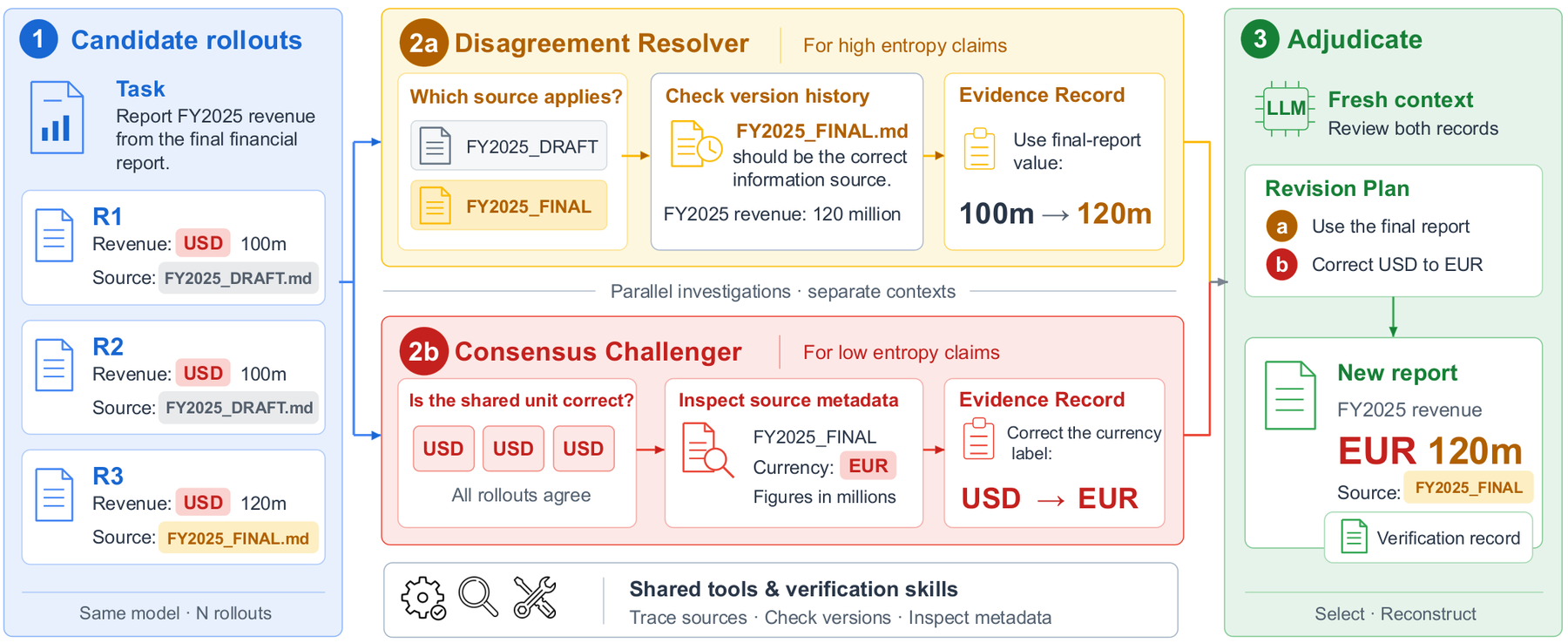
Original VeriHarness verification diagram. From the paper; copyright belongs to the authors. Not a local result.
Core mechanism
\(score(y)=supported(y)-contradicted(consensus)-\epsilon|claims(y)|\).
Paper results
Across five long-horizon workspace benchmarks, the paper reports 6.2 points for Gemini 3.5 Flash and 6.4 for Claude Opus 4.8 over single rollout, releasing about 26k rollouts.
Local reproduction
Compare the disabled/default checker with the enabled mechanism. Three-seed diagnostics check invariants only (diagnostic_only=true), not relative capability.
Reproduction limits
Fixture checking is not the paper's real tool environment.