DeFA: Dependency-Guided Failure Attribution for LLM Agents
L1 graph tracing and decisive-error selection; no gold answer/plan or multimodal judge.
Paper information
| Field | Details |
|---|---|
| Paper | arXiv 2610.01256 |
| Institution | Qwen DianJin Team, Alibaba Cloud Computing (first author). |
| First public release | 2026-10-01 (arXiv v1) |
| Author code | No public author implementation found as of 2026-10-02. |
| Local adapter or method key | defa |
| Local reproduction code | src/auto_research/agent_research/latest_20261002.py |
Paper method and evidence
Fuse protocol relations and semantic dependencies into an event graph. Trace backward from a violation to possible sources, retain downstream consequences in a failure-propagation graph, and select the decisive error.
flowchart LR
  E[Protocol and semantic dependencies] --> G[Event graph]
  G --> T[Trace back from violation]
  T --> A[Decisive error and affected subgraph]
Original paper figure
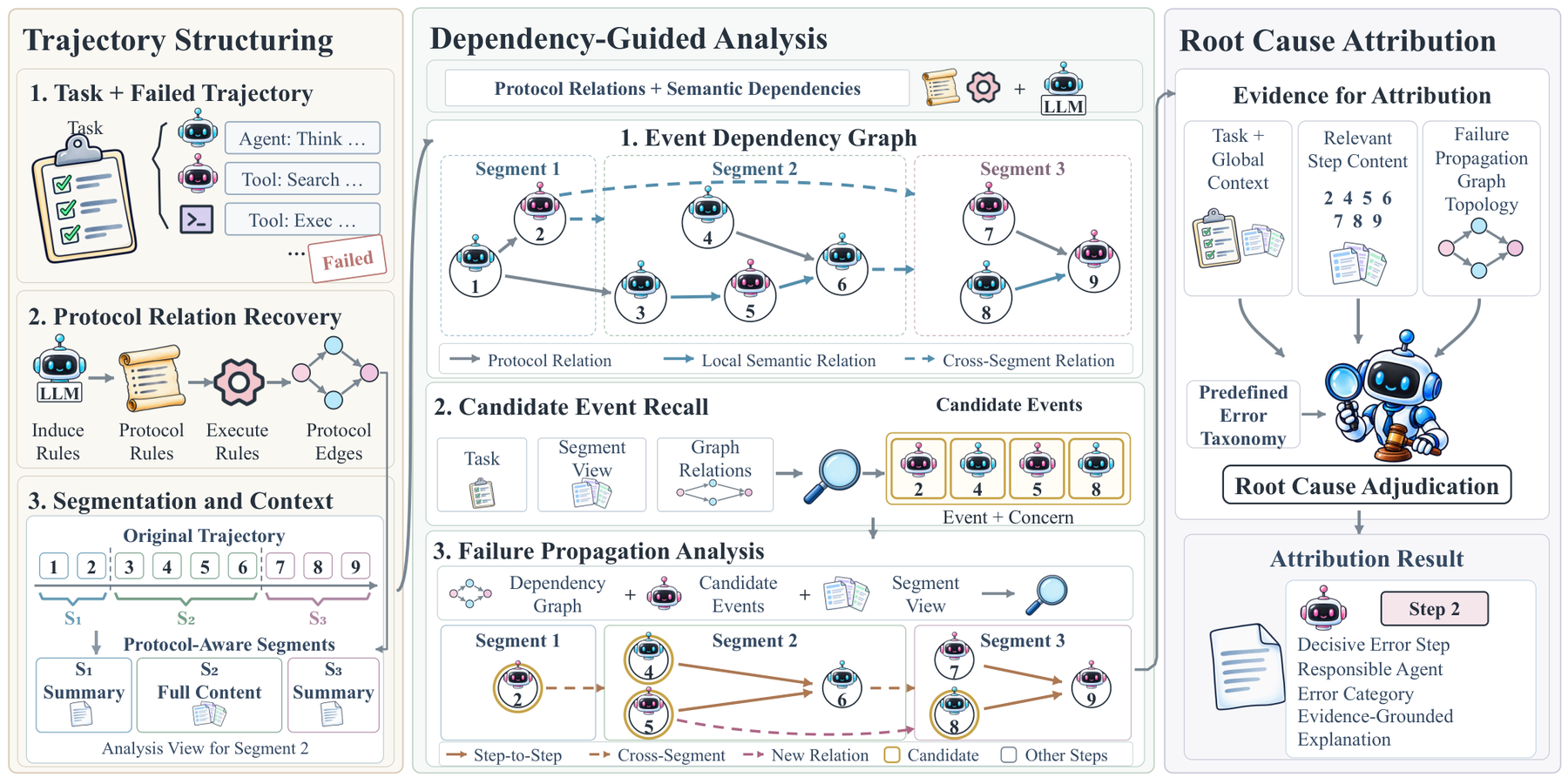
The original figure shows dependency-guided failure attribution. From the original paper; copyright remains with the authors.
Core equation
\(e^*=argmax_{e\in Ancestor(V)} error(e)\); retain both the responsible agent and the propagation subgraph.
Reported results
The paper reports the best responsible-agent and exact-step accuracy on Who and When, and 6–15 points of downstream gain with Trace2Skill.
Local reproduction
Three-seed mechanism results are diagnostic_only=true. Fixed-budget fixtures verify the defining operator and auditable intermediate states; they are not a benchmark, production result, or capability-ranking entry. The comparator is the disabled/default operator, not an independently trained agent.