Mem++: Non-Destructive Memory for Long-Term Organizational LLM Agents
L1 complete writes, temporal filtering and hybrid retrieval; no OrgMemBench or external embedding service.
Paper information
| Field | Details |
|---|---|
| Paper | arXiv 2610.02002 |
| Institution | The University of Texas at Austin (first author). |
| First public release | 2026-10-01 (arXiv v1) |
| Author code | AIDAChip-Inc/mem-plus-plus. |
| Local adapter or method key | mem-plus-plus |
| Local reproduction code | src/auto_research/agent_research/latest_20261002.py |
Paper method and evidence
Keep full documents, dates, and authors; do not irreversibly summarize at write time. At retrieval, filter by the question's as-of date before fusing lexical and semantic scores.
flowchart LR
  D[Store complete document and metadata] --> F[Filter by question time]
  F --> R[Combine lexical and semantic ranking]
Original paper figure
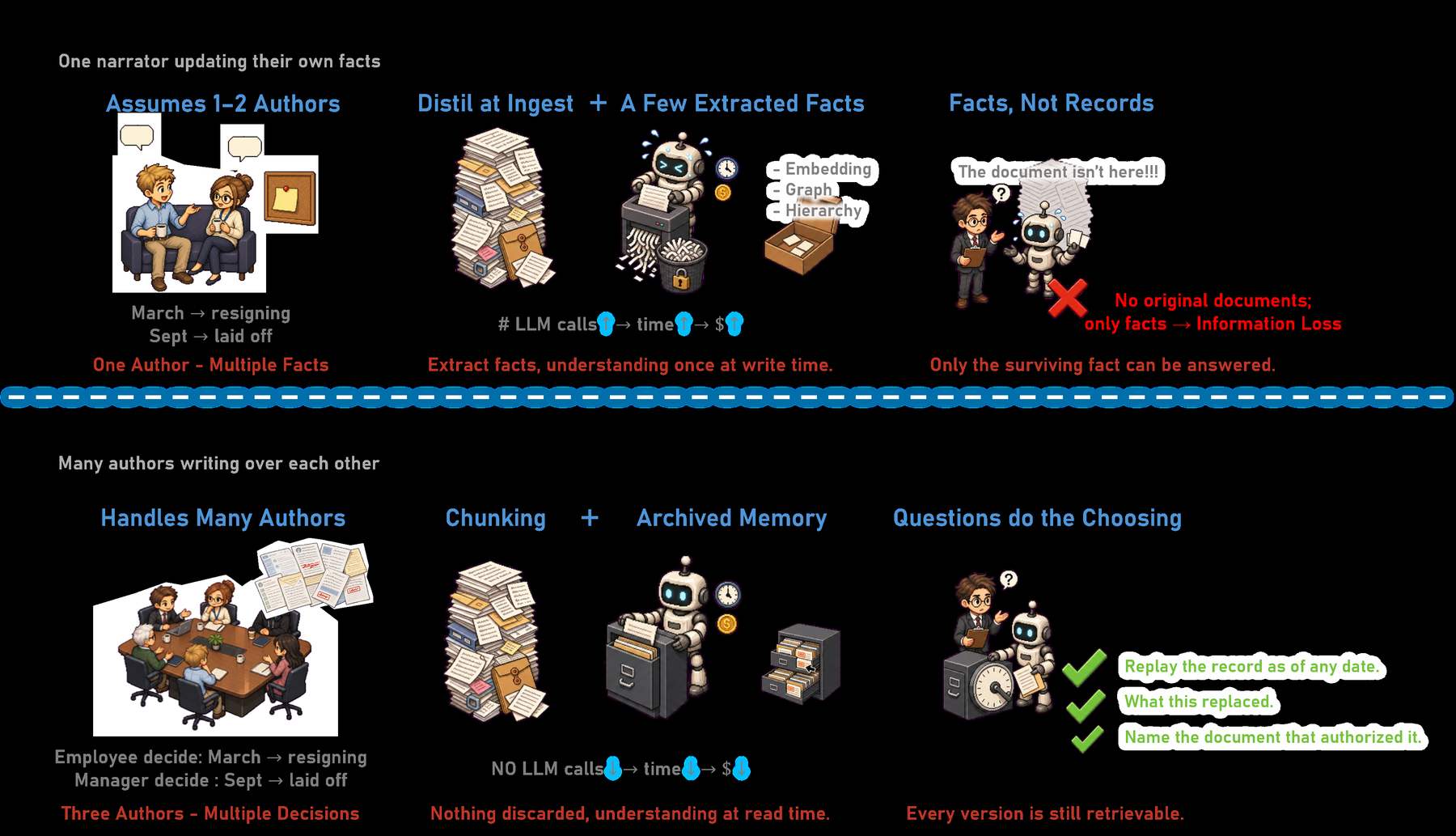
The original figure documents the memory protocol. From the original paper; copyright remains with the authors.
Core equation
\(score(d,q)=BM25(d,q)+sim(e_d,e_q)\), eligible only if \(time(d)\le time(q)\).
Reported results
The paper reports +8.0–13.1 points over the strongest memory baseline on OrgMemBench and +2.6 for gpt-4.1-mini versus RAG.
Local reproduction
Three-seed mechanism results are diagnostic_only=true. Fixed-budget fixtures verify the defining operator and auditable intermediate states; they are not a benchmark, production result, or capability-ranking entry. The comparator is the disabled/default operator.