简体中文 · English
OnTrack: Real-time monitoring of agent execution trajectories
The local implementation replays public logs for monitoring without executing logged commands. It is not an agent task-success measurement or a production safety certification.
Paper information
| Field | Details |
|---|---|
| Paper | OnTrack: Real-Time Monitoring and Intervention in LLM Agent Trajectories via Streaming Structure-Aware Optimal Transport |
| Institution | Cribl AI (first author Babak Barazandeh) |
| First public release | 2026-10-08 (arXiv v1) |
| Original source code | The paper says code and configs are public. No verifiable public repository was found in this review, so this is not an author-implementation integration. |
| Local adapter | ontrack |
| Local reproduction code | src/auto_research/agent_research/ontrack.py, ontrack_transport.py, ontrack_replay.py; entry point scripts/run_ontrack_public_replay.py |
Original paper summary
Background and main changes
A final answer score cannot explain what happened on the way to an agent failure. OnTrack forms a dependency graph from events and aligns the current execution prefix to successful reference trajectories with unbalanced, structure-aware optimal transport. Without references it explicitly falls back to loop, retry and information-stagnation detection.
flowchart LR
  P[Proposed action] --> C[Check irreversible actions before execution]
  C --> E[Actual event stream]
  E --> G[Dependency graph and artifact ledger]
  G --> F[Frontier mask and actual UFGW]
  F --> L[Per-node leakage and exploration grace period]
  L --> I[Increase solve budget before possible intervention]
  E --> N[Reference-free loop and stagnation signals]
Key figure from the paper
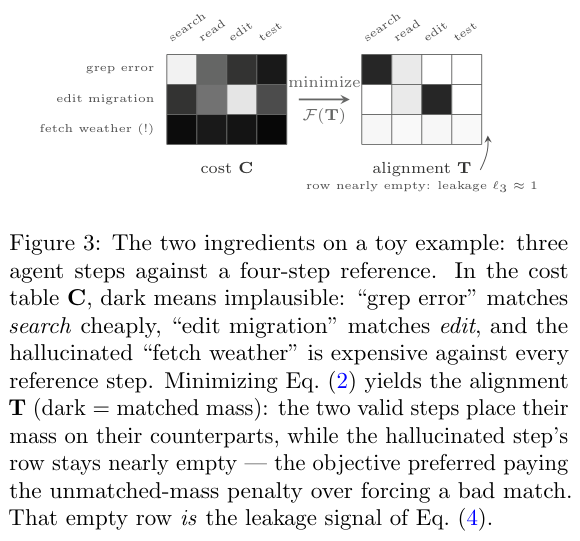
Figure 3: In a toy alignment, an irrelevant weather-tool call cannot match any reference step, giving leakage mass near 1. From the paper; copyright belongs to the authors. Click the image for the source.
Core equations
Agent-node prefix mass is fixed at \(\mu_i=1/\bar m\), without rescaling old nodes to \(1/t\) as each new event arrives. Reference nodes activate based on coverage in the previous event's alignment, so independent branches can be active together. Node leakage is \(\ell_i=[1-\sum_jT_{ij}/\mu_i]_{[0,1]}\).
The structure term uses the actual quadratic Gromov–Wasserstein gradient, not an indexwise distance proxy. Each event takes one warm-start CG step and a short Sinkhorn solve. Structural contribution grows as a new node ages; consuming an artifact removes its discount immediately. Before intervention, increase the solve budget and reassess. At termination, cold-start the same implementation without the frontier mask or age weights for batch finalization.
The pre-execution gate does not read a stale cached frontier. Reversible actions pass through. For irreversible actions it checks schema-required artifacts, recomputes the reference frontier from the current coupling, and evaluates the proposed action against it. Planner references are warning-only and cannot automatically stop execution.
Paper results
The paper includes synthetic faults and replay of real SWE-agent logs. It reports near-random discrimination for some structural anomalies on real trajectories and substantial false-stop costs. Diagnostic scores are not correctness proofs, and the paper's stop thresholds are not used in production here.
Local reproduction
Installation and usage
python -m pip install -e '.[agent-monitor]'
PYTHONPATH=src python scripts/run_ontrack_public_replay.py \
  --calibration-instances 64 --reference-pool 32 --references 3 \
  --evaluation-instances 64 --steps 8 --reference-steps 24 \
  --seed 42 --output runs/ontrack-public-replay.json
The runner downloads pinned public sailplane/swe-agent-trajs (about 92 MB) and all-MiniLM-L6-v2. Embedding and monitoring are CPU-only; no GPU is needed. Commands in trajectories are always untrusted text and never execute. Default cache: .cache/ontrack-public.
Data isolation and model inputs
Split by SWE-bench instance ID into 64 calibration, 32 reference-pool and 64 evaluation instances. Select successful trajectories only from the separate reference pool. Calibration selects regularization from seven values, then a severe-flag density threshold; freeze both before evaluation. The parser does not read resolved/exit_status/submission; labels are only for external scoring and reference-pool selection, never events or embeddings.
Extract paths from strings and open_file metadata. The ledger can add artifact IDs discovered later and repair old dependency edges. Dynamic shell paths and implicit dependencies can be missed. The distance matrix is recomputed fully; the paper's bitset millisecond optimization is not reproduced.
Measurements
A rerun on current source matched the initial results. There were 11 resolved instances among 64 evaluated. With selected \(\lambda=0.5\), OnTrack AUROC was 0.6021 versus 0.5437 for local pooled-action cosine. The paired-bootstrap difference interval [-0.0872, 0.1939] crosses zero, so no stable advantage is established.
Under a calibration false-stop cap of 10%, the selected density threshold was 1.0. The current protocol requires density strictly above threshold, so no trajectory stops. Both true and false stops were 0 on evaluation. This policy was inactive under the budget; it establishes neither safety nor savings. All results.
Code map, tests, and missing parts
ontrack_transport.py implements the full quadratic gradient, unbalanced Sinkhorn, frontier mass and separation of the actual objective from the reported surrogate. ontrack.py covers the artifact ledger, structural age, grace-period lifecycle, reference-free signals, multiple references, pre-execution gate and increased solve budget before intervention. ontrack_replay.py covers safe parsing, instance isolation and paired statistics.
Regression tests check allows and blocks: allowing valid irreversible actions, blocking absent artifacts, avoiding stale-frontier false blocks, retry caps, late dependencies, cold-start finalization, and label leakage prevention. Synthetic embeddings are unit-test-only; public results use actual MiniLM.
No official SWE-bench container ran and no agent trajectories were regenerated. The authors' full 2,294-trajectory protocol, multiple seeds and all baselines are not reproduced, nor are bitset/hierarchical compression or real dollar savings. The gate is a callable API. Public logs lack irreversible-action schemas; its tests are not evidence of production blocking. Results are not eligible for Evolve capability promotion.