Diviner: Evidence and Human Governance for Production Incident Diagnosis¶
简体中文 · English
component_only/ L1 CPU protocol component. Implements contracts for evidence admission, hypothesis state, and human approval. Does not run a production root-cause analysis agent or participate in Evolve promotion.
Paper information¶
| Field | Details |
|---|---|
| Paper | Diviner |
| Affiliation | First author Pradipta Ghosh; Meta, as are all authors. |
| First public release | 2026-10-15, arXiv v1; overlap backfill for the 10-16 announcement, not a first release on 10-18 |
| Authors' open-source code | No public author repository for Diviner was found. Dependencies such as LangChain are not the paper's implementation. |
| Local adapter | None (adapter: null); component key diviner |
| Local implementation | src/auto_research/agent_research/diviner.py; scripts/run_oct18_agent_components.py |
Original paper summary¶
Background and main changes¶
Production incident symptoms can propagate across recommendation, ranking, data, configuration, and compute services. Tool access does not make an LLM a reliable diagnostician. A timeout does not mean there is no anomaly; a similar historical incident does not establish the current root cause; and a postmortem is not evidence available during the incident. §§4–5 define an Encode/Execute/Evaluate/Adapt loop for domain knowledge, lead–worker investigation, postmortem review, and owner-approved knowledge updates. Runtime adaptation can revise only the current investigation plan, not publish shared workflows or execute mitigation.
flowchart LR
    H[Historical snapshots and owned knowledge] --> E[Bounded lead and isolated workers]
    T[Current target and time window] --> E
    E --> V[Evidence with provenance and tool status]
    V --> Q[Supported, refuted, or unresolved hypotheses]
    Q --> R[Runtime review and human conclusion]
    R --> P[Postmortem replay and owner approval]
    P --> H
Key figure from the paper¶
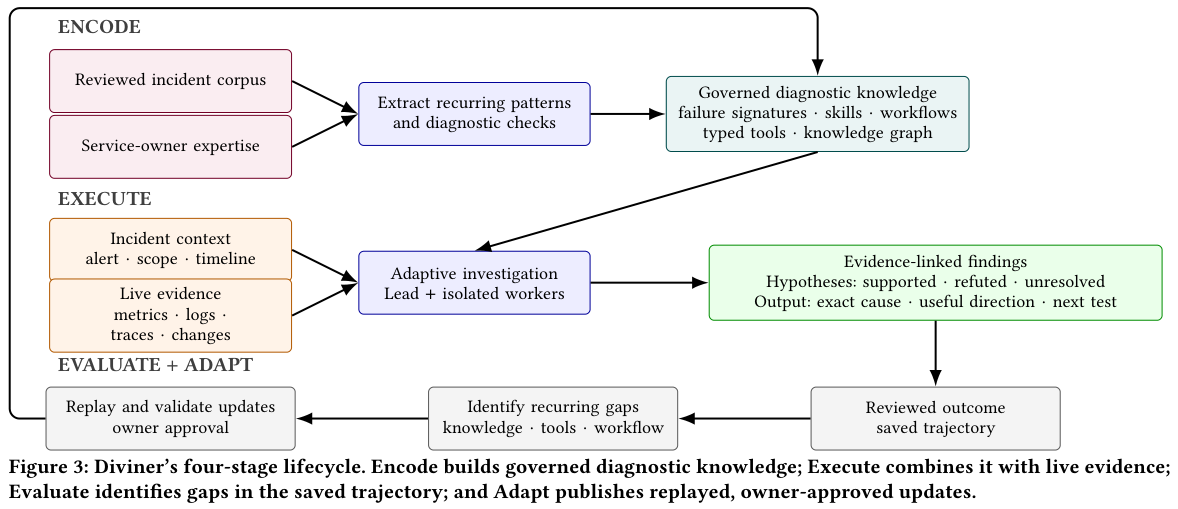
Figure 3 from the paper: Diviner's Encode, Execute, Evaluate, and Adapt lifecycle, retaining evidence attribution, isolated workers, and owner-approved updates after replay. The figure comes from the original paper, © the original authors. Select the image to see the source.
Core equations¶
The local implementation expresses the paper's evidence contract as structured admission conditions, not a new root-cause analysis model:
Statuses such as partial, timeout, and denied cannot support or refute a hypothesis. valid_empty can be evidence of a valid absence or refutation, not a positive finding. This check verifies structure and temporal boundaries only; it cannot establish semantic entailment or causality. Publishing persistent knowledge requires the next version, a passed replay, and explicit artifact-owner approval.
Reported offline and online results¶
The paper reports supporting thousands of incidents in Meta's recommendation and ranking infrastructure, with 45% Exact RCA, 60% useful Direction, and 80% mean Groundedness. In an observational cohort, assisted incidents had approximately 52% shorter detection-to-mitigation time and approximately 15% less upfront engineering effort. This was not a randomized online A/B test and cannot be interpreted as an isolated causal effect. A same-model paired historical replay reports an 11-percentage-point Exact RCA gain from the end-to-end harness, but Direction and Groundedness intervals included no change. The results use different cohorts and cannot be pooled. Experiments and limitations
Local reproduction¶
Data protocol and execution¶
PYTHONPATH=src python scripts/run_oct18_agent_components.py \
  --methods diviner --seeds 42,43,44 --device cpu \
  --output runs/oct18-agent/diviner.json
Each seed generates 24 synthetic events with provenance, randomizing tool status, availability time, and values. An independent reference recomputes the number admitted. A negative control treats any nonempty tool response as evidence and retains its false admissions. Additional checks reject unapproved publication and allow a version advance after owner approval. The interface neither takes real incidents nor generates root-cause answers.
Results and code mapping¶
EvidenceLedger.admit admits evidence and preserves rejection reasons. update_hypothesis checks citations and the three hypothesis states. publish_update enforces the owner gate. The CPU component artifact has per-seed values, source hashes, negative controls, and aggregates. These are contract diagnostics, not RCA success rates.
Cost and limits¶
The paper depends on private Meta incidents and production observability permissions, DRAMA-1B multiview retrieval, and actual multi-agent/API investigations. Time to a final conclusion is about 15 minutes p50 and 24 minutes p95 for an individual investigation. The full cohort study cannot be rerun cheaply on one A100, A30, or Mac. It was not reproduced (review complete), and fabricated public incidents do not stand in for its findings. diagnostic_only=true, promotion_eligible=false, evolve_integrated=false. No CUDA path or GPU receipt is needed.