Librarian Agents: Workspaces That Anticipate Future Queries and Recomputed Public Results
简体中文 · English
The local status is
evaluation_protocol_interface: a real filesystem/provenance contract and CPU recomputation from official compact score records. No RL builder was trained, and static summaries do not stand in for the paper's core model.adapter: null, diagnostic only, not eligible for Evolve promotion.
Paper information
| Field | Details |
|---|---|
| Paper | Librarian Agents: Training LLMs to Curate Long-Context Workspaces that Anticipate Future Queries |
| Affiliations | First author Anikait Singh and co-first authors Teresa Zhang and Yoonho Lee, all Stanford University; collaboration with CMU. |
| First public release | 2026-10-15, arXiv v1 17:35:17 UTC (10-16 01:35:17 Beijing time) |
| Authors' open-source code | Official code, MIT. Appendix A.11 states CC-BY-4.0 for results and synthetic artifacts. |
| Local adapter | None (adapter: null); local key librarian-agents |
| Local implementation | src/auto_research/agent_research/librarian_agents.py; scripts/run_librarian_agents.py |
Original paper summary
Background and main changes
Conventional RAG retrieves after each query, repeatedly exploring cross-document relationships. Before seeing evaluation questions, Librarian's trainable builder organizes the raw corpus into a reusable hierarchical filesystem. A fixed answerer later navigates it and can follow provenance back to the raw documents. CreateFile, MergeFiles, Delete, and Stop form a finite-horizon MDP. Delete can never remove raw documents.
flowchart LR
    A[Raw corpus without test questions] --> B[RL builder]
    B --> C[Create, Merge, Delete, Stop]
    C --> D[Hierarchical workspace and source references]
    D --> E[Fixed answerer answers later questions]
    E --> F[Independent grader reward]
    F --> B
Key figure from the paper
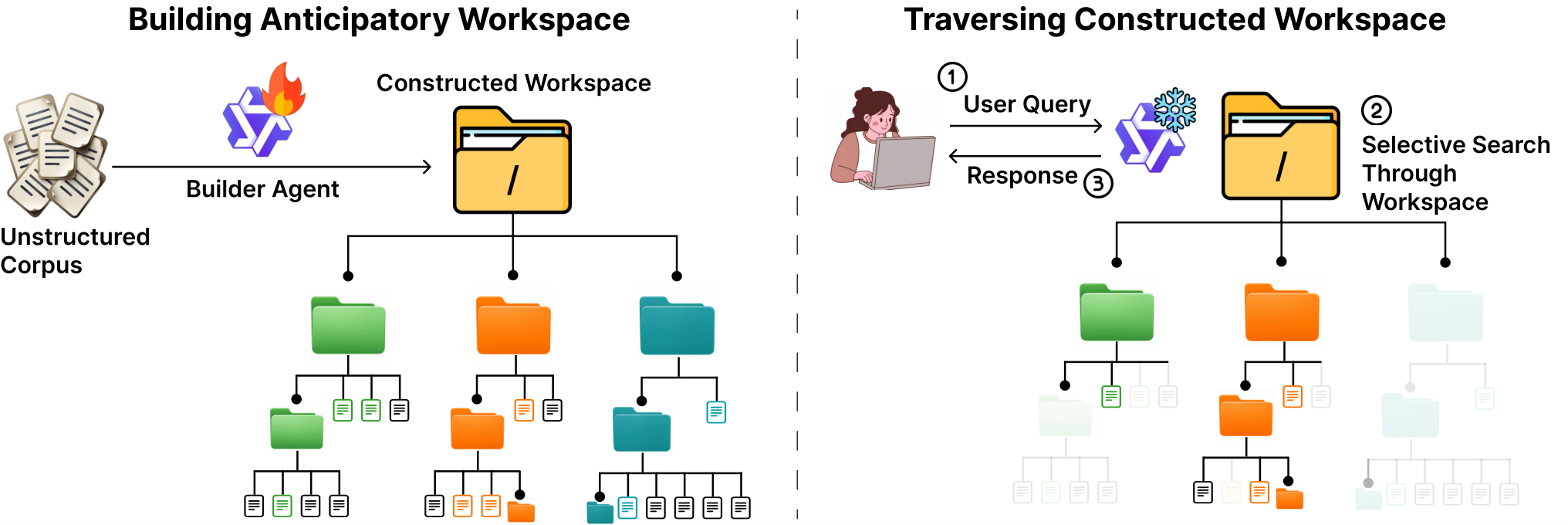
Figure 1 shows constructing a workspace ahead of time and reusing it. The figure comes from the original paper, © the original authors. The asset is
teaser_v2_workspace.pngfrom the official v1.
Core equations
\(S(\mathcal F)=\mathbb E_{q,\tilde y}[\mathrm{Acc}(\tilde y,y^*(q))]\) and general utility \(U(\mathcal F)=S(\mathcal F)-\lambda_{tok}C_{tok}-\lambda_{read}C_{read}\). Navigation penalties are weighted by correctness; an incorrect answer has zero utility. The sparse objective is \(r=U(\mathcal F_H)-\alpha\sum_t\mathrm{Cost}_{build}(\mathcal A_t)\). The main training runs actually set \(\alpha=\lambda_{tok}=\lambda_{read}=0,\gamma=1\), probe the answerability delta every 8 builder turns, and add terminal correctness reward. The general cost formula does not mean the main runs used cost shaping.
Reuse cost is \(T_m(q)=B_m/q+A_m\) and its quality-normalized form is \(T_m(q)/p_m\). Report raw tokens and full-denominator accuracy together; fewer tokens alone do not establish improvement.
Reported offline and online results
The paper reports gains over the strongest baseline of 33 percentage points on main BrowseComp-Plus and 31 points on average across BRIGHT domains. These are paper results, not new local model scores. In the appendix's 443-question reuse protocol, Base scores 107/443 and RL 282/443. Do not conflate this with the main figure's 50 questions or the separate 178,926 construction-token protocol. No production online A/B test was reported.
Local reproduction
Data protocol and pinned sources
Official revision 455ac88c81c639c10a8404464dabf71a7fbb563e. The compact corpus records preserve results/browsecomp_per_corpus.jsonl unchanged, SHA256 3417da0c54a4b16e182ef148e79b70e2622689a9cc0c690c928e4ce0b3837cb4. Code uses the MIT LICENSE; results are attributed under CC-BY-4.0 per Appendix A.11. The authors' scripts were not executed locally.
Both arms contain exactly the same 50 corpora and 443 expected questions. max_token_capped_failure retains the corpus's whole question denominator with zero correct. Answerer/judge/infrastructure errors, duplicate corpora, missing arms, and non-finite metrics are rejected. Per-corpus question counts must match between arms. The paired corpus bootstrap uses 10,000 resamples: resample 50 corpora and sum questions within the sample to compute micro accuracy rather than treating questions as independent bootstrap units.
PYTHONPATH=src python scripts/run_librarian_agents.py \
  --records docs/agent-research/2610.22273-librarian-agents/validation/upstream/browsecomp_per_corpus.jsonl \
  --resamples 10000 --seed 19105 --output runs/librarian-agents/official-reuse-cpu.json
CPU recomputation results
| Metric | Base | Librarian RL |
|---|---|---|
| Correct / full question denominator | 107/443 | 282/443 |
| Accuracy | 24.1535% | 63.6569% |
| Corpus-bootstrap SE | 3.5545 percentage points | 2.9456 percentage points |
| Capped-failure corpora | 14/50 | 0/50 |
| Builder tokens/corpus | 126,012.2 | 147,633.7 |
The paired accuracy difference is 39.5034 percentage points, 95% CI [31.4732, 47.7480]. The ratio of correct answers per builder token is 2.2495, CI [1.7530, 3.0101]. At ten queries, the tokens-per-expected-correct ratio is 0.661957, CI [0.504052, 0.836325]. The crossover is 31 queries/corpus, CI [18, 54]. These are recomputed from frozen official records, not new training or a new answerer. Statistical seed 19105 is not an independent training seed. See CPU metrics for the full cost curve and actual command.
Filesystem contract and code mapping
Workspace creates raw_docs/, synthetic_fs/, and history/ on disk. Create takes explicit source IDs and invokes the caller's content executor. Merge nests real child directories beneath a synthetic parent. Delete archives only synthetic nodes, promotes children, and preserves historical provenance and raw fallback. Nodes track direct sources and transitive raw-source sets. Checks cover raw-document hashes, path safety, and symlink escape. Stop saves JSON data. A cold load verifies hashes, hierarchy, and on-disk contents, never using eval or executing serialized code.
The interface has no future-query or gold-answer parameter. The unit-test executor only concatenates raw documents; it is a filesystem-contract fixture, not a learned builder or a reproduction of paper capabilities. recompute_records only recomputes frozen scores and token counts. There is no new-model navigation experiment on complete author workspace snapshots, full BRIGHT baseline rerun, checkpoint selection, training, or Evolve integration.
Cost decision: the Qwen3.5-4B builder and Qwen3.5-35B-A3B executor use 680 tasks, 10 epochs, batch 8/group 4, up to 60k tokens per trajectory, and Tinker/Modal/Gemini services. That is above the budget of one A100, A30, or Mac with no API/training budget. The full experiments were not reproduced (review complete). full_experiment_status: not_reproduced_high_cost closes the full RL and model pipeline, not the completed bounded audit of public results.