HDA: Dissecting gains from harness evolution
evaluation_protocol_interface/ L1 CPU. Implements attribution and control admission; it does not automatically establish that a harness generalizes.
Paper information
| Field | Details |
|---|---|
| Paper | Harness-Delta Attribution: Dissecting Gains From Harness Evolution |
| Company / institution | First author Wenxuan Ding lists Amazon first and New York University second (affiliations 1 and 2 on the PDF front page). |
| First public release | 2026-10-15 17:39:38 UTC, arXiv v1; official October 19 announcement |
| Author code | Wenwen-D/HarnessDeltaAttribution provides HDA skills, bootstrap, framework code, and artifacts. |
| Local adapter | None (adapter: null); protocol key harness-decomposition |
| Local implementation | src/auto_research/agent_research/harness_decomposition.py; scripts/run_oct19_evening_agent_components.py |
Paper summary
Background and main changes
A harness around the same frozen model can gain score through more inference compute or benchmark shortcuts. Even held-out data can share those shortcuts. HDA begins with a two-sided paired bootstrap of baseline/evolved per-item differences. If the gain is not significant, attribution stops. Otherwise, construct a compute-matched baseline and an evolved variant with detected shortcuts removed. Both controls need task-specific human review. See Section 3.
flowchart LR
    B[Baseline H0] --> P[Paired bootstrap significance]
    E[Evolved H] --> P
    P --> C[Human review: compute-matched baseline]
    P --> N[Human review: minimally neutralize detected shortcuts]
    C --> D[Signed T / O / G attribution]
    N --> D
    D --> L[Residual is only an upper bound; test held-out separately]
Paper Figure 2 on PDF page 3 shows four arms and the three differences.
Original paper figure
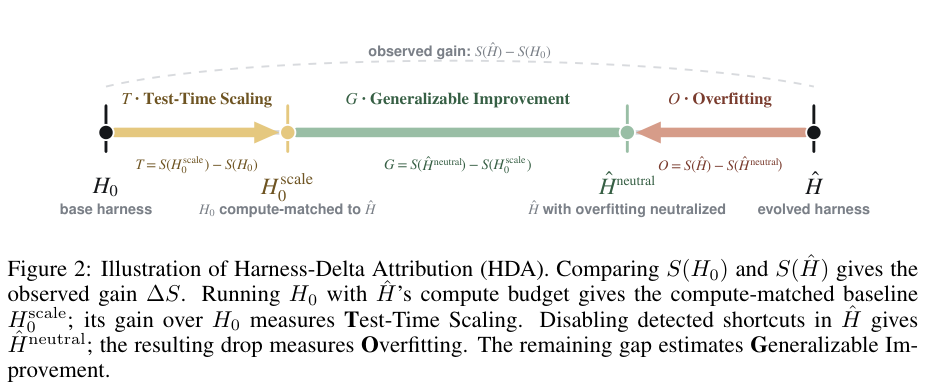
Paper Figure 2: Observed gain is split into extra test-time compute, detected overfitting, and a residual generalization upper bound. The four arms and signed intervals are preserved. From the original paper; copyright remains with the authors. Click the image to open its source.
Core equation
\(O\) covers only detected, neutralizable mechanisms and is a lower bound on overfitting. \(G\) can contain unknown shortcuts and is an upper bound on generalization, not transfer evidence. Raw differences retain signs. Display shares clip \(O\), restrict \(T\) to the remaining share, and allocate the rest to \(G\), without changing the raw identity. If evolved compute did not increase, the compute control equals baseline.
Paper results and negative findings
The paper covers 25 configurations across 11 models, three frameworks, and four task families. Of the 21 with significant search-set gains, mean shares are 54% detected overfitting and 14% extra inference compute. An ALFWorld winner became a deterministic controller with no model calls; high held-out success could still reflect a shared simulator shortcut. This does not invalidate all evolution: CREATE and other tasks show compute gains and residuals. See the experiments and discussion.
Local reproduction and limits
PYTHONPATH=src python scripts/run_oct19_evening_agent_components.py \
  --methods harness-decomposition --seeds 42,43,44 --device cpu \
  --output runs/oct19-evening-agent/harness-decomposition.json
All arms must have identical ordered item IDs, finite per-item scores, harness SHA256, and mean inference cost in the same unit. Controls need reviewer identity and rationale. The CPU kernel actually resamples 10,000 times and computes intervals, two-sided p-values, signed differences, display shares, and identity error. Compute-match tolerance is an explicit local parameter, not an assumed paper constant. Missing review or mismatched items/budgets are rejected. Zero-gain and noise controls do not enter attribution.
The interface does not find all shortcuts, edit source, or execute neutralization. Inputs are immutable measured four-arm results. Random fixture scores test the operator, not models. The interface does not call an actor or pass references or scored trajectories back. Archived metrics record three seeds, bootstrap, and negative controls.
The full 25-configuration matrix spans models, evolution frameworks, and tasks, including SWE-bench containers and expensive reevaluation rounds. Reviewed and not reproduced because of cost. The small statistical kernel is implemented, not the full experiment. diagnostic_only=true, promotion_eligible=false, evolve_integrated=false.