Cache Engineering for Agents: Editing active KV without rewriting text
Reference entry only. No local AKV serving operator, experiment, metric or GPU receipt.
Paper information
| Field | Details |
|---|---|
| Paper | Cache Engineering for Agents |
| Affiliations | First author Tianyu Fu: Tsinghua University; collaborators include The Chinese University of Hong Kong. |
| First public release | 2026-10-20 17:32:24 UTC |
| Author code | Author AKV repository, verified from the paper backlink and repository description. |
| Local key | cache-engineering; no adapter |
| Local code | No executable local implementation. |
| Local evidence | No local experiment, metrics or GPU receipt. |
What the paper changes
Rewriting early conversation text invalidates later KV and requires prefill. Keep logical text unchanged; drop old tool-response KV and optionally reposition retained keys. AKV extends a radix structure with position versions, eviction and recovery and explores RSI-generated cache policies. A cache state depends on operation history, not merely the final token prefix.
Original paper figure
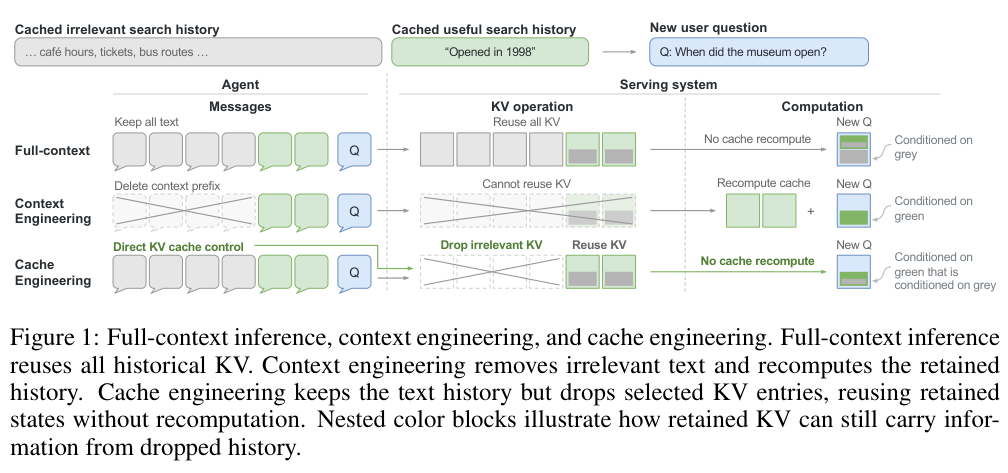
Original figure from the reviewed paper, reused without redrawing. See figure provenance.
Core equations
Drop leaves logical text, retained positions and next append position unchanged. Reposition rotates the RoPE key from \(p\) to \(q\) without modifying values. Different drop timings can leave different KV even with identical text and retained tokens, so reuse must account for history.
Results reported by the authors
On deep-search and SWE tasks the paper reports +1.7 percentage points and 27.7% lower cost versus conventional summarization, plus serving throughput and P95 latency improvements. These are author evaluations, not production A/B or local results.
Local reproduction and limits
No model download, inference, operator, local command or Evolve. A small RoPE calculation would not constitute AKV serving or RSI; consult upstream for installation.
Full experiment: not reproduced
Serving uses eight A800-80GB devices, four prefill/four decode, TP4, GPT-OSS-120B, MiniMax-M2.7 and MiroThinker-1.7-Mini, plus repeated long-horizon agent evaluation. Not reproduced on one A100/A30 or Mac; no automatic retry.
Additional references
Full paper · Paper Section 3 · Paper Section 3.3 · Paper Section 5 · Paper PDF · Paper PDF, p. 2