Agent S4: Evolving computer-use interfaces from experience
CPU control-plane diagnostic, not a full Agent S4 reproduction. Scripted actors/builders only exercise contracts.
Paper information
| Field | Details |
|---|---|
| Paper | Evolving Agent Interfaces |
| Affiliations | Co-first authors Saaket Agashe and Yuzhe Yang: UC Santa Barbara. Work performed at Simular; see PDF affiliations. |
| First public release | 2026-10-20 17:47:37 UTC |
| Author code | Agent-S / agent_s4, Apache-2.0, pinned 58187e364e3024076540892f5f69d1efc218b74f. |
| Local key | agent-s4; no adapter |
| Local code | src/auto_research/agent_research/agent_s4.py |
| Local evidence | Local mechanism metrics |
What the paper changes
Store executable interfaces and their usage knowledge together. Hold the task actor and harness fixed while the meta-agent modifies how it can observe and act, not merely composing tools. The builder sees unlabeled training traces only; validation traces, tasks, diagnostics and scores are withheld and used for parent selection.
Original paper figure
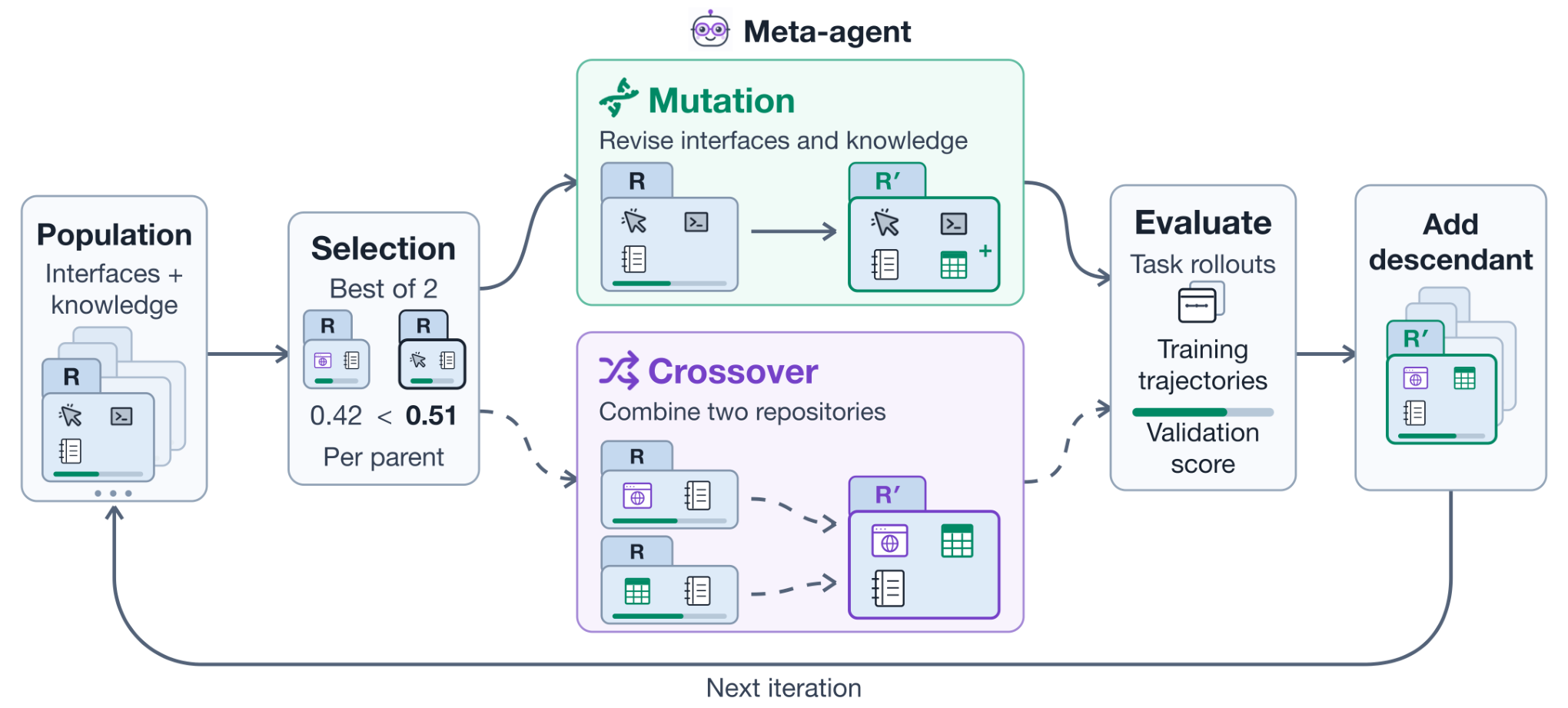
Original figure from the reviewed paper, reused without redrawing. See figure provenance.
Core equations
Uniformly sample two eligible candidates and select higher validation score; crossover chooses a distinct second parent. Retain even lower-scoring evaluated children. Search uses mean partial credit; final OSWorld V2 ranks binary success then partial score, ScienceBoard by success. Do not conflate criteria.
Results reported by the authors
Across all 108 OSWorld V2 tasks the paper reports Qwen3.8-27B at 21.3% binary success (3.8× fixed interfaces); ScienceBoard 41.4→58.6%. Both include their 15 validation tasks and are not wholly independent test sets. Repeated validation risks overfitting. No production A/B or local ability gain.
Local reproduction and limits
Population.advance alternates mutation/crossover and atomically adds evaluated children; BuilderContext only carries parents, public unlabeled traces and lineage. Public task/trace reconstruction strips attached gold fields and rejects subclasses. prune_lowest removes parent eligibility, not lineage or final candidacy. denoise_top revalidates fixed top-k atomically without training or offspring; selected returns frozen content. No arbitrary exec, multi-island migration, SQLite resume, AWS or Landlock. API separation is not a callback sandbox. Three seeds run nine synthetic integer tasks (3 train/6 validation), testing isolation, duplicates, lineage, invalid/missing scores, atomicity, IDs, paths and final-vs-search choice, not model accuracy or Evolve.
PYTHONPATH=src python scripts/run_oct21_agent_s4.py \
  --device cpu --seeds 42,43,44 \
  --output runs/oct21-agent-s4/fresh-result.json
Full experiment: not reproduced
Qwen3.8-27B as actor/meta-agent, 30 generations, per repository OSWorld 30+15 and ScienceBoard 48+15 tasks, up to 300 steps, up to two/one hours for train/validation, 108/169 final tasks and cloud desktops. No 27B download, paid VM, full trial or retry.
Additional references
Full paper · Paper Section 3 · Paper Figure 3 · Paper Section 4