ASTEROID: Learning exploration from on-policy context and privileged demonstrations
L1 small causal Transformer in a bounded BAMDP; diagnostic only. Full exploration and robot experiments not reproduced.
Paper information
| Field | Details |
|---|---|
| Paper | Asymmetric On-Policy Distillation Learns In-Context Exploration |
| Affiliations | First author Sriyash Poddar: University of Washington. Jacob Krantz, Matthew Chang, Xavier Puig and Roozbeh Mottaghi note work performed at Meta. |
| First public release | 2026-10-21 17:50:31 UTC (announced 2026-10-22) |
| Author code | WEIRDLabUW/asteroid at 95eee5ee66488af3aaa0aa55a09ae163b1ca3778, linked from the author project. No LICENSE/COPYING or open license verified; independent local implementation. |
| Local key | asteroid; no adapter |
| Local code | src/auto_research/agent_research/asteroid.py |
| Local evidence | Local mechanism metrics; A100 validation receipt |
What the paper changes
A privileged expert can solve hidden-goal tasks immediately, but expert-only imitation omits context showing how to explore after failure. Collect current student episodes first, then a complete successful expert episode for the same latent task. Use public student history to condition expert-action imitation and grow context across rounds. Fixed-latent BAMDP uses cross-episode history; general POMDP uses expert takeover from reached states. This is not gold in the prompt or ordinary one-step DAgger.
Original paper figure
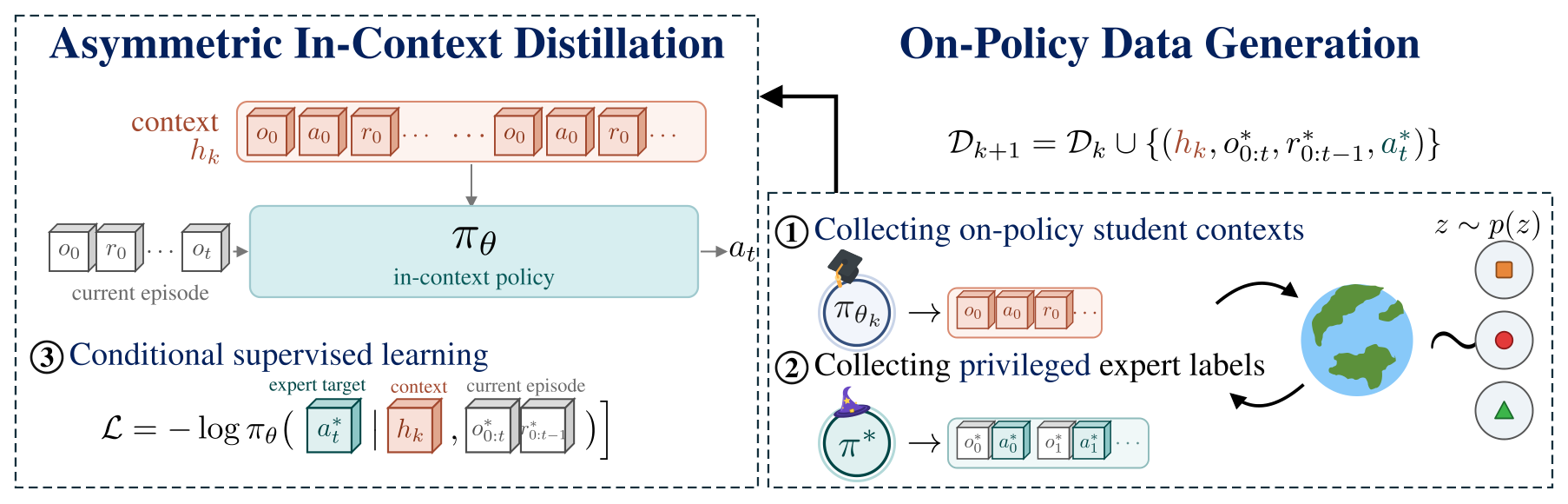
Original figure from the reviewed paper, reused without redrawing. See the original SVG and figure provenance.
Core equations
Supervise only expert query actions, never student context actions. Deployment starts empty, uses observations/rewards alone and slides the window beyond training length; it cannot query the expert.
Results reported by the authors
The authors report exploration and interaction efficiency across 11 environments and sim-to-real robot transfer. No production A/B. Three-door diagnostics do not reproduce Darkroom/Key-Door/Habitat/Procgen or the paper's capability values.
Local reproduction and limits
ThreeDoorTask holds a hidden door across episodes; observation is constant and each door choice is a complete one-step episode. CausalHistoryStudent uses width 24, four heads and one layer, with public actions, rewards, episode markers and positions only. Initialize at k=0 with expert examples, then k=1,2 collect from the previous student before adding paired successful expert episodes. Eight tasks per goal each round, cumulative data, 18 Adam updates/round, 54 total. Labels are stored separately and only query NLL is optimized. deploy is tested with a failing teacher callback. Tests check CE, actual gradients/update, causal masking, label isolation, order, success-only supervision and history sensitivity. Three fixed seeds check mechanism, not a validation/test comparison or Evolve capability.
OMP_NUM_THREADS=1 MKL_NUM_THREADS=1 PYTHONPATH=src python -m pytest tests/test_asteroid.py -q

OMP_NUM_THREADS=1 MKL_NUM_THREADS=1 PYTHONPATH=src python -c \
  'from auto_research.agent_research.asteroid import diagnostic; print(diagnostic(42))'
Full experiment: not reproduced
Appendix F.1 reports about 1–6 hours on one L40 for normal training, largely rollout-bound, two RTX 4090s for robot tasks and roughly eight hours for the state expert, plus UR5e hardware. No general POMDP takeover, multi-step expert, sim/robot transfer, large run or retry.