RSI-Opt: Evolving optimizer-agent policies across training runs
Reference entry only. No local optimizer agent or cross-run controller; full experiments not reproduced due to cost.
Paper information
| Field | Details |
|---|---|
| Paper | RSI-Opt: Recursive Self-Improvement Optimizer Agents For Model Training; reviewed full text |
| Affiliations | First author Binghang Lu: Purdue University; Yige Sun: independent; Guang Lin: Purdue. |
| First public release | 2026-10-23 01:05:11 UTC (announced 2026-10-26) |
| Author code | No verified method source. OPAL is the underlying framework, not the cross-run RSI-Opt policy evolution code. Paper/figure CC BY 4.0. |
| Local key | rsi-opt; no adapter |
| Local code | No executable local implementation. |
| Local evidence | No local experiment, metrics or GPU receipt. |
What the paper changes
A coding agent edits optimizer code at 20 preset opportunities using actual training loss and diagnostics while model, data order, loss, batch size and update count are fixed. A short check can roll back an anomalous updater. The outer meta-agent inherits and edits prompts, natural-language playbooks, libraries and cadence; it checks syntax, fields and size with at most two repairs. All valid evaluated children, including regressions, enter the archive. Inner agents cannot see final metrics, but outer scoring uses them; a suite's split named test is not proof of unseen-task transfer. Base LLM weights stay fixed.
Original paper figure
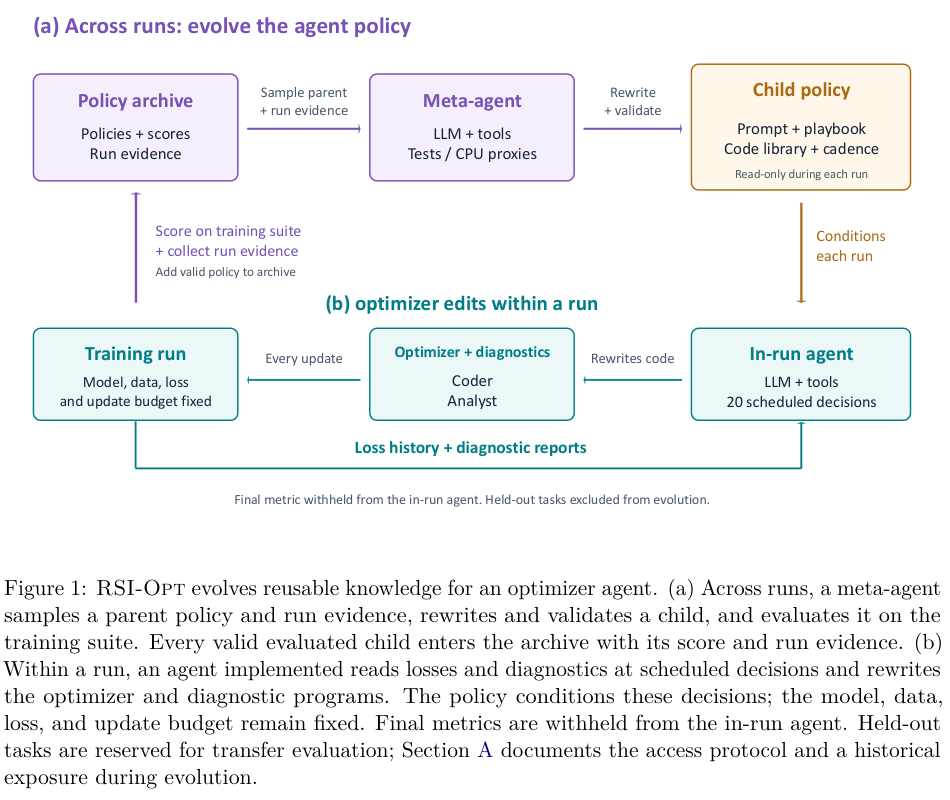
Original figure from the reviewed paper, reused without redrawing. See figure provenance.
Core formulation
Parent sampling favors high scores but discounts expanded branches: \(P(p)\propto\operatorname{sigmoid}(\lambda(s_p-\tilde s))/(1+n_p)\). Normalize task direction and scale with \(z_{t,s}=d_t(h_t(m_{t,s})-\mu_t)/\sigma_t\), using log10 PDE error and raw metrics elsewhere, and average tasks and seeds equally. Small baseline variance can dominate; this is not significance testing. Raw-space table means are not the PDE per-seed log-space selection score, and summary moments do not give paired CIs or seed-win counts.
Results reported by the authors
The paper reports transfer on training-suite, held-out ML and PDE tasks against static, tuned-static and fixed-prompt controls. A static baseline tuned on the evaluated metric is an optimistic oracle. Appendix A discloses early access to one held-out noisy-label task description; exposed policies and descendants were excluded, but archive summaries could transmit information indirectly. This is unresolved, not complete isolation. Shell/tool audit also cannot establish all generated-code access paths. No production A/B or local result.
Local reproduction and limits
No generated optimizer code is executed, and neither parent sampling alone nor a generic evolution controller represents the complete method. No metrics, receipts, capability promotion or Evolve integration.
Full experiment: not reproduced
Sections 4/5.8 cover nine single-GPU tasks, including CIFAR ResNet/ViT, FineWeb GPT-34M, MNIST flow UNet, WikiText LSTM and PDEs with 10k–30k updates. Static reference uses five seeds, evolution two, re-evaluation of the top three two more and final runs another three. Opus 5.5/GPT-5.5/GPT-6.1 use high reasoning; final RSI runs average 3.65–4.61M input and 24–42K output tokens before training, proxy tasks or waiting. No downloads, paid matrix, generated code or automatic retry.