Verified Quantum Wiki: verify independently before sharing results
component_only / L1 mechanism diagnostic. The local component applies wiki admission rules after receiving a trusted external verification result. It does not run Lean, quantum programs, or LLMs. The full experiment is too costly and not reproduced (review DONE); the authors have not yet released this paper's quantum Lean library, specifications, and verified solutions.
Paper information
| Field | Details |
|---|---|
| Paper | Discovering formally verified quantum programs with AI; fixed v1 full text |
| Company / author institutions | Google DeepMind and Google Quantum AI; some authors worked as research consultants on assignment at Google |
| First public date | 2026-11-06 18:08:06 UTC (arXiv v1), November 7 at 02:08:06 in Shanghai. Found in the November 9 incremental scan |
| Author code | Not released / no executable package for this paper found. Code availability says the quantum Lean library, problem specifications, and verified solutions will be open sourced shortly. Lean Comparator is an existing dependency, not the paper's complete implementation |
| Local adapter / key | verified-quantum-wiki; adapter: null, not eligible for Evolve promotion |
| Local code | src/auto_research/agent_research/verified_quantum_wiki.py |
Original paper summary
Motivation and main changes
Quantum programs can exceed classical simulation capacity, so numerical examples cannot establish general correctness. Researchers first freeze correctness and resource specifications in a quantum Hoare logic (QHL) library. Heterogeneous LLM teams then search for programs and Lean proofs. The paper does not prescribe each team's models, framework, or division of labor; it fixes the specification, external verification, and collaboration protocol (Sections 1.1–1.2 and Appendices A–C).
A local Lean success is insufficient for admission. Appendix B requires clean-sandbox replay using Lean Comparator to check all target theorems and transitive definitions. Proof terms may depend only on standard axioms propext, Quot.sound, and Classical.choice, with no sorry or custom axioms; the resource theorem must reduce to the claimed cost. Formal correctness remains conditional on the specification. A physical-model or accounting loophole requires researchers to revise that specification, not reuse an old proof as evidence for a changed problem.
The wiki stores each problem's best verified solution, reusable compiling Lean modules, and reviewed notes on verified, promising, and dead-end ideas. Cross-team conferences every four hours exchange conjectures and critiques; conference estimates and idea notes are not proven results. Appendix C's admission thresholds limit churn from small improvements and allow substantial code simplification to reduce context and compilation burdens.
Key figure from the paper
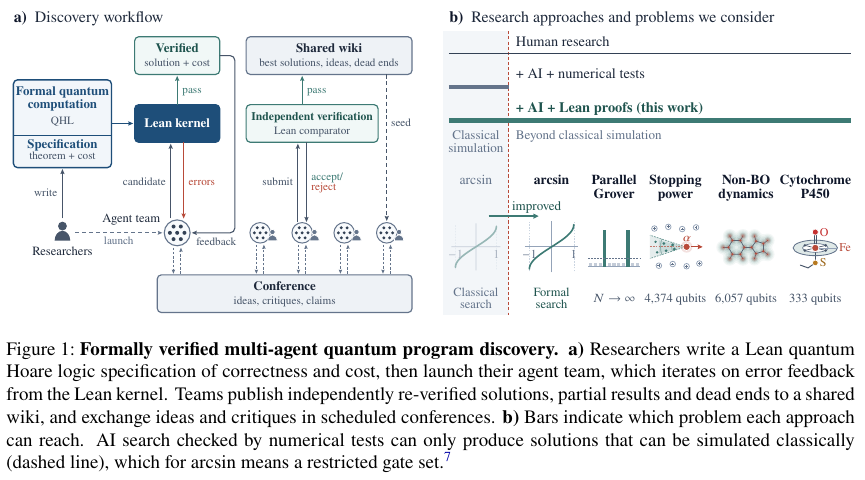
From Figure 1 on page 2 of the author v1 PDF, cropped to retain the complete figure and caption, without redrawing or changing labels or data. CC BY 4.0; copyright remains with the original authors. See assets/provenance.json for transformation and visual review. The Lean, kernel, and agent boxes describe the paper's system, not implemented local components.
Core equations
Appendix C's default rule uses current cost and code size \(C_0,L_0\), candidate values \(C_1,L_1\), and external re-verification result \(V\):
The local implementation uses exact integer/rational cross multiplication, avoiding floating-point rounding at the 5% and 20% boundaries. It applies only to an established best solution with \(C_0>0\) under an unchanged specification and cost convention; initialization is outside scope. The paper does not define code size in bytes, lines, or tokens. Callers must use the same measurement convention for both solutions; no byte convention is attributed to the paper.
Offline and online results
Section 2 and Figure 2 report up to a 1.41-fold reduction in expected oracle rounds for parallel Grover search; more than 290-fold lower logical spacetime \(Q\mathcal T\) for fixed-point arcsin, a lower bound because the baseline used lower precision; and reductions of 10.9, 8.08, and 2.49 for stopping power, non-Born–Oppenheimer dynamics, and P450. These are proven resource costs under specifications, not measured quantum-hardware runtime or local CPU acceleration.
The 61% within-team / 15% wiki / 24% conference figures in Section 2.6 and Figure 5 retrospectively attribute logarithmic cost reductions during the sharing phase across three scientific applications. The authors acknowledge ambiguous mixed credit. This is not a randomized multi-agent ablation or causal uplift estimate. No online A/B experiment is reported. Appendix D and the discussion state that the scientific applications still exceed early fault-tolerant hardware capabilities.
Local reproduction
Data protocol and code mapping
Solution carries frozen-specification and artifact hashes, a cost convention, exact cost, and code size. ExternalComparatorResult is a trusted-host boundary recording clean replay, theorem and transitive-definition matching, proof-term checking, absence of sorry, resource-theorem reduction, and used axioms. admit binds this evidence to the candidate before applying the two threshold branches. It returns a decision without modifying a wiki.
The hash and receipt schema are local mismatch-prevention safeguards, not an author-published receipt format or cryptographic authentication. The caller must authenticate provenance outside this interface; agent-supplied True flags are not verification. A real repository must apply the decision atomically against the same current revision and re-evaluate if that revision changes. The local component implements neither external verification services, signatures, axiom parsing, cost proofs, code-size measurement, nor concurrent git merges.
PYTHONPATH=src python -c 'from auto_research.agent_research.verified_quantum_wiki import diagnostic; print(diagnostic(42, "cpu"))'
PYTHONPATH=src python -m pytest -q tests/test_nov09_verified_quantum_wiki.py
Results, negative controls, and boundaries
Inputs are explicitly synthetic receipt fixtures: no datasets, model calls, or gold answers. Seeds 42–44 randomly scale costs and sizes and each test the same nine admission contracts: both positive boundaries plus insufficient gains, equal cost, absent verification, changed definitions, custom axioms, stale artifacts, and unproven costs. Additional unit tests cover each failed external check, changed specifications/cost conventions, inexact or invalid costs, invalid sizes, and zero baselines. Passing these checks establishes the admission rule only. The number of actual Lean proofs verified is zero, not a discovery success rate, task accuracy, or collaboration gain.
Full experiment cost
The original experiment uses multiple independent teams, repeated LLM proposal/proof work, a shared library, and five quantum problems involving thousands of logical qubits and extensive proofs. Model configuration and aggregate token/API budgets are not fully disclosed, so no defensible hour or dollar estimate is available. The quantum library, specifications, and verified solutions are not public; an existing general Comparator does not fill those gaps. With a local Mac or one A100/A30, full reproduction lacks public inputs and cannot be established as affordable. Too costly; not reproduced (review DONE). No weights, search runs, or automatic retries were initiated. Only the zero-model-call CPU boundary component is approved, with promotion_eligible=false and evolve_integrated=false.