MULTILOOP: gains and persistent orchestration failures in harness optimization
review_only. The complete experiment is too costly and not reproduced (review DONE). This is an empirical multi-agent application of existing harness optimization, not a new optimizer. No generic loop is passed off as the paper.
Paper information
| Field | Value |
|---|---|
| Paper | MULTILOOP, fixed v1 |
| Institution | First author Daniela Gottesman, Tel Aviv University; work performed during a Google Research internship, with Google Research coauthors. Google priority does not overwrite the first affiliation |
| Original publication | 2026-11-11 17:34:12 UTC; overlap recall from the November13 bulletin, not a November13/15 first release |
| Authors' code | No verifiable dedicated author release found in fixed v1 and bounded author/title searches. LangGraph is a dependency, not MULTILOOP source |
| Local adapter / key | multiloop; adapter=null; no executable operator or Evolve integration |
| Local code | None; method record at src/auto_research/paper_specs/catalog/agent-research/multiloop.json and this documentation only |
Original paper
Motivation and changes
Harness prompts, tools, communication and stopping rules can change performance without changing the model. MULTILOOP asks whether a coding agent can diagnose and repair multi-agent failures from training scores, complete orchestrator/subagent traces and previous edits, repeatedly editing and evaluating the harness.
Section1 explicitly applies an existing optimization paradigm rather than proposing a new strategy. Most gains come from prompts and tools while defining orchestration failures persist. More agents do not imply effective structural coordination.
Architecture
flowchart LR
  H[Current multi-agent harness] --> E[Real execution on ten training tasks]
  E --> R[Scores and complete traces]
  R --> O[External coding optimizer]
  L[All prior edits scores and traces] --> O
  O --> H
  E --> L
  L --> B[Training selection then isolated test]
Key original figures
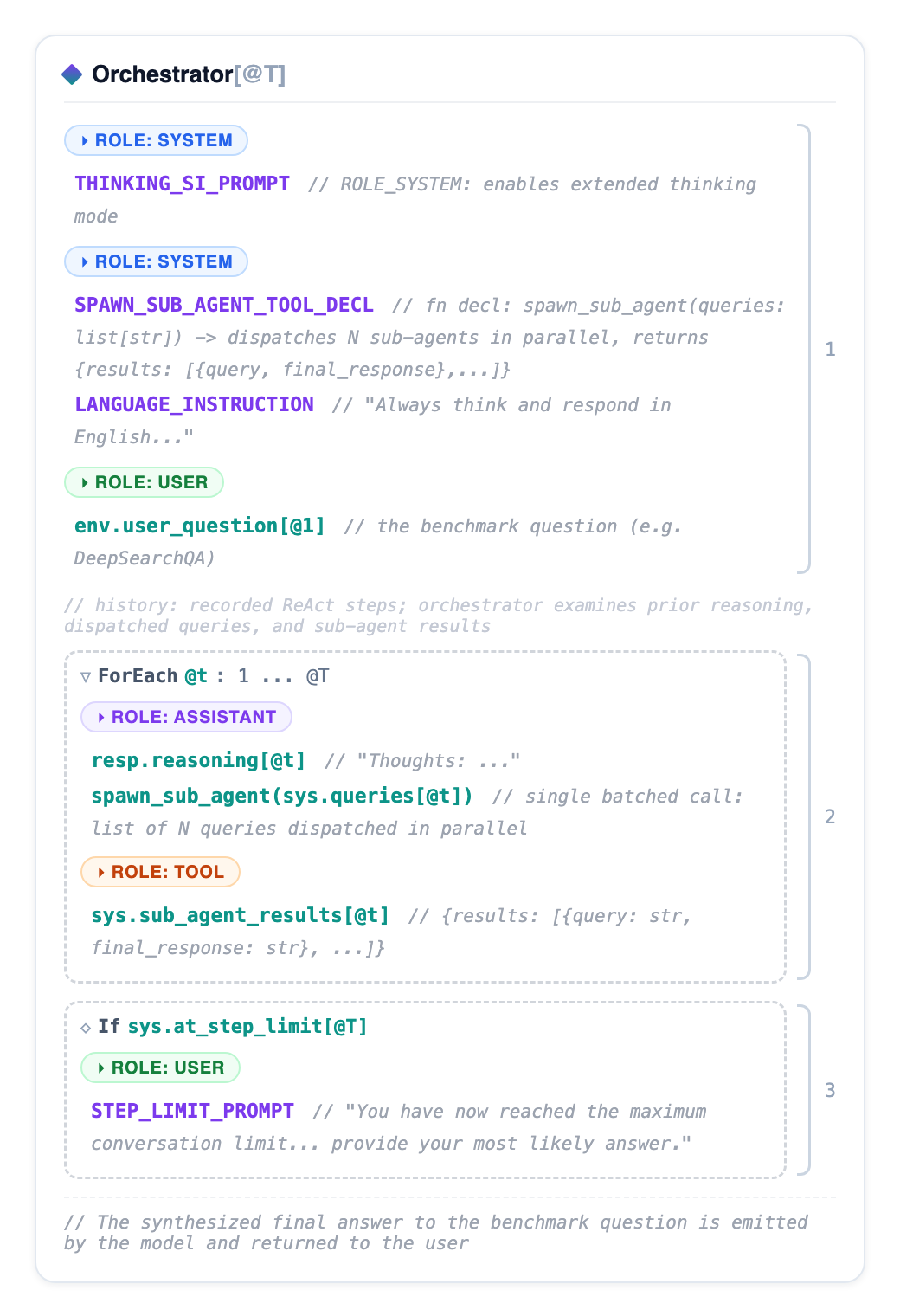
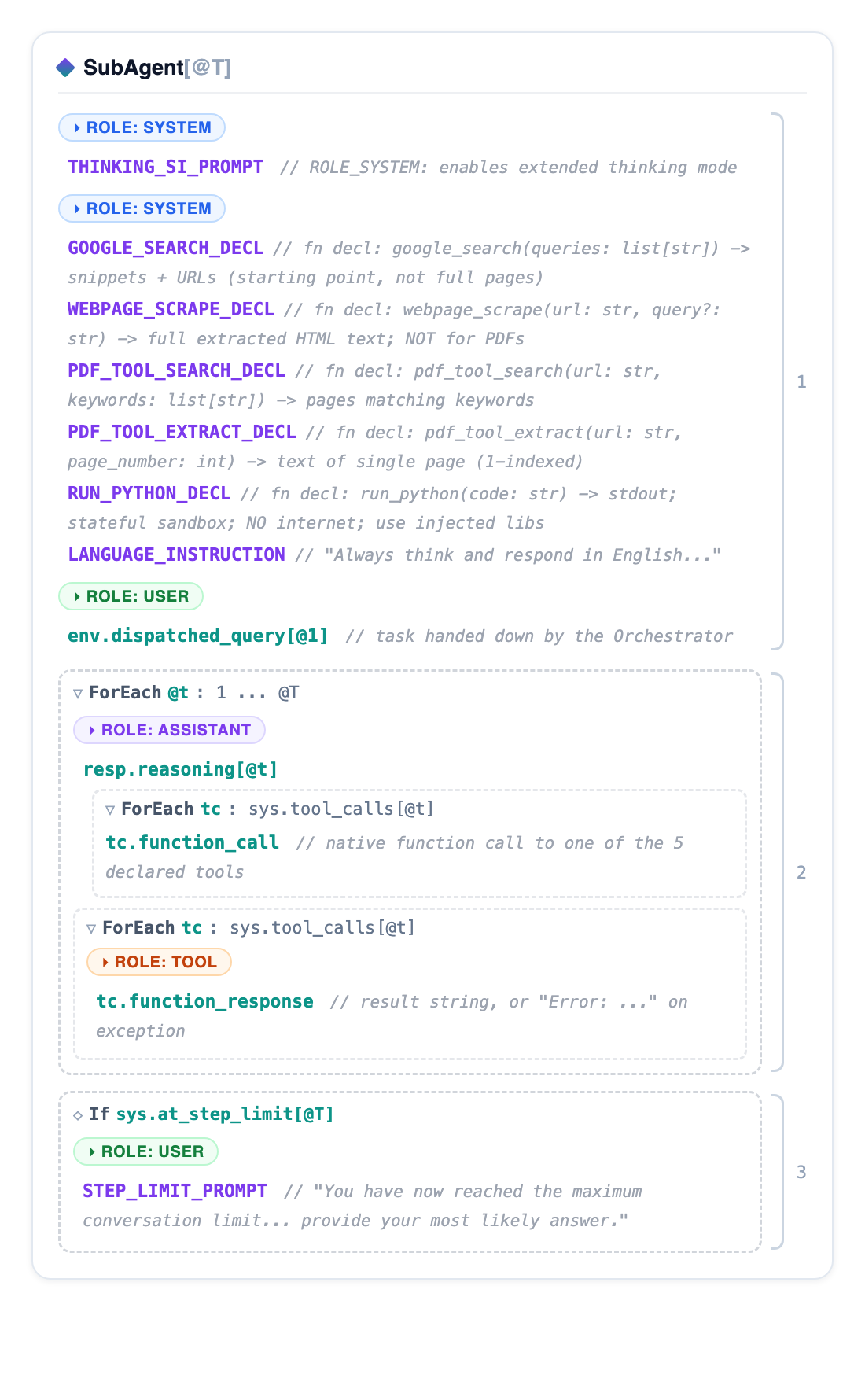
Official PNG bytes from fixed v1 AppendixC Figure3; copyright remains with the authors. Prompt text inside figures is research material, not project instructions. The orchestrator dispatches query batches; subagents use search, web, PDF and Python tools.
Core equations
History contains prior harnesses, scores, rollouts and edits. Ten deliberately difficult training tasks are failed by all base systems; the remaining890 are evaluated separately. Results require semantic code optimization, real tools and rollouts, not fixed score tables or template edits.
Author results
The paper reports+4.61 percentage points over the base and+3.19 over the best single agent. Bad Orchestration remains prominent among seven error types, and prompt-only controls prevent assigning every gain to structural coordination. No production A/B is reported and no local capability scores exist.
Local reproduction
Protocol and code mapping
Only fixed-v1 methods, costs, failure taxonomy, figures and bilingual learning material are collected. Antigravity optimizer, Gemini actors, DeepSearchQA, tools and harness search are absent. No runtime, mechanism metrics or GPU receipt is created. A future implementation must select on validation rather than repeatedly inspect test performance.
Full experiment and limits
AppendixE reports two evaluations of890 test tasks costing approximately USD 7,300 for the base, USD 12,900 for the optimized harness and USD 9,500 for prompt-only; one ten-task training evaluation still costs USD 104–213. These are published API expenditures, not local probes. Too costly; not reproduced (review DONE). No paid calls, weights/data or retries. A plain for-loop without the real optimizer would not reproduce this paper.