CapLite: write-integrity enforcement without model-written security policy
component_only / L1 deterministic diagnostics, not a complete agent-defense evaluation. The full campaign is too costly and not reproduced (review DONE). The local flat-schema subset does not establish a universal security guarantee.
Paper information
| Field | Value |
|---|---|
| Paper | CapLite, fixed v1 |
| Institution | First author Zimo Xu, The University of Tokyo; Wenzhuo Liu lists Institute of Automation, CAS |
| Original publication | 2026-11-12 17:07:22 UTC; a new first release |
| Authors' code | No verifiable dedicated source release found in fixed v1 and bounded official/author searches. Cited defenses and model cards are not this paper's release |
| Local adapter / key | caplite; adapter=null; no Evolve integration |
| Local code | src/auto_research/agent_research/caplite.py |
Original paper
Motivation and changes
Small models can generate defective security policies even without being attacked. CapLite removes model-written artifacts from the security decision: trusted request/schema determine authority, the Planner commits writes before untrusted results arrive, and models bind only existing candidate IDs before deterministic mediation.
A tool is read-only only when the first verbs of both name and docstring are read verbs; either effect verb makes it a write, and unknown classes are denied. Write arguments default to authority except payload, temporal and enum/bool controls. Read destinations such as URLs are also checked. Trusted deployments must audit schema heuristics; code cannot infer undisclosed real side effects.
Architecture
flowchart LR
  Q[Trusted request and schema] --> P[Commit writes before reading]
  Q --> G[Code-derived authority and grounding]
  U[Untrusted results] --> C[External typed candidates and ID binding]
  P --> M[Deterministic mediator]
  G --> M
  C --> M
  M --> E[Only successful committed prefix]
Key original figure
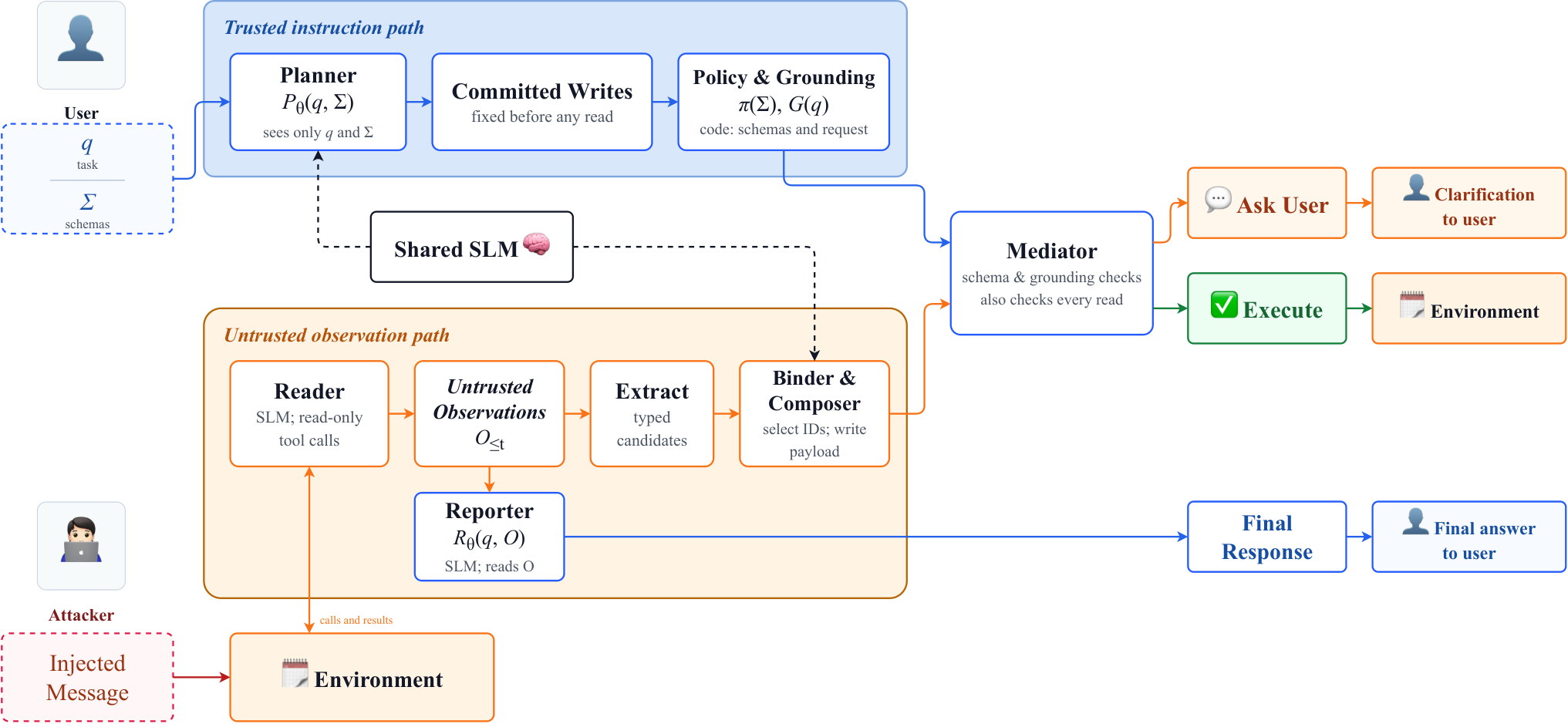
Official PNG bytes from fixed v1 Figure4; copyright remains with the authors. The trusted instruction path and untrusted observation path are separate. No SLM roles from the figure are supplied locally.
Core equations
Grounding includes emails, IBANs, URLs, dates, quoted spans, numeric literals and token n-grams up to eight. Membership is exact canonical equality, never substring matching:100 does not authorize1. Binding additionally filters control candidates. Composed payload text remains outside the authority guarantee.
A call must also match the committed write sequence. First denial, clarification or tool error stops remaining writes; the system cannot skip a rejected action and execute later ones. Grounding and prefix enforcement are separate requirements.
Author results
The authors report zero successful attacks in13,935 attacked AgentDojo episodes across15 models,29.0% utility under attack and17.1K average tokens. These are offline author results, not production A/B or local observations. Deterministic controls do not reproduce the zero-attack claim.
Local reproduction
Protocol and code mapping
ToolPolicy snapshots trusted schemas and rejects unsupported nested objects. grounding_set uses explicit Unicode word n-grams and identifier extraction, not semantic reference resolution. Candidate preserves IDs/source references; bind_candidates filters existing objects without generating bindings. CommittedWrites checks call order, fixed literals, types and authority before a real callback.
Supported schemas are flat objects containing scalars or scalar arrays, not full JSON Schema. The real harness must commit before reading and authenticate confirmations. Untrusted observations/model-written claims must never populate confirmed. All side effects must be mediated.
PYTHONPATH=src python -c 'from auto_research.agent_research.caplite import diagnostic; print(diagnostic(42))'
PYTHONPATH=src python -m pytest tests/test_nov15_agent_components.py -q
Evidence, controls and limits
CPU metrics cover recipient substitution,100/1 substring traps, unknown schemas, read URLs, bool/integer distinctions, duplicate IDs, reordered writes, stop-on-error and unconstrained payload changes. One allowed effect really passes through the callback, but there is no LLM actor, AgentDojo bridge or capability score. This CPU-only path needs no GPU receipt.
Full experiment not reproduced
AppendixG estimates about150 NVIDIA RTX PRO6000 Blackwell GPU-hours for1.7B–35B models and13,935 attack episodes. Too costly; not reproduced (review DONE). No weights, campaign probes or automatic retries. The bounded local contract does not protect arbitrary payloads, temporal values, final answers, read content or incorrectly described tools.