CoReMem: prospective memory value and step-local credit across coding tasks
component_only / L1 mechanism diagnostics, not a coding-agent reproduction. The full campaign is too costly and is not reproduced (review DONE). Only reward, provenance gates and genuine small-tensor training objectives execute locally.
Paper information
| Field | Value |
|---|---|
| Paper | CoReMem, fixed v1 |
| Institution | First author Peiwen Li, Yale University; collaboration does not replace the first affiliation |
| Original publication | 2026-11-12 18:58:22 UTC; a new first release |
| Authors' code | The paper links an anonymous source entry; access returned HTTP401 on November15. Contents, license and a fixed revision remain unverified; this is not a verified open-source release |
| Local adapter / key | coremem; adapter=null; no Evolve integration |
| Local code | src/auto_research/agent_research/coremem.py |
Original paper
Motivation and changes
Successive coding tasks inherit both repository changes and written memory. Memory is written before the next task arrives and valued on that future task, comparing memory/no-memory rollouts from the identical inherited repository state. Judging a summary's apparent usefulness or resetting to gold patches changes the problem.
Training compares own, empty and misplaced memories at a shared boundary. A success-first reward prevents saving steps by abandoning solutions. Exact repository/check anchors localize the overall memory-value difference to traceable first-use steps. Semantic extraction and real coding rollouts remain external.
Architecture
flowchart LR
  S[Inherited repository] --> E[Next task without memory]
  S --> M[Next task with own memory]
  E --> V[Matched-state value difference]
  M --> V
  M --> G[First-use and sibling-prefix exclusion]
  V --> C[Fixed-scale step credit]
  G --> C
  C --> P[Generated-token PG and reference KL]
Key original figure
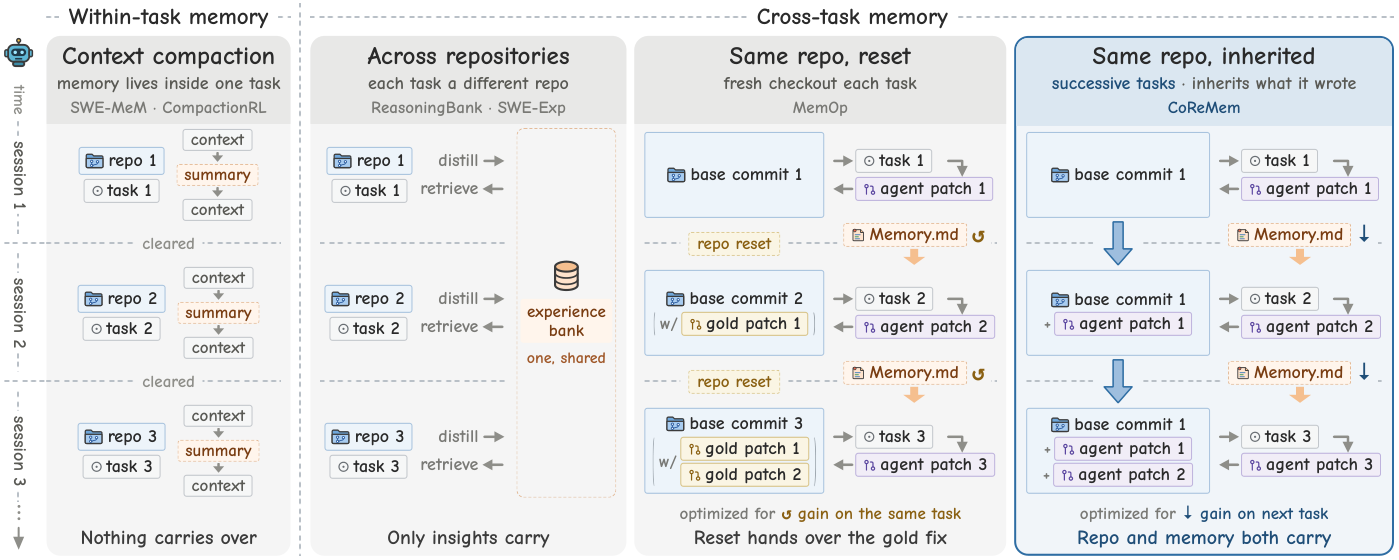
Official PNG bytes from fixed v1 Figure2; copyright remains with the authors. The rightmost setting inherits both repository and memory rather than resetting with gold patches.
Core equations
With empty/own means \(\bar R_0,\bar R_m\) and \(\widehat V=\bar R_m-\bar R_0\), own-memory step credit is
The gate requires a memory anchor in the current assistant step, absent from prior history and the first eight steps of empty-memory siblings. Repeated use is not gated again; ungated steps retain outcome credit. This establishes traceable use, not causal contribution. Empty/misplaced arms use the empty-memory mean.
AppendixA uses fixed scale100, not within-group standard deviation. The27B recipe averages all generated tokens; the9B recipe averages tokens per session, then sessions. Reference KL has coefficient0.2; local code requires explicit KL rather than silently treating it as zero.
Author results
The paper reports27B resolution21.0%→25.7%,17% fewer steps and11% fewer cache-aware tokens on repository-disjoint ChainSWE chains. These are offline author results, not local measurements or production A/B. The credit kernel cannot validate those gains.
Local reproduction
Protocol and code mapping
ReplayOutcome is trainer/evaluator-only. paired_step_saving rejects mismatched boundaries or inherited-state IDs; provenance_gates consumes external exact anchors without pretending to extract semantics. step_advantages executes Eq7. policy_gradient_loss differentiates actual log probabilities with explicit token/session reductions, detached advantages and padding masks. Callers must still form groups from one boundary; IDs do not implement Git-tree isolation.
PYTHONPATH=src python -c 'from auto_research.agent_research.coremem import diagnostic; print(diagnostic(42))'
PYTHONPATH=src python -m pytest tests/test_nov15_agent_components.py -q
Evidence, controls and limits
Tests cover strict success-first ordering, state mismatches, first-use/sibling exclusions, fixed scale, retained outcome credit, distinct reductions, zero padding gradients and no gradients into evaluator rewards. CPU metrics and A100 mechanism evidence concern only these operators, not coding capability or causal memory gains.
Full experiment not reproduced
AppendicesA/B use9B/27B/31B and commercial actors,32K/49K sessions,20 LoRA updates, repeated boundary replays and1500–3600-second per-session budgets. These are source configurations, not measured local runtimes. Too costly; not reproduced (review DONE). No checkpoints/data, cost probes or automatic retries. Memory generation, real repository replay, seven-segment leave-one-out valuation and full training are absent. Actors must not receive evaluator results or gold.