ProdPilot: a repair is a claim until its independent checker accepts it
component_only / L1 CPU repair and deploy-gate contract. Real checker/fix callbacks operate on an in-memory file mapping. No cloud, Docker, GitHub or IDE model is called. This is neither a complete MCP server nor a production deployment reproduction.
Paper information
| Field | Content |
|---|---|
| Paper | ProdPilot, fixed-v1 PDF |
| First-author affiliation | Muhammad Sudais Khalid; NLP Lab, AITeC, and Shifa Tameer-e-Millat University, Islamabad, Pakistan |
| Original publication | 2026-11-11 11:36:45 UTC, arXiv v1 |
| Author code | The paper describes Python package 1.0.0rc1 but fixed v1 supplies no verifiable author-source repository URL. A package-version statement alone does not establish public source |
| Local adapter / key | prodpilot-protocol; adapter=null, not integrated into Evolve |
| Local code | src/auto_research/agent_research/prodpilot_protocol.py |
Original paper
Background and main changes
Locally runnable AI-written applications need not be production-ready. ProdPilot's five layers detect the stack, audit, repair, gate and deploy. Of 50 rules, 28 use fixed templates, 16 extract project values, and six delegate to the IDE agent. Thus 88% of rule types need no model-written content—not 88% of projects deploying without a model. Node/Express and React/Vite have different blueprints; unsupported or ambiguous stacks are not guessed.
Fix contracts bound files, anchors and invariants. Regardless of fix type, an applied report remains a claim until the original checker passes. Each issue gets at most three attempts per run and each run at most five cycles. A full post-change audit detects regressions; breaking a previously passing rule causes rollback and manual review. The deployment gate audits again rather than trusting repair success counters.
Architecture and workflow
flowchart LR
  P[Project and rules] --> A[Full audit]
  A --> F[Bounded real fix callback]
  F --> C[Original checker and regression check]
  C --> R[Accept or restore snapshot]
  R --> G[P0 / score / probability gate]
  G --> D[Explicitly approved deploy and smoke callbacks]
Original paper figure
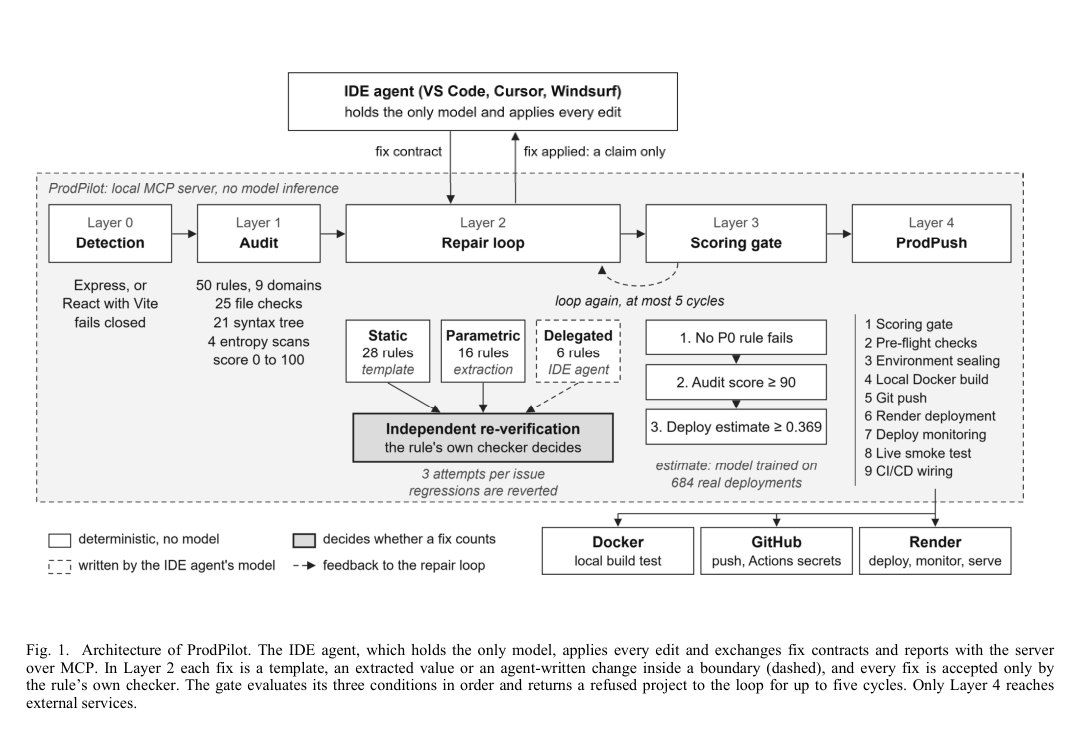
Fixed-v1 PDF p.8, Figure 1, including its caption. Docker, GitHub and Render belong to the author system; the local interface connects to none. Original figure, copyright belongs to the authors. Provenance.
Image from the original paper; copyright belongs to the original authors.
Core equations
For priority \(p\in\{0,\ldots,5\}\), use \(w_p=2^{5-p}\) over applicable rules:
The sequential conditions are no failing P0 rule, \(score\ge90\), and deployability \(\hat p\ge0.369\). The model may veto but never overrule rejected rules; missing model inputs or an undetermined build close the gate. The paper's probability comes from a calibrated model trained on 684 actual Render deployments. Locally, probability is an external interface, not a trained/copied estimator; an audit score is not a probability.
Author results
Of violations in 499 real repositories, 93.5% belong to template/extraction classes. Independent verification rejected 25 of 237 reported applied fixes in 23 full-chain samples. Those full-chain Render/GitHub APIs and live smoke responses were scripted substitutes, and delegated fixes were not executed; this is not 23 real cloud deployments. Separately, collecting 684 real Render outcomes took about 35 hours, with held-out AUC 0.909; one gated project completed real deployment, smoke and CI/CD in 82 seconds. None is randomized production A/B or a local result.
Local implementation
Data protocol and code mapping
Rule separates static, parametric and delegated types and carries actually executed checker/fix callbacks plus allowed files. repair gives callbacks copies, rejects out-of-bound changes and accepts only checker success. Regression/exception paths preserve the original snapshot. Missing executors go to manual review rather than fabricated model actions. Non-bool/None checker output and exceptions are errors; None is inapplicable, not passed.
deploy_gate reruns every checker and applies P0/90/0.369 in order. gated_deploy also requires explicit approval and calls injected deploy/smoke functions. A returned deploy handle is not a verified service. A deploy exception may follow external side effects: retain the attempt and return deployed=null / deployment_status=unknown, not an assertion that nothing deployed. Missing components include the 50 JavaScript-AST/secret rules, stack detector, MCP stdio, Docker builds, cloud providers and actual deployment model.
PYTHONPATH=src python -c 'from auto_research.agent_research.prodpilot_protocol import diagnostic; print(diagnostic(42))'
PYTHONPATH=src python -m pytest tests/test_nov18_agent_protocols.py -q
Diagnostics and limits
CPU mechanism metrics count real fix/deploy callbacks, audit score and rollback on synthetic projects. Controls include a success claim without edits, regressions, file-boundary violations, invalid checker types, absent approval/probability, smoke failure and idempotent reruns. Unlike Harness²'s open execution contrasts, this contract relies on task-specific checkers; vulnerabilities outside their coverage may still pass. No general software-security claim follows.
High-cost full experiment
The complete configuration requires 50 rules, real IDE agents, containers, credentials and 684 actual cloud deployments; data collection alone took about 35 hours and creates infrastructure side effects. Full experiment not reproduced due to cost (review DONE). No cloud creation, project push, model download or automatic retry. The CPU contract needs no GPU receipt and supplies no capability ranking or Evolve promotion evidence.