Instant Weight-Space Consolidation for Long-Term Memory in LLMs
review_only / deferred_high_cost; not an agent-capability reproduction. Full experiment not reproduced due to cost(review DONE); not Evolve promotion evidence.
Paper information
| Field | Content |
|---|---|
| Paper | clam-memory, fixedv1 |
| First-author affiliation | Manan Suri, University of Maryland, College Park |
| Original publication | 2026-11-16 09:09:55 UTC, arXivv1; announcement date is separate |
| Author code | No verified paper-specific author source repository in this bounded review. Referenced dependencies and project pages are not equivalent to a verified release. |
| Local adapter / key | clam-memory; adapter=null, not integrated into Evolve |
| Local code | No executable reproduction code(review-only; no adapter) |
Original paper
Background and main changes
CLAM separates accumulative parametric memory from verbatim episodic retrieval. A frozen LLM supplies per-layer session activations; a hypernetwork emits down_proj LoRA weights without test-time gradient descent, supplemented by top-five session pieces at query time. No extraction calls does not mean no prior training: capability comes from offline context distillation.
Read uses nine Perceiver cross-attention blocks with eight latent slots, each reading only session tokens. Carry applies one eight-head slot self-attention block, then one sigmoid gate per slot mixes oldQ with newx and LayerNorm stabilizes it. Decode uses one query per layer/rank pair to produce fixed rank-eight adapters plus a learned fixed bias. Adapter size does not grow with sessions; mean pooling is not a substitute.
Architecture and workflow
flowchart LR
  S[Session activations] --> R[Independent slot reads]
  Q[Previous Q] --> R
  R --> A[Slot self attention]
  A --> G[Per slot gate and LayerNorm]
  G --> D[Fixed rank LoRA decoder]
  B[Episodic top5] --> O[Adapted frozen LLM]
  D --> O
Original paper figure
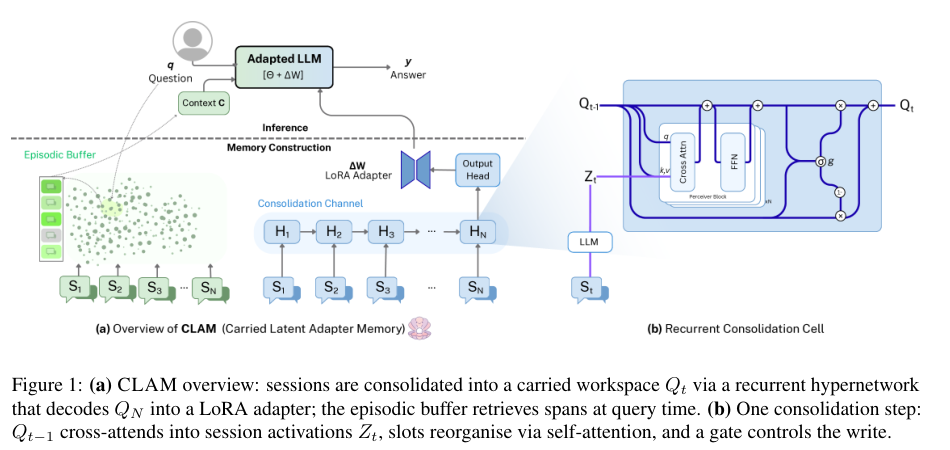
Fixedv1 PDFp.3, Figure1 and original caption. Only surrounding text/whitespace is cropped; scientific content is unchanged. Original figure and provenance. Image from the original paper; copyright belongs to the original authors.
Core equations
Author results
Experiments use1,540 answerable LoCoMo questions and173 sampled answerable LongMemEval-S questions over three2–7B bases. Seven abstention items are excluded, so full abstention capability is not established. Some comparison intervals cross zero. A70B primary judge shares a generator family; three additional judges audit independence. No production A/B is reported.
Local implementation
Data protocol and code mapping
This is review-only: no executable adapter, metrics or GPU receipt, and no weight/corpus downloads. The record preserves read/carry/decode, two-stage training, rank and retrieval protocols. A forward pass through an untrained random hypernetwork would not reproduce consolidation capability.
No local experimental metrics. A terminal high-cost review requires neither invented metrics nor a GPU receipt. No automatic retry or implementation queue.
Diagnostics and limits
CoReMem values memory by future same-repository with/without-memory replay and trains provenance credit. CLAM distills full-history teacher behavior into weights. Prospective utility and a parametric memory channel are different; neither is validated by static summary similarity. Full experiment not reproduced due to cost(reviewDONE).
The representative coremem was read for the mechanism comparison; unmeasured superiority is not claimed.
High-cost full experiment
The paper uses900K synthetic trajectories generated by a70B model,8K–25K hypernetwork training steps on one A100-80GB, three2–7B backbones and70B judges. These are source configurations, not measured local runtime. Available resources are one A100/A30 or a local Mac, not multiple GPUs or free APIs. Full experiment not reproduced due to cost(review DONE). This is terminal and does not block the review watermark. No large download, full-matrix probe or automatic retry is launched.