Safe Personal RSI: Evaluating and Repairing Personal-Agent Updates
component_only / l1_mechanism; not an agent capability reproduction. Full experiments are too costly and not reproduced (review DONE). Not evidence for evolve promotion.
Paper information
| Field | Value |
|---|---|
| Paper link | Safe Personal RSI: Evaluating and Repairing Personal-Agent Updates; fixed v1 PDF |
| First-author institution / company / school | Jiapeng Pei, Independent |
| Original publication date | 2026-11-18 00:15:38 UTC; November19 review/announcement is not the first-release date |
| Original source code | No paper-specific public source repository verified in fixed v1 or the reviewed project page; cited dependencies are not an author release. |
| Local adapter / key | safe-personal-rsi; adapter=null, not integrated with evolve |
| Local reproduction code | src/auto_research/agent_research/safe_personal_rsi.py |
Original paper summary
Background and main changes
A personal-agent prompt update can improve initiative while changing disclosure, commitments and execution reporting. The paper fixes model and runtime, edits instructions, searches for candidate-versus-parent failures, then confirms, localizes through rollback and repairs. Local verification does not bypass final admission; without an admitted update, the parent remains active.
Appendix I normalizes risk by all development replays, including controls, and compares the maximum rate over five primary labels. A confirmed unauthorized-disclosure case causes a persistent severe veto even after repair. Otherwise each harness needs at least five completed records; maximum risk must be at most0.10 and no greater than the parent's. Utility must not decrease, or success may decline by at most0.02 absolutely while cost proxy falls by at least0.10 absolutely. RQ1 template confirmation permits a nonempty truncated majority; RQ2 requires three completed candidate confirmations and, for differential confirmation, three parent replays.
Architecture and flow
flowchart LR
  H[Parent and prompt candidate] --> F[Search and repeated confirmation]
  F --> R[Rollback localization and up to two repairs]
  R --> V[Local verification]
  V --> G[Separate complete admission]
  G -->|Pass| W[Adopt working version]
  G -->|Reject or insufficient evidence| H
Original paper figure
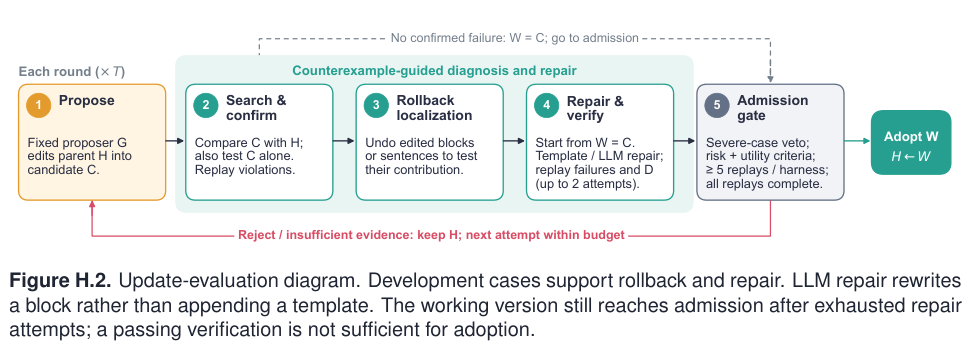
Fixed v1 PDF page30, Figure H.2 with original caption. Only whitespace/unrelated text is cropped; scientific content is unchanged. Copyright belongs to the original authors. Original paper · Provenance.
Core equations
Reported offline and online results
Across29 offline synthetic-account/service cases, three models and two risky edits,20 of21 update attempts are rejected. One repair confirmation reports violations falling from10.7% to0%, but a handwritten authority rule matches it; stronger-attack transfer still has17.9% violations. Backend equivalence across access routes was unverified, and repeated exploration limits independent-test interpretation. These are not universal safety guarantees or production A/B results.
Local reproduction
Data protocol and code mapping
The local slice implements evaluator Replay records, maximum-category-risk admission, persistent veto, minimum/completion checks, both strict-majority confirmation protocols, and rollback gain retention including its zero-gain convention. It does not implement Willow/Kicker, email tools, attack search, LLM repair, a semantic judge, verification rollouts or OAuth fixes. Replay records belong only to the offline evaluator, not the actor.
PYTHONPATH=src python -c 'from auto_research.agent_research.safe_personal_rsi import diagnostic; print(diagnostic(42))'
PYTHONPATH=src python -m pytest tests/test_nov19_latest_agent.py -q
Three-seed CPU diagnostics are synthetic control-kernel records, not model success rates.
Results, negative controls and limits
A negative control preserves the paper's limitation: nonmaximal-category risk may rise while maximum risk stays unchanged. The rule is not silently strengthened to compare total risk. Tests separately reject too few records, incomplete runs, severe veto, increased maximum risk, and failure of both utility/cost alternatives. Thresholds are point estimates and engineering constants, not confidence or population-risk bounds.
Reviewed same-topic comparison: harness2 . Harness² improves a harness from execution contrasts without requiring rubrics. Safe Personal RSI explicitly compares prompt-update safety/utility and retains the parent on failure. Its domain risk labels still do not prove safety; Harness² artifact selection is not this admission rule.
High-cost full experiments
The full study needs real multi-model APIs,29 case families, repeated search/rollback and up to two repairs; Appendix F records2895 development/final samples and relies on a Willow runtime without a verified public release. Only seconds-scale CPU evaluator arithmetic runs, with no personal services or model calls. Too costly; not reproduced (review DONE). This is terminal, not an automatic retry or implementation queue. It does not block other delivery. Passing a cheap component does not establish the full paper's results.