CAPE: let the executable policy determine what to calibrate next¶
component_only/ L1 finite CPU-compiler diagnostic,diagnostic_only=true, not an LLM tool-success reproduction. First published November 24; discovered/reviewed November 25, 2026. No Evolve integration.
Paper information¶
| Field | Content |
|---|---|
| Paper | CAPE: Coordinating Calibration and Search for Tool-Use Policies, fixed v1 |
| Authors / institution | Jiahao Wang, Xiaoxuan Chen, Aijun Yang, Xiaohua Wang; State Key Laboratory of Electrical Insulation and Power Equipment, Xi’an Jiaotong University |
| Original publication | November 24, 2026, 04:43:02 UTC; v1, unchanged update timestamp |
| Announcement / discovery | Identity absent from this announcement pool; announcement date unverified. Discovered/reviewed November 25 |
| Author source code | No verifiable paper-specific repository found in fixed-v1 text/supplement or bounded search. Vega data, DuckDB and pandas documentation are not the author's code release |
| Local adapter / key | adapter: null; cape |
| Local code | src/auto_research/agent_research/cape.py; tests/test_nov25_agent_components.py |
Original paper¶
Background and method¶
A correct operation can still be misread under a hidden parser configuration. CAPE calibrates calls offline on a reproducible candidate family H, then compiles a policy that branches only on responses at deployment. It does not wait for a complete effect table: an action becomes executable once its effects on the reached scope V are known (local closure). Persistent executable witnesses and optimistic bounds guide calibration toward cells that can improve the policy.
flowchart LR
  A[Initial policy and candidate family] --> B[Validate protected coverage R0]
  B --> C[Executable witness and optimistic bound]
  C --> D[Executable and optimistic frontiers]
  D --> E[Acquire effects and selected T2 tightening]
  E --> C
  C --> F[Return witness on interruption]
  F --> G[Deployment sees tool responses only]
Original figure¶
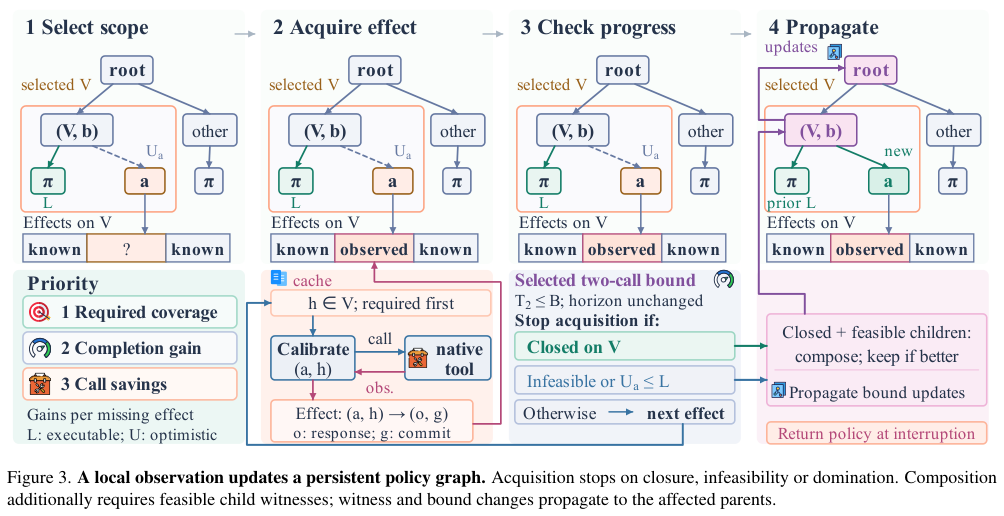
图片来自原论文,版权归原作者所有。Figure 3 on PDF p.5, including its complete caption, was visually inspected. Only unrelated text/whitespace was cropped; provenance. Not a local result.
Core equations¶
An effect \(f(a,h)=(o,g)\) contains the observation and commit bit. Probes never commit; noncommitting actions leave future task state unchanged. The initial success set R0 must be preserved configuration by configuration, not merely in expectation:
Closed actions compose success sets and call mass through actual response cells:
An unknown program optimistically commits immediately; an unknown probe optimistically separates each configuration. With potential program-success union G and largest single-program support d, the cheap bound is \((|G|,-[|V|+|G|-d])\). The selected operator \(T_2(V)=\max_a U_a(V,2;B)\) tightens two-call continuations of the currently acquired action, without shortening the real deployment horizon. A certificate requires equality of valid root lower/upper values.
Reported results¶
The main study uses 64 requests, 64 CSV/88 JSON configurations, C=3/5 and a 30-second compilation allowance. CAPE attains the independent optimum in 502/504 compilations, averaging 11.449 seconds versus eager search's 14.673 (22.0% lower). At 128 configurations, completion is 88.28% versus 66.41% eager and 74.22% matched AND/OR. This is not universal acceleration: in the 64-configuration scaling study, CAPE takes 15.14 seconds versus eager's 14.17. Including compilation, fixed-endpoint totals over 1/8/32 executions remain slower than LLM retry. These are author results, not local measurements. No production online A/B is reported.
Local component and limits¶
Interface and data protocol¶
CapeCompiler accepts a declared finite family, action catalog, initial policy and calibration callback: one to eight configurations and one to four deployment calls. It implements local closure, persistent witnesses, per-configuration R0, the Eq.1–7 optimistic relaxations, executable/optimistic frontiers and required-coverage/completion/call-saving acquisition tiers. Effects are acquired once. At table completion the finite-horizon recurrence is exact.
Policy contains actions, response branches and fallbacks only. execute(policy,tool,call_limit) sends actions and receives observations/commit status; it accepts no active hidden configuration, full effect table, gold answer or reference. Access to named calibration candidates is not access to the active deployment configuration. The separate complete-information exhaustive_oracle is evaluator-only. Commit checking belongs to the tool; this interface is not an adversarial same-process security boundary.
A deterministic query-count allowance replaces the paper's wall-clock budget, so compilation timing is not reproduced. Small teaching tables are not the native DuckDB/pandas transactions, CSV/JSON data or LLM proposals. Guarantees fail if noncommitting actions change task state, the family omits the true configuration, or calibration and deployment effects differ.
PYTHONPATH=src python -c 'from auto_research.agent_research.cape import diagnostic; print(diagnostic(42))'
PYTHONPATH=src python -m pytest tests/test_nov25_agent_components.py -q
Results and negative controls¶
CPU diagnostics, seeds 42/43/44: all four configurations complete in eight total deployment calls, agree with the independent oracle and receive a certificate; the initial three configurations remain protected. All 20 effect cells are calibrated: there is no local calibration saving, and the paper's 22% speedup is not a local result. Seeds change the teaching configuration iteration order, not independent model training.
Tests check lower≤independent optimum≤upper at recorded steps, monotone bounds, initial coverage under allowances 0–24, certificates on random finite tables, local closure without outside-scope effects, no duplicate acquisition, probe-commit rejection and failure on unseen deployment responses rather than reading h. No capability ranking or model tuning is performed.
Same-topic comparison¶
The complete CapLite write-up was reviewed after confirming membership in tools-and-collaboration. CapLite freezes trusted write sequences and authority grounding to decide whether a call is authorized. CAPE calibrates parser effects and searches how to represent an already selected operation. Correct commits are not authorization; preserving R0 is not write-prefix safety. A compiler-optimality certificate is not an agent-security certificate.
Full-campaign cost decision¶
The complete study includes 64 requests, two interfaces, multiple compilers/ablations, a 14-model proposal panel, 240 scaling measurements, 960 measurements across 5–240-second allowances and 80,756 native calls, plus DeepSeek online retry. It is CPU/API research, not necessarily CUDA research. Fresh-process multi-condition timing and API campaigns exceed this short one-A100/A30-or-Mac scope: 成本过高,不复现(审查 DONE) / high cost, not reproduced, review DONE. Only small-H compilation runs; no large data/models, paid APIs, automatic retries or Evolve. This cost basis is the paper configuration, not a measured local full-campaign bill.
Sources¶
Fixed-v1 PDF SHA256: 529ace5a686d8a6ed892132888969207803de27110effb799acde902d86f0e35. Method: §3–4 Eq.1–7 and Supplement Algorithm 1; full results/cost: §5 and Supplement C/G. A bounded intake is not exhaustive domain coverage.