Spectral Ghost: a spectral view of self-supervised objectives
Theory review only, not implemented. Fixed v4 leaves empirical ablations to future work. There is no local training, metric or GPU experiment, and no invented expensive experiment attributed to the paper.
Paper information
| Field | Value |
|---|---|
| Paper | arXiv:2601.20154v4; fixed v4; v1 |
| Institution/company | Fixed v4: Bo Dai, Georgia Tech; Na Li, Harvard; Dale Schuurmans, University of Alberta. V1 listed Google DeepMind first for Bo Dai and Dale; v4 no longer does. Group by the reviewed-v4 first affiliation, not author-name inference |
| Original release | V1: January 28, 2026, 01:08:24 UTC. Reviewed v4: November 10, 2026, 21:17:38 UTC. A historical-version backfill, not a November first release |
| Authors' code | No dedicated author repository found in fixed v4 or arXiv resources. Baseline links and acknowledgments do not establish a source release |
| Local adapter/key | spectral-ghost; adapter null; review_only_theory; no Evolve integration |
| Local code | Not implemented: theoretical discussion, versioned affiliation evidence and original figure only; no run metrics |
Original paper
Motivation and changes
The contrastive/non-contrastive split does not explain representation sufficiency or batch-size effects. The paper organizes spectral, energy-based, denoising, nonlinear, latent-variable and multimodal approaches by representation parametrization and objective estimation. It connects established methods and derives new objectives, rather than providing an empirical leaderboard or only an opinion survey. Sections 2–3 and 9
Key original figure
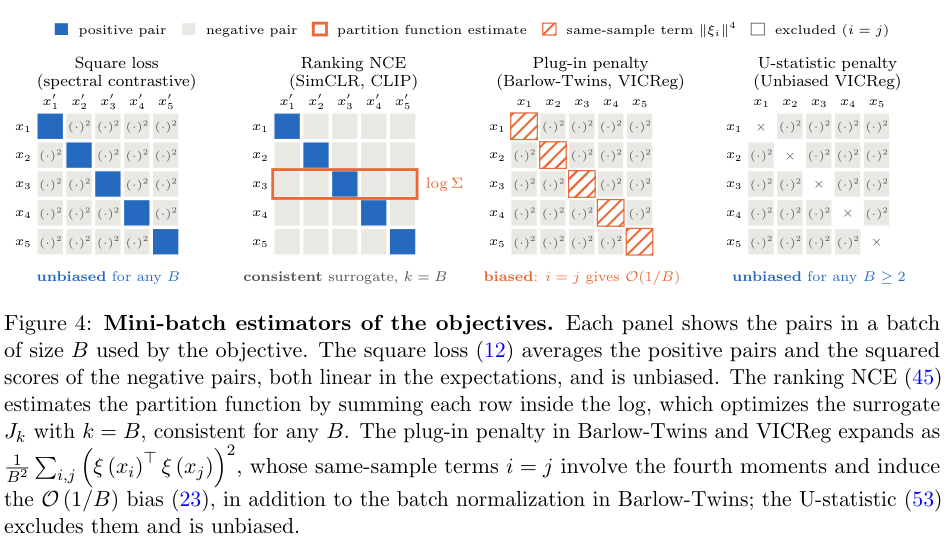
Fixed-v4 Figure 4 and caption; authors retain copyright under the arXiv perpetual non-exclusive license. This illustrates estimators, not local experimental results. Provenance.
Mechanisms and equations
A finite-dimensional spectral representation can factor a paired density ratio, but sufficiency for arbitrary downstream tasks also depends on assumptions and rank. A learned finite vector is not automatically a universal sufficient statistic.
One identifiable new objective removes same-sample terms from the squared plug-in covariance penalty. For \(z_i=\xi(x_i)\), Eq.53 uses:
Under the paper's independent-sampling conditions it is unbiased for \(\|E[zz^T]-I\|_F^2\), unlike the \(B^{-2}\) plug-in including \(i=j\). Unbiasedness guarantees neither low small-batch variance nor stability at arbitrary learning rates. Sections 3.2 and 9.1
Ranking NCE optimizes a fixed-negative-count surrogate and is consistent under a well-specified model. With misspecification, different negative counts may change the optimum: more negatives do not universally only reduce variance. JEPA's stopped/EMA targets have a variational-power-iteration interpretation; this does not make every objective interchangeable with ordinary MSE.
Results and evidence boundaries
The results are derivations about representations, estimator bias and algorithmic connections, not a new unified training matrix or production A/B. Section 12 explicitly leaves empirical parametrization/optimization ablations outside scope. There are no local accuracy, loss-reduction or GPU-receipt claims; discussing an existing method does not reproduce it.
Local scope
Review only: no implementation, queue or automatic retry. An independent future implementation would need explicit sampling, positivity/nonzero constraints, finite-rank assumptions and matched budgets, then arithmetic/gradient checks. No such experiment is claimed here. The status is review_only_theory / no_empirical_experiment, not a deferred high-cost campaign.