简体中文 · English
Modular Robust Generative: Robust gating with explicit global normalization¶
Paper information¶
| Field | Details |
|---|---|
| Paper | arXiv 2602.17554; pinned v1 full text |
| Original title | A Theoretical Framework for Modular Learning of Robust Generative Models |
| Institution | First author Corinna Cortes: Google Research |
| First public release | 2026-02-19 (arXiv v1) |
| Author code | No implementation repository found or released in v1 or the official institution page. This is not a claim that no code exists anywhere. |
| Local adapter or method key | modular-robust-generative; adapter: null, component_only |
| Local reproduction code | src/auto_research/foundation_models/google16_robust_gate.py; scripts/run_google16_neural.py |
| Full experiment | The original-scale multi-expert campaign with multiple controls, datasets, and seeds is too costly; not reproduced (review DONE). |
Original paper summary¶
Background and main changes¶
The method learns an input-dependent gate over frozen generative experts against the worst data domain. It is not an expert average. A per-input softmax does not guarantee that the entire generative distribution integrates to one, so global mass must be constrained separately. Noncausal teacher samples are also distilled into a causal router that reads only prefixes. See §§5.2, 6, and 7.3.
flowchart LR
  E[Frozen expert probabilities] --> G[Input-dependent gate]
  G --> M[Unnormalized generative mass]
  M --> D[Domain KL and adversarial EG weights]
  M --> Z[Global mass constraint and dual ascent]
  D --> U[Gate gradient update]
  Z --> U
  M --> S[SIR sampling]
  S --> C[Cache expert probabilities for target tokens]
  C --> R[Prefix-only causal router NLL]
Key figure from the paper¶
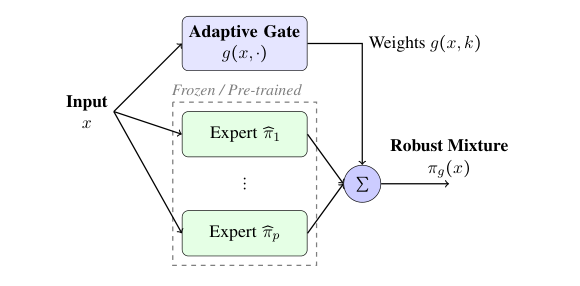
Figure 1, PDF page 6: An input-dependent gate combines frozen experts. This is an original crop from the official PDF, not redrawn. The local implementation covers finite support only; the figure does not imply a trained LLM system. Copyright belongs to the authors. See source, crop bounds, and hash.
Core equations¶
The theoretical adversarial payoff in Algorithm 1 is domain KL, but the practical §5.2 / Appendix D Algorithm 6 uses domain NLL \(\ell_k=-\mathbb E_{p_k}\log\pi_g\). The two differ by domain entropy. Their gate gradients are equivalent; their adversarial weights need not be when entropies differ. Local practice defaults to nll. Explicit adversary_objective="kl" is a theoretical comparison only. Tests keep an unequal-entropy counterexample so symmetric fixtures do not hide the difference.
Algorithm 2 updates \(\lambda_k\propto\lambda_k\exp(\eta_\lambda\ell_k)\) and \(\mu\leftarrow\mu+\eta_\mu(Z_g-1)\), then updates the gate. Exact summation on finite support replaces Monte Carlo/EMA estimation while preserving the constraint rather than hiding errors through silent renormalization. SIR proposes from uniformly weighted experts with weights \(\pi_g/q\). Algorithm 5's cached target is \(-\log\sum_k\gamma_k(x_{<t})\widehat\pi_k(y_t|x_{<t})\), not the arithmetic mean of expert NLLs.
Offline and online results¶
The paper reports synthetic-domain and Wikipedia/Code/FineWeb offline NLL and distribution-shift comparisons, not production online A/B. The local run does not reproduce those tables or present lower finite-support training loss as evidence of language-model robustness.
Local reproduction¶
gated_mass explicitly returns unnormalized mass; primal_dual_step performs three-party updates; sir_resample executes importance resampling; and cached_router_nll trains the router on a frozen cache. Independent tests cover the global-constraint counterexample, EG/dual formulas, reproducible sampling, mixture probabilities, and gradient isolation. The API does not automatically verify causality of the caller's network. The caller must generate router logits from prefixes alone.
PYTHONPATH=src python scripts/run_google16_neural.py \
  --device cpu --steps 16 --seed 42 --output runs/google16-neural-cpu.json
The runner is a two-expert by four-outcome mathematical diagnostic, explicitly fixture_only: true. It runs only 16 steps and logs the global normalization residual without requiring it to converge to zero. It does not claim a robust gate satisfying the theoretical constraint. No full Transformer or language data training, model downloads, capability comparison, or Evolve integration. The CUDA receipt verifies execution and provenance only.
Cost and unreproduced scope¶
Section 8.4 uses 80K×128 tokens per expert, three experts of about 6.5M parameters, additional gate training and a 19.8M control, and five repetitions each of two types. Experts alone require about 3.07 × 10⁸ tokens, excluding extra gate/control training. No full-run local runtime is measured. One small synthetic run is affordable, but the full multi-arm campaign exceeds the short single-A100/A30 budget and is not launched. The finite-support component does not replace those experiments or trigger automatic retries.