Decoding-constrained beam search: deterministic near-verbatim risk bounds
Local delivery is an L1 numerical/protocol component, not a full paper capability reproduction. Full experiments are cost-deferred and review-DONE, with no pretrained model/API training, automatic retry or evolve promotion.
Independent component artifacts: CPU, three seeds. They validate only the stated small operators; actual NVIDIA execution is supported by a separate sanitized batch receipt.
Paper information
| Field | Value |
|---|---|
| Paper | Estimating near-verbatim extraction risk in language models with decoding-constrained beam search; fixed v1 |
| Company / institution | First author A. Feder Cooper: AVERI / Stanford University; original byline also verifies Google DeepMind. Group by the first author's institution, not model brands. |
| First publication | 2026-03-26 01:15:16 UTC, arXiv v1; historical omission, not a new paper this batch |
| Author code | Author-linked repository. The original paper links this author repository, but its GitHub metadata API and main/master README returned Not Found on2026-11-13. Availability is unverified; the exception is preserved. |
| Adapter | decoding-constrained-beam is a catalog key; adapter=null, not a full reproduce/evolve adapter |
| Local code | src/auto_research/foundation_models/decoding_constrained_beam.py; tests/test_nov13_colm_evaluation.py |
Key figure from the original paper
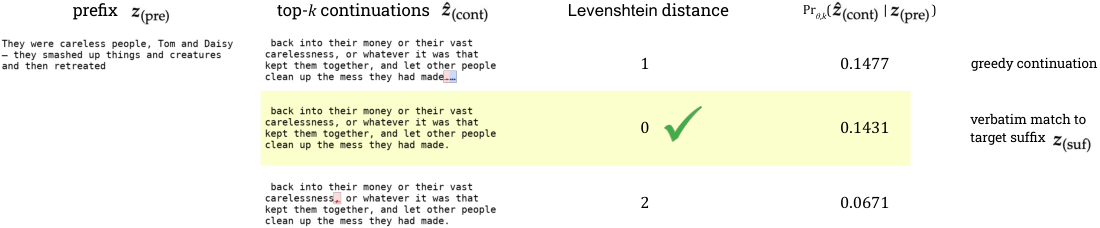
Source: fixed original. Image from the original paper; copyright belongs to its original authors. The complete system or results in this figure are not results of the local component. Source hashes and visual review are recorded in assets/provenance.json.

Original paper summary
Background and main change
Greedy verbatim matching can miss a substantial total mass of near-verbatim variants. Ordinary beam scores are also not probabilities under top-k decoding. The method renormalizes within the decoder's support, keeps exact path probabilities, and sums enumerated near-target continuations to obtain a deterministic lower bound.
The local implementation is an audit-side probability and distance component. A model callback receives only the prefix and generated tokens; it is not given the target suffix used for distance pruning. No training corpus or pretrained model is downloaded.
flowchart LR
    A[External next-token logits] --> B[Normalize within top-k]
    B --> C[Expand exact-logprob paths]
    C --> D[Hamming or banded-edit viability]
    D --> E[Intermediate top-B and pruned-mass bank]
    E --> A
    D --> F[Do not prune final expansion to B]
    F --> G[Full-target distance and mass sum]
    G --> H[LB and LB plus bank]
Core formulas
With top-k support \(S_k(u)\), the decoder probability is \(q(v\mid u)=\exp\ell_v(u)/\sum_{w\in S_k(u)}\exp\ell_w(u)\). Path log probability is the sum of these conditionals. Neither removing low-rank tokens nor viability pruning permits renormalizing over the surviving beam.
Section4.2 retains up to \(Bk\) final expansions rather than \(B\), then sums near-target path probabilities. Section4.3 tracks a monotone mismatch count for Hamming or a streamed Levenshtein band of width at most \(2\epsilon+1\). A row minimum above \(\epsilon\) proves nonviability, but the final acceptance check is \(D[T,T]\le\epsilon\), not merely row-min viability.
The mass of viable prefixes removed by cross-beam pruning is banked, giving \(UB=LB+bank\), capped at1 locally. Banked mass is only potentially recoverable mass, not evidence that those completions were found.
Original offline and online results
For10,000 Wikipedia training sequences and OLMo2-32B, the source reports a near-verbatim extraction-rate lower bound of2.57% at edit budget5, compared with1.62% for greedy near-verbatim and0.61% for greedy verbatim. It also tests post-cutoff Wikipedia negative controls. These model/corpus results are not estimated by the local two-token example. No production online A/B is reported.
Local component
Data protocol and code mapping
search performs top-k normalization, exact path scoring, Hamming/banded-edit pruning, deterministic ties and final mass calculation. EOS is removed before the final depth but retained in final expansions, matching the fixed-length algorithm. Optional minimum-probability early stopping, batch KV caching and GPU model execution are not implemented.
PYTHONPATH=src python -c 'from auto_research.foundation_models.decoding_constrained_beam import diagnostic; print(diagnostic(42))'
PYTHONPATH=src python -m pytest -q tests/test_nov13_colm_evaluation.py
Local evidence and negative controls
Tests enumerate a complete two-token, three-step distribution for both distance metrics, several edit budgets and beam widths. They verify \(LB\le p\le UB\) and exact recovery with a wide beam, plus normalization, final expansion cardinality, EOS handling and target isolation. This supports the numerical search core, not real-model memorization risk, throughput or a formal deployment audit.
Full-experiment cost decision
The original matrix includes OLMo2 up to32B, Llama2 up to70B, Pythia, thousands of sequences and independent controls, commonly with \(B=20,k=40,T=50\). AppendixC.3/F.7 distinguishes token work, sequential forward passes, KV-cache memory and wall time. Full reproduction is cost-deferred and review-DONE. The linked author repository returned404 in this review; its URL is preserved as an access exception, not advertised as verified available code.