Latent generalization: separating exposed and held-out answer-set recall
L1 mechanism/evaluation component, diagnostic only—not a complete capability reproduction. CPU component tests passed. There is no CUDA execution path and no GPU claim. Not integrated with Evolve; fixture results cannot justify promotion.
Paper information
| Field | Value |
|---|---|
| Paper | arXiv:2604.01430v1; fixed v1 source |
| First author / institution | Arslan Chaudhry, first affiliation Google DeepMind; Google participation is verified from the author block, not model names |
| Original publication date | 2026-04-01 22:10:21 UTC, arXiv v1 record; historical official-source backfill, not today's first publication |
| Author code | No verified paper-specific author implementation repository was found in fixed v1 as of 2026-11-13; model/dependency repositories do not count as this paper's code. |
| Local adapter / key | latent-generalization; adapter: null, independent component |
| Local code | src/auto_research/foundation_models/latent_generalization.py |
| Validation | CPU component tests passed. There is no CUDA execution path and no GPU claim. |
Original paper summary
Background and main change
Knowing A>B does not guarantee answering B<A or unseen relational combinations. The paper separates knowledge acquisition, reasoning-trace bootstrapping and correctness RL to test whether reasoning trained on one structure transfers to another exposed only through knowledge SFT.
Key original-paper figure
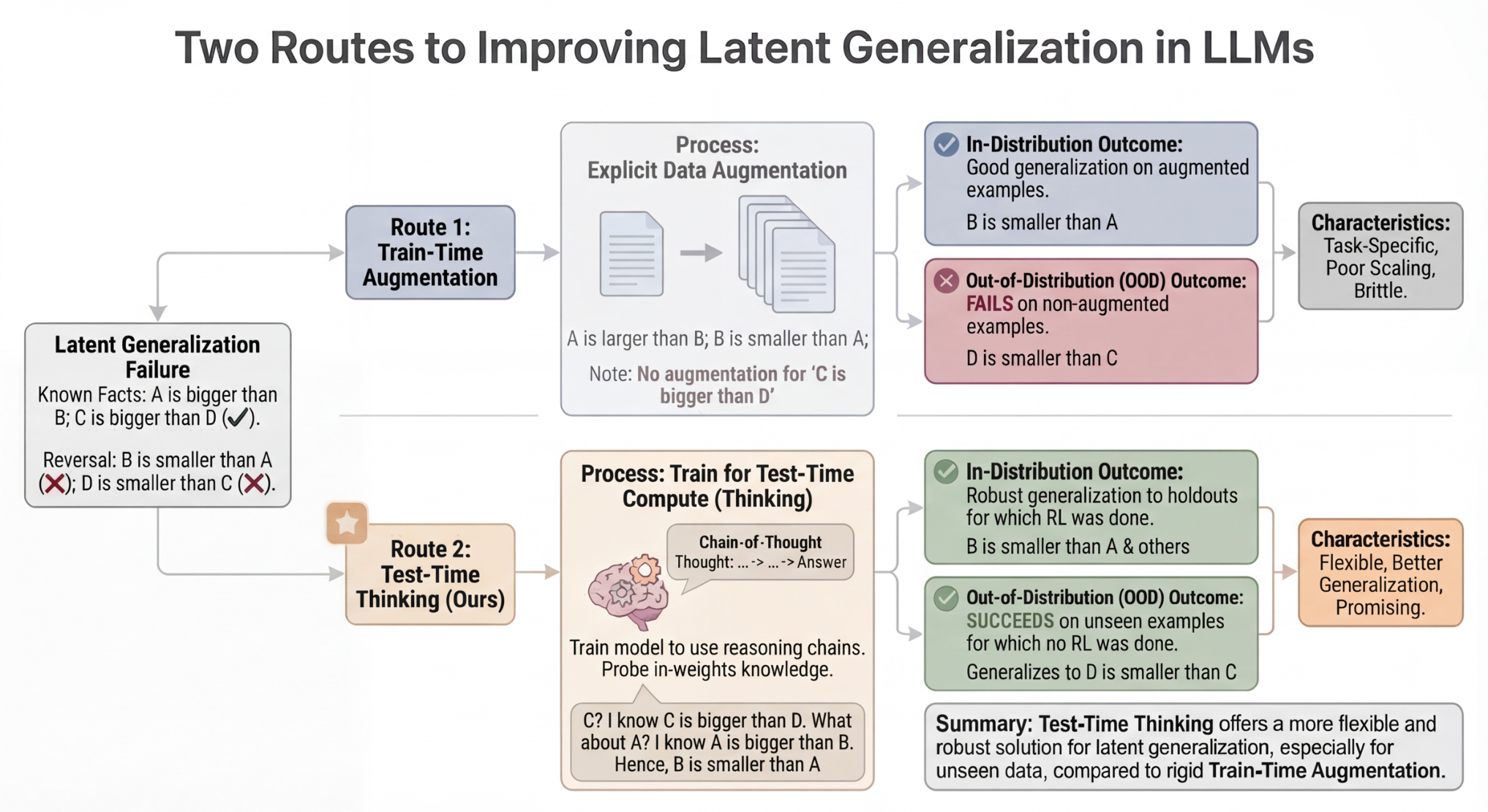
Figure 1 from fixed v1 HTML: the authors' comparison of train-time augmentation and test-time thinking. Source and image hashes are in assets/provenance.json. Figure from the original paper; copyright belongs to the original authors. Full-paper findings are not local component results.
Defining mechanism and formula
The original pipeline uses Gemini 2.5 Flash knowledge SFT, gold-conditioned teacher trace bootstrapping and a correctness REINFORCE variant. No private trainer is fabricated locally. The implemented Section 3.3 protocol reports overall set precision/recall/F1, exposed/held-out recall, exact-set match/pass@N and designated held-out primary inclusion. Exact success allows neither omissions nor false additions.
Original results and limitations
The paper compares knowledge SFT, augmentation and thinking on controlled semantic/reversal tasks. Local code generates no model answers and establishes no cross-structure transfer. Held-out knowledge can be exposed during acquisition while remaining excluded from the relevant bootstrap/RL targets and rewarded traces; the paper uses structure-specific prefixes to reduce trace leakage.
Local reproduction
Data protocol and code mapping
Input checks require a nonempty held-out subset and a held-out primary. Exact-set pass@N is estimated from completed independent attempts. Negative controls show that perfect exposed recall can coexist with zero held-out recall, and perfect held-out recall can still fail exact matching through false additions. This is CPU offline evaluation, without model training, semantic judging or Evolve promotion.
PYTHONPATH=src python -c 'from auto_research.foundation_models.latent_generalization import diagnostic; print(diagnostic(42, device="cpu"))'
PYTHONPATH=src python -m pytest -q tests/test_colm_foundation_components.py
Results, negative controls and boundaries
The component test set has 44 passes and six locally skipped CUDA cases; skipping is not passing. Standard three-seed outputs use metrics/component-cpu-seeds42-44.json, not training or public-benchmark results. CPU component tests passed. There is no CUDA execution path and no GPU claim. All metrics are L1 diagnostics. No gold is exposed to an actor, no test-based selection is authorized, and no model improvement is claimed.
Full-experiment disposition
Private Gemini 2.5 Flash fine-tuning plus teacher traces and RL; not a fully specified public training recipe; full experiment not reproduced (commercial/private dependency).
Full experiment not reproduced: private/commercial training dependency (review DONE). No private training API or unreported GPU-hour estimate is invented.