StoryScope: stable narrative cores rather than surface detection shortcuts
Local delivery is an L1 numerical/protocol component, not a full paper capability reproduction. Full experiments are cost-deferred and review-DONE, with no pretrained model/API training, automatic retry or evolve promotion.
Independent component artifacts: CPU, three seeds. They validate only the stated small operators; actual NVIDIA execution is supported by a separate sanitized batch receipt.
Paper information
| Field | Value |
|---|---|
| Paper | StoryScope: Investigating idiosyncrasies in AI fiction; fixed v1 |
| Company / institution | First author Jenna Russell: University of Maryland, College Park; original byline also verifies Google DeepMind. Group by the first author's institution, not model brands. |
| First publication | 2026-04-03 15:56:38 UTC, arXiv v1; historical omission, not a new paper this batch |
| Author code | Author-linked repository. A public MIT author repository, README and dataset entry are verified. Current upstream authors/sample counts contain revisions; this write-up's method and cost claims remain pinned to v1. |
| Adapter | storyscope is a catalog key; adapter=null, not a full reproduce/evolve adapter |
| Local code | src/auto_research/foundation_models/storyscope.py; tests/test_nov13_colm_evaluation.py |
Key figure from the original paper
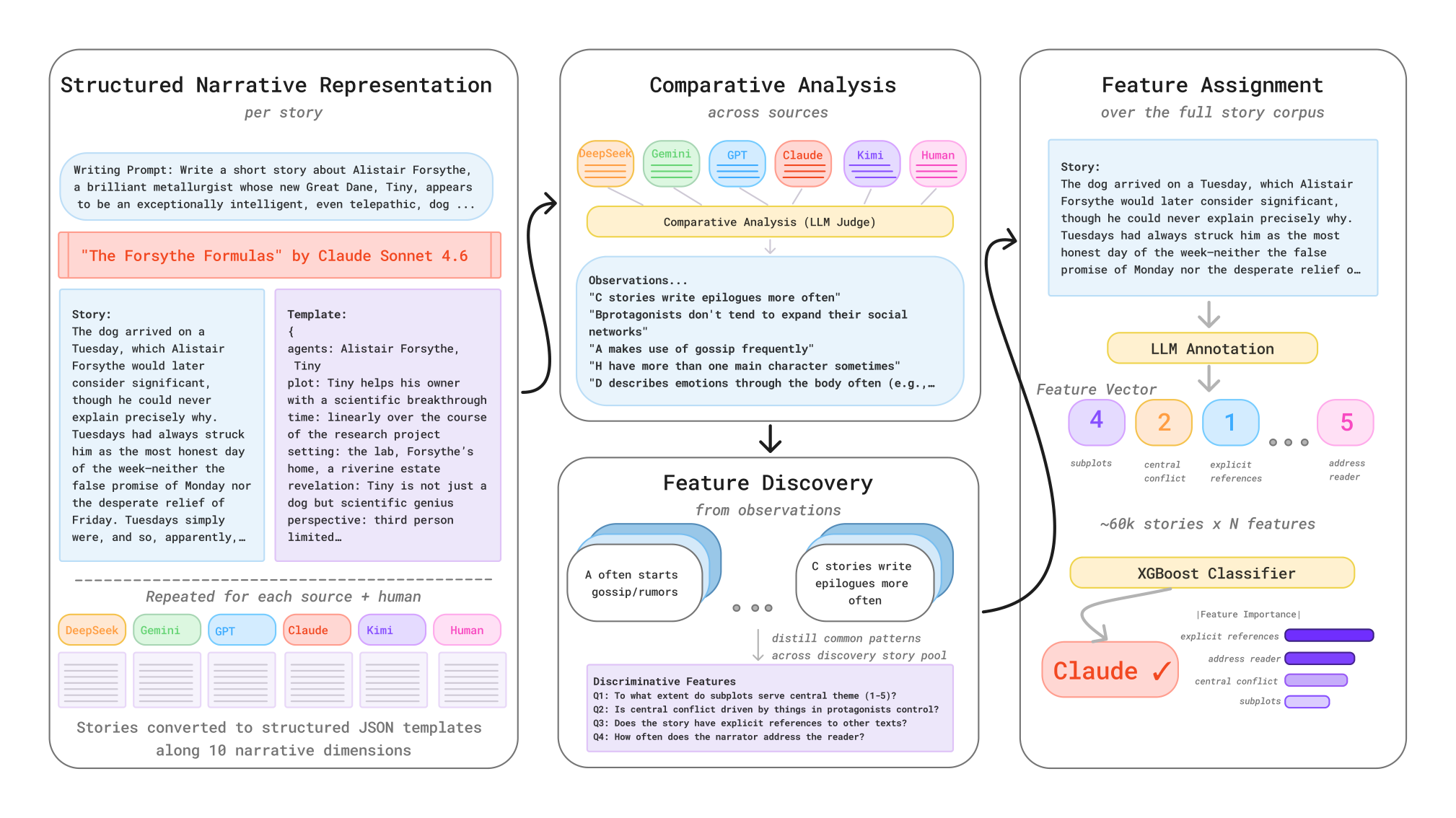
Source: fixed original. Image from the original paper; copyright belongs to its original authors. The complete system or results in this figure are not results of the local component. Source hashes and visual review are recorded in assets/provenance.json.

Original paper summary
Background and main change
StoryScope studies narrative choices rather than only lexical style. It structures stories, compares human and five-model narratives written from the same prompt, discovers and deduplicates semantic features, assigns them at corpus scale, and uses classifiers plus bootstrap SHAP to distinguish cross-model cores from source-specific fingerprints.
The local component does not replace semantic features with word counts, keywords or author labels. It implements AppendixD's core gate on external statistics and prompt-block bootstrap indices. Fixed v1 does not fully quantify fingerprint thresholds in AppendixD, so no guessed fingerprint selector is supplied.
flowchart LR
    A[External semantic feature pipeline] --> B[Real classifiers and SHAP]
    C[All source rows sharing a prompt] --> D[Prompt-block bootstrap]
    D --> B
    B --> E[Importance and stability]
    E --> F[Null95 and permutation p]
    F --> G[Gap and cross-AI spread conjunction]
    G --> H[Signed core role]
Core criteria
A feature is important only when its mean absolute SHAP strictly exceeds the75th percentile across features. Stable-important membership also requires stability at least the median among important features, SHAP above the95th-percentile null-label baseline, and permutation \(p\le0.10\).
Core membership requires that quadrant and null significance, \(stab\ge0.55\), \(top25\ge0.60\), an absolute human–AI mean-value gap of at least0.20, and a range of at most0.35 across the five AI source means. These are conjunctive thresholds, not an invented weighted score. The sign of the mean gap labels AI-leaning versus human-leaning cores.
Real classifier, encoding and prompt-level resampling statistics are external. Supplying synthetic vectors does not recreate50 fitted SHAP analyses. Prompt groups must be separated before training/validation/test splits and resampling.
Original offline and online results
The fixed paper uses61,608 stories,10,272 prompts and304 narrative features. It reports93.2% macro-F1 for human-versus-AI detection and68.4% for six-way attribution. Thirty core features retain about91% of the narrative detector's F1. Strong surface-text attribution baselines prevent interpreting this as universal detection superiority. No production online A/B is reported.
Local component
Data protocol and code mapping
prompt_bootstrap samples prompts and expands all rows for every selected prompt, including repeated blocks. select_core_features actually computes importance/stability thresholds, significance and cross-model checks, returning a core mask and direction. There is no semantic feature generation, full XGBoost/SHAP fitting or text-detector API.
PYTHONPATH=src python -c 'from auto_research.foundation_models.storyscope import diagnostic; print(diagnostic(42))'
PYTHONPATH=src python -m pytest -q tests/test_nov13_colm_evaluation.py
Local evidence and negative controls
The diagnostic generates50 prompt-block draws and checks source-row integrity. A high-SHAP source-specific feature fails the cross-model spread criterion; tests also exercise permutation and top25 boundaries. A selected-feature count is not accuracy or an attribution verdict. No evolve capability promotion is provided.
Full-experiment cost decision
The original pipeline processes roughly5,000 words per story, uses GPT5.1 for templates/discovery and Gemini3Flash for304-feature assignment, embeds feature descriptions with F2LLM4B, and fits bootstrap classifiers and baselines. Full reproduction is cost-deferred and review-DONE: no corpus download, API calls or full detector training. Released caches are not evidence of local semantic execution. Current upstream author/sample details have changed, so methods and costs remain pinned to v1.