ECG: shared representations for retrieval and context compression
L1 mechanism/evaluation component, diagnostic only—not a complete capability reproduction. CPU and real NVIDIA A100-SXM4-80GB L1 checks passed for seeds 42/43/44; only small tensor operators were executed, not full training. Not integrated with Evolve; fixture results cannot justify promotion.
Paper information
| Field | Value |
|---|---|
| Paper | arXiv:2604.14403v1; fixed v1 source |
| First author / institution | Julian Killingback, first affiliation University of Massachusetts Amherst; Google participation is verified from the author block, not model names |
| Original publication date | 2026-04-15 20:34:10 UTC, arXiv v1 record; historical official-source backfill, not today's first publication |
| Author code | No verified paper-specific author implementation repository was found in fixed v1 as of 2026-11-13; model/dependency repositories do not count as this paper's code. |
| Local adapter / key | ecg-rag; adapter: null, independent component |
| Local code | src/auto_research/foundation_models/ecg_rag.py |
| Validation | CPU and real NVIDIA A100-SXM4-80GB L1 checks passed for seeds 42/43/44; only small tensor operators were executed, not full training. |
Original paper summary
Background and main change
On-device RAG must limit both index storage and generation context/KV costs. ECG stores one multi-vector retrieval representation and projects it into compressed context for the same decoder, avoiding separate retrieval and compression representations.
Key original-paper figure
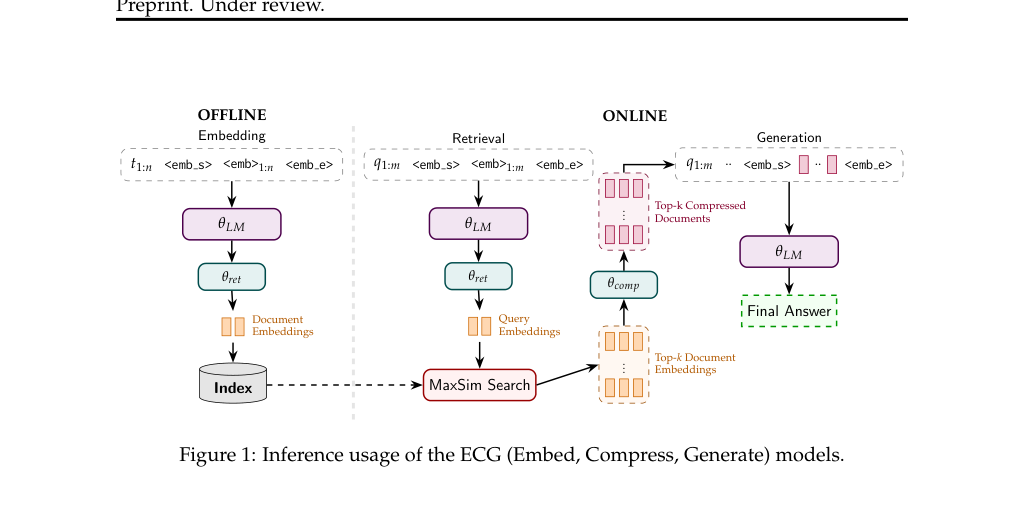
Figure 1, PDF page 2: shared model/document representations for Embed, Compress and Generate. Source and image hashes are in assets/provenance.json. Figure from the original paper; copyright belongs to the original authors. Full-paper findings are not local component results.
Defining mechanism and formula
Each projection block has four scalar-gated residual layers, with ReLU only in the first three. Retrieval vectors are scaled by sqrt(d), not unit-normalized; compression undoes that scaling. Retrieval averages per-query-vector maximum document dot products. RAG training sums teacher-to-student generation FKL, learned-temperature InfoNCE and learned-alpha teacher-margin MSE.
Original results and limitations
The paper reports near-reader performance at roughly one tenth of the context, with 135M/1B models, eight H100 training GPUs, about 110k questions and 840k/2.1M pooled passages. Only the differentiable core is implemented here; there are no generated answers or replicated on-device latency/retrieval claims.
Local reproduction
Data protocol and code mapping
Compression genuinely consumes stored E_ret. Teacher distributions/relevance are detached while alpha and temperature remain differentiable. FKL sums answer-token KLs before batch averaging; margin uses declared hard negatives only. The paper specifies a large positive gate bias but no exact value: five is an explicit local convention. There is no pretrained decoder, index, special-token integration or full training pipeline.
PYTHONPATH=src python -c 'from auto_research.foundation_models.ecg_rag import diagnostic; print(diagnostic(42, device="cpu"))'
PYTHONPATH=src python -m pytest -q tests/test_colm_foundation_components.py
Results, negative controls and boundaries
The component test set has 44 passes and six locally skipped CUDA cases; skipping is not passing. Standard three-seed outputs use metrics/component-cpu-seeds42-44.json, with metrics/component-cuda-seeds42-44.json and a sanitized GPU receipt for CUDA. CPU and real NVIDIA A100-SXM4-80GB L1 checks passed for seeds 42/43/44; only small tensor operators were executed, not full training. All metrics are L1 diagnostics. No gold is exposed to an actor, no test-based selection is authorized, and no model improvement is claimed.
Real-GPU evidence: three-seed CUDA metrics and sanitized A100 receipt, bound to frozen source commit 1b7fe8699efd48e6421b01f6df756d6e4086eb52. About 1.468 seconds for all seven CUDA components is small-operator time, not this paper's training runtime.
Full-experiment disposition
8 NVIDIA H100 training; 135M/1B models, Wikipedia pretraining and ~110k NQ/TriviaQA questions, pooled 840k/2.1M passage evaluation; full study not reproduced.
Full experiment not reproduced due to cost (review DONE). No large checkpoint/corpus downloads, scaled-down substitute presented as replication, or automatic full-training retries.