LoopSpec: Pipelined Self-Speculative Decoding for Looped Transformers
L1 mechanism diagnostic. Reference depth scheduling, not paper GPU throughput.
Paper information
| Field | Value |
|---|---|
| Paper | LoopSpec: Pipelined Self-Speculative Decoding for Looped Transformers |
| Affiliations | Seoul National University / KAIST |
| First public release | 2026-09-15 (arXiv v1) |
| Authors' code | No public author repository found as of 2026-09-16. |
| Adapter / method | loopspec |
| Local code | src/auto_research/foundation_latest_20260916.py |
Original paper
Background and contribution
Use intermediate predictions across recurrent depth for self-speculation. Pipeline residual proposals to hide verification latency.
flowchart LR
  I[Looped model state] --> P[Intermediate draft] --> R[Pipelined residual proposal] --> V[Verification]
Key figure from the paper
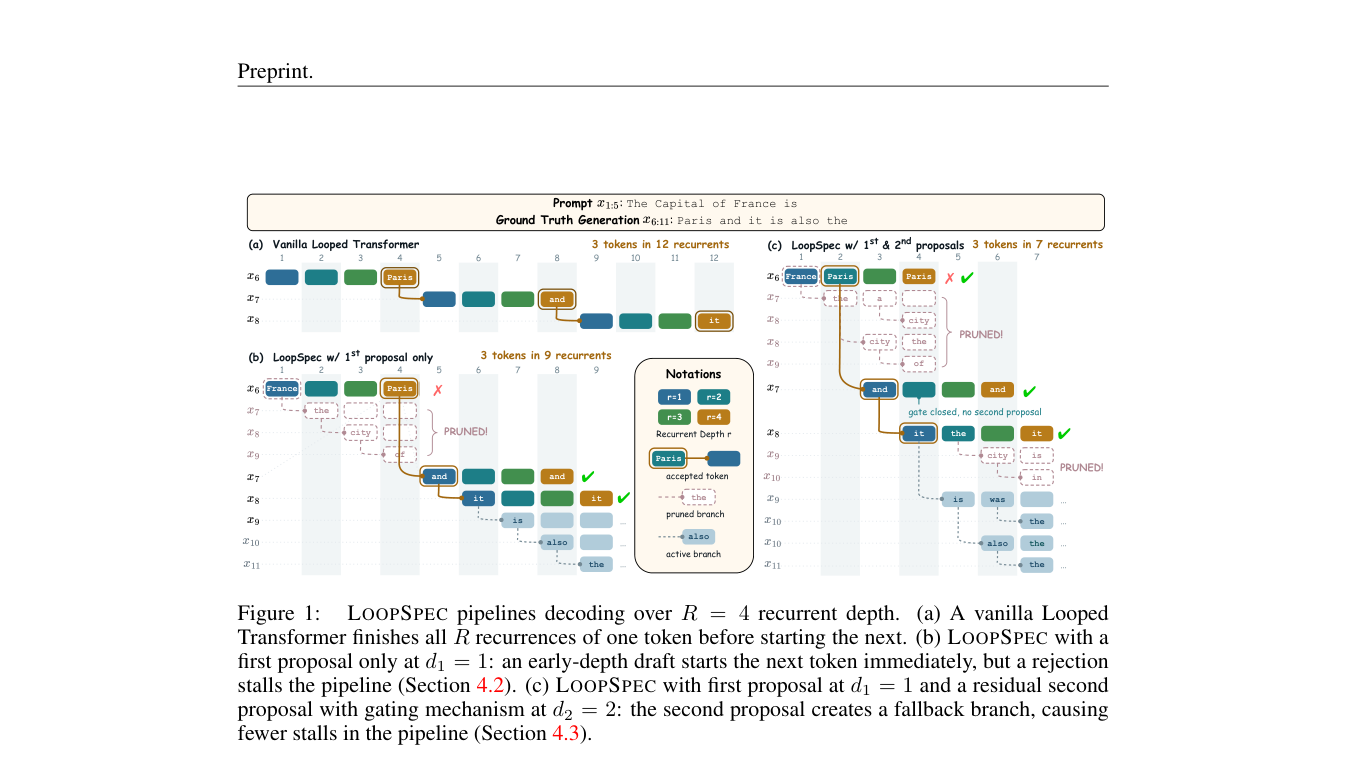
Original Figure 1: self-speculation workflow. From the paper; copyright belongs to the authors. Not a local result.
Core mechanism
The reference preserves defining gate, weighting, and state transitions, exposing auditable scheduling/depth intermediates. Fixed-budget three-seed tests check invariants, not paper-scale training.
Paper results
Paper capability, cost, and speed are not local evidence or production gains.
Local reproduction
Three-seed results are diagnostic_only=true and not treated as full capability gains.
Reproduction limits
Only the reference depth scheduler executes; no reproduction of paper GPU throughput.