MS-GLA: Multi-Temporal Gated Linear Attention
L1 architecture with real A100 forward/backward. Multiscale decomposition, causal hold, and input-dependent fusion are implemented, not the paper's Flash kernel or matched-parameter training.
Paper information
| Field | Value |
|---|---|
| Paper | MS-GLA: Multi-Scale Gated Linear Attention for Addressing Representational Bottlenecks via Multi-Temporal Resolution |
| Affiliation | First author: International Institute of Information Technology Hyderabad |
| First public release | 2026-09-28 (arXiv v1) |
| Authors' code | prasoondev/msgla |
| Adapter / method | ms-gla |
| Local code | foundation_latest_20260930.py |
Original paper
Background and contribution
One time resolution can bottleneck linear attention. Allocate heads over scales, run nonoverlapping masked-average pooling and separate GLA branches, then align back with causal hold and fuse through input-dependent softmax routing.
flowchart LR
 X[Token states] --> P1[Scale 1] --> G1[GLA]
 X --> P2[Scale 2 pooling] --> G2[GLA]
 X --> P4[Scale 4 pooling] --> G4[GLA]
 G1 --> F[Causal alignment and softmax fusion]
 G2 --> F
 G4 --> F
Key figure from the paper
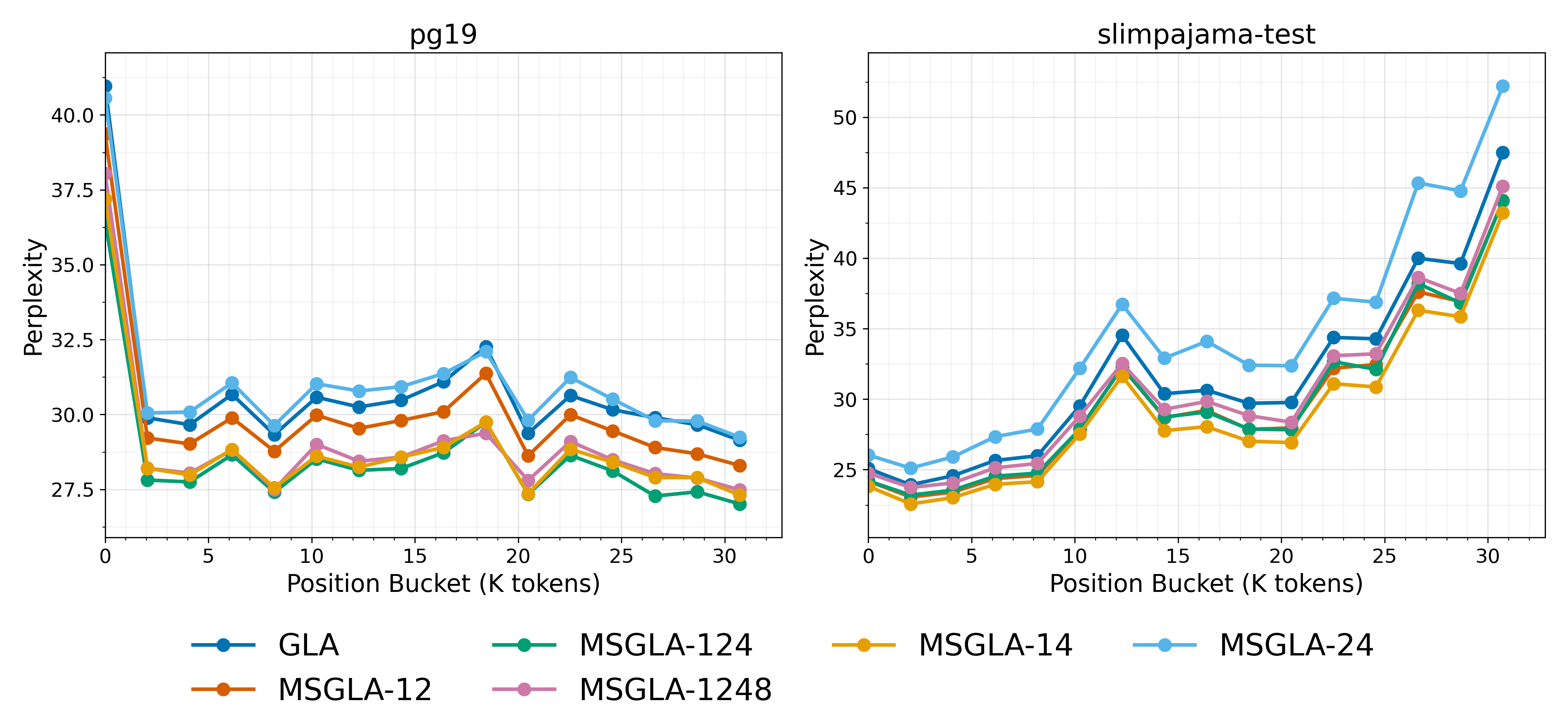
Branches at different resolutions and their fusion, from the paper. Copyright belongs to the authors.
Core equation and evidence
A scale-\(s\) masked block average is available only when its final token arrives, avoiding future leakage. \(\alpha_{t,s}=\operatorname{softmax}_s(W_f h_t)\) and output \(\sum_s\alpha_{t,s}\tilde o_{t,s}\). Language modeling and throughput belong to the paper. Local metrics check pooling, causal hold, normalized routes, and finite gradients.
Local reproduction
MultiScaleGLA is a compact differentiable PyTorch layer. The aggregate experiment and sanitized NVIDIA A100 receipt verify CUDA execution only.
Reproduction limits
The recurrent reference favors correctness, not throughput. No Triton/Flash replication, paper-scale parameter budget, or executed Evolve integration. A registry name is not a runnable search operator.