简体中文 · English
Triadic Linear Attention: A third-order recurrent state
L1 recurrence mechanism. Implements writes, dual-query contraction and decay along the second key axis from Eqs. (2)–(3).
Paper information
| Field | Details |
|---|---|
| Paper | arXiv v1 |
| Institutions | MIT / MIT-IBM Watson AI Lab |
| First public release | 2026-09-29 (arXiv v1) |
| Original source code | Yes: OliverSieberling/TriadicLinearAttention |
| Adapter | triadic-linear-attention |
| Local reproduction code | src/auto_research/foundation_latest_20260930_followup.py |
Background and main changes
Ordinary linear attention writes a second-order state \(k\otimes v\). Triadic attention adds another key to write \(k\otimes k'\otimes v\), contracting the two key axes with \(q,q'\) during reads. A second key dimension of \(E\) multiplies state capacity by \(E\) while adding only two projection sets. \(E=1\) reduces exactly to ordinary linear attention.
Key figure from the paper
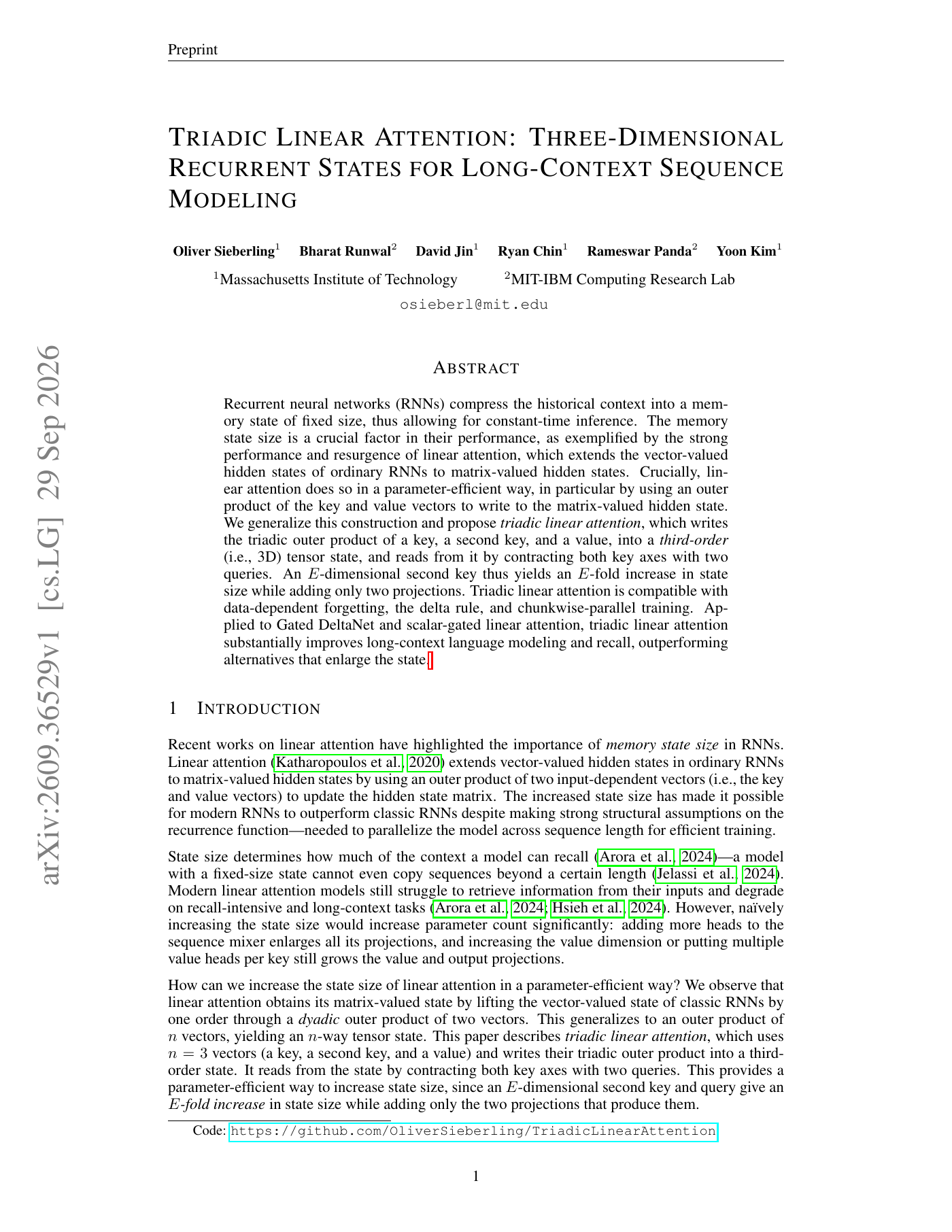
The paper's first page shows the third-order state and summarizes long-context results. From the paper; copyright belongs to the authors.
Local reproduction
triadic_linear_attention is a transparent recurrent reference. Tests compare with explicit summation and check causality, \(E=1\) reduction and gradients. See three-seed mechanism results. The paper's chunkwise Triton kernel, Gated DeltaNet upcycling and long-book language modeling are not reproduced. Small-tensor agreement is not reproduction of paper results.