LeapQuant: windowed quantization and compensator tokens
L1 mechanism. Retains per-window state quantization, low-rank compensator tokens, and residual smoothing. The paper's CUDA kernel and full-model throughput were not reproduced.
Paper information
| Field | Details |
|---|---|
| Paper | LeapQuant |
| Organization | First-author affiliation: UC Berkeley |
| First public release | 2026-09-29 (arXiv v1) |
| Authors' code | No author repository was provided as of 2026-09-30. |
| Adapter / method | leapquant |
| Local reproduction code | src/auto_research/foundation_latest_20260930.py |
Original paper
Motivation and method
Quantizing recurrent state at every token repeatedly rounds it. LeapQuant retains a low-bit base state, buffers within-window updates at high precision, and requantizes once at the window boundary. It separates the largest outliers into a few high-precision compensator tokens, then smooths and quantizes the residual.
flowchart LR
  S[Low-bit state at window start] --> D[Separate outliers]
  D --> C[High-precision compensator tokens]
  D --> R[Smooth residual]
  R --> Q[Quantize once at window end]
  C --> O[Readout]
  Q --> O
Key figure from the paper
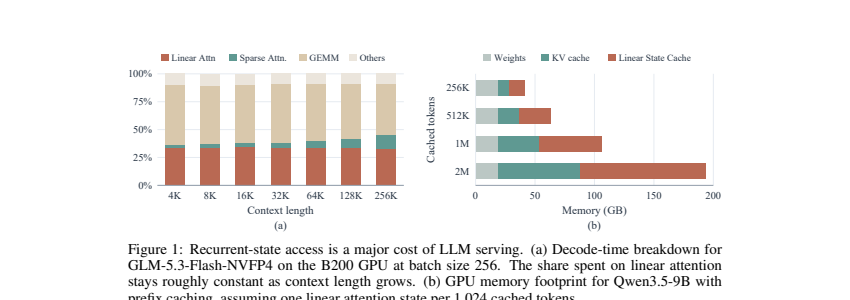
Figure 1: Decoding cost of recurrent-state access. From the original paper; copyright remains with the authors.
Core equations
Within a window, \(S_t=Q(S_{kw})+\sum_{i=kw+1}^{t}\Delta S_i\), requantized only at \(t=(k+1)w\). The local code uses truncated SVD for a rank-\(r\) compensator \(C=U_r\Sigma_rV_r^\top\), symmetrically quantizes \(S-C\), and adds \(C\) back at readout.
Paper results
On Qwen, Kimi, and GLM families the paper reports 8-bit results near FP32, 2.05–3.70× kernel speedup, and 1.47× end-to-end speedup. These are not local results; see the separate local metrics.
Local reproduction and limits
The diagnostic checks window boundaries, compensator rank, state error, and CUDA execution. It does not implement the authors' custom kernel. See the sanitized A100 receipt.