STEPQuant: Spatiotemporal quantization of recurrent linear-attention state
L1 lifetime-aware allocation and dual-axis scale fitting, not SGLang kernels or whole-model throughput.
Paper information
| Field | Details |
|---|---|
| Paper | STEPQuant |
| Institution | Zhejiang University (first author). |
| First public release | 2026-09-29 (arXiv v1) |
| Author code | Dreamer-Toby/STEPQuant. |
| Local adapter or method key | stepquant |
| Local reproduction code | src/auto_research/foundation_latest_20260930.py |
Paper method and evidence
Each concurrent request retains a fixed-size delta-rule state, and quantization errors compound. Estimate remaining state lifetime and key-row impact, allocate more precision to important blocks under a fixed average budget, and fit row/column scales.
flowchart LR
  S[Recurrent state] --> L[Remaining lifetime and key-row impact]
  L --> B[Allocate bits within budget]
  B --> Q[Quantize with row and column scales]
  Q --> R[Next recurrent update]
Original paper figure
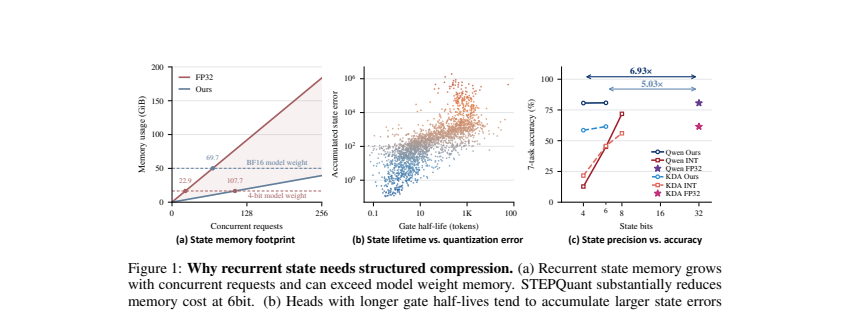
Figure 1 motivates quantization by linking state memory, lifetime and error. From the original paper; copyright remains with the authors.
Core equation
Use normalized lifetime \(w_t=(T-t)/\sum_j(T-j)\) and solve \(\min\sum_i w_i e_{i,b_i}\) exactly over candidate widths subject to average bits. Quantize with the geometric combination of key-row and value-column scales, not uniform INT8.
Reported results
For Qwen3.8-27B and Kimi-Linear-48B-A3B-Instruct, the paper reports nominal 6-bit state near FP32, over 5× state compression and up to 68.7% lower serving memory. Not local results.
Local reproduction
Three-seed diagnostic verifies bit budgets, finite scales, state MSE and CUDA forward/backward. Sanitized A100 receipt. No reproduction of throughput or model accuracy.