VETO: Video Efficient Token Optimization for Vision Language Models
L1 core-mechanism diagnostic. Runs spatial-first, temporal-second compression on GPU. No 7B VLM or real video benchmark is run, and paper throughput is not a local result.
Paper information
| Field | Details |
|---|---|
| Paper | arXiv 2610.01785 |
| Organization | First-author affiliation: National Taiwan University |
| First public release | 2026-10-01 (arXiv v1) |
| Authors' code | No public author implementation was found as of 2026-10-02. |
| Adapter | veto |
| Local reproduction code | src/auto_research/foundation_latest_20261002.py |
Original paper
Motivation and method
Merge semantically neighboring tokens within frames first, then remove cross-frame redundancy from compressed frame representations. Spatial-first processing reduces global temporal matching cost.
flowchart LR
  I[Input and current state] --> M[VETO mechanism]
  M --> A[Auditable intermediates]
  A --> O[Output or state update]
Key figure from the paper
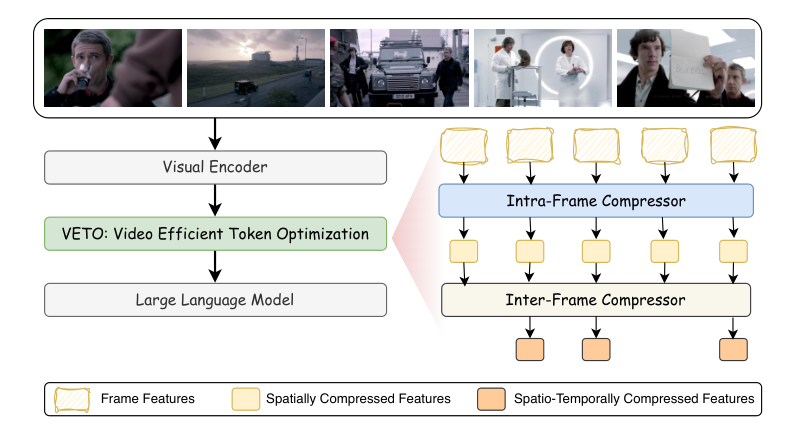
Key figure: Original architecture, training flow, or system protocol. From the paper; copyright remains with the authors.
Core equation
\(X'=C_{time}(C_{space}(X))\). Deterministic farthest-point representatives verify axis order and budget locally.
Paper results
LLaVA-OneVision-7B inference is up to 45% faster, and accuracy at a 10% token budget is 55.7%.
Local reproduction
Local comparison: The baseline disables the mechanism or uses default state; the treatment enables the core operator. Relative percentage change is not applicable. This checks invariants, gradients, or state transitions, not paper-scale outcomes.
- Three-seed diagnostic
diagnostic_only=true, ineligible for formal capability ranking.- GPU validation
Reproduction boundaries
GPU execution covers spatial-first, temporal-second compression only. There is no local 7B VLM, real video benchmark, or reproduction of the paper's throughput.