Elastic Expert Routing: Smoothing the Sparse Top-k Boundary
Paper information
| Field | Value |
|---|---|
| Paper | Smoothing the Top-k Exposure Boundary for Sparse Mixture-of-Experts |
| Affiliations | First author Yunkai Chai; Shanghai AI Laboratory / Shanghai Jiao Tong University |
| First public release | 2026-10-08 (arXiv v1) |
| Authors' code | No public author implementation found; third-party code is not official. |
| Adapter | elastic-expert-routing |
| Local code | src/auto_research/foundation_models/elastic_expert_routing.py |
| Entry point | scripts/run_elastic_expert_lm.py |
Original paper
Background and contribution
Fixed top-k starves experts just below the ranking boundary. During training sample a nearby budget independently for each token and layer. This exposes near-boundary experts to actual sparse computation at unchanged expected budget. Deploy fixed k.
flowchart LR
 X[Token state] --> R[Router probabilities]
 K[Discrete Gaussian budget r] --> S[Sparse top-r dispatch]
 R --> S --> E[Compute selected experts only]
 E --> W[Renormalize selected probabilities] --> Y[Weighted output]
Key figure from the paper
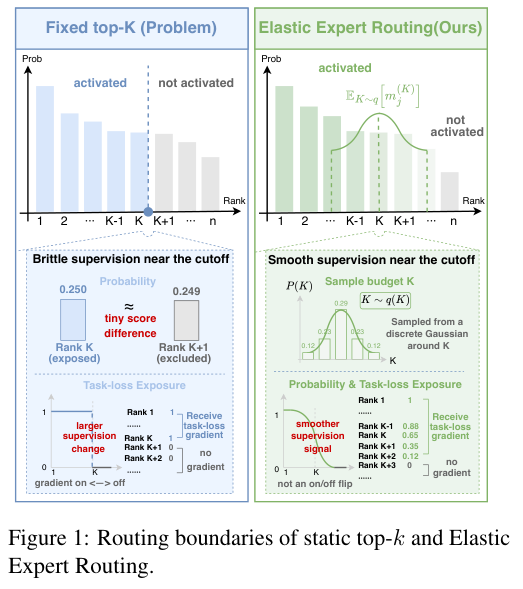
Architecture from the paper; copyright belongs to the authors.
Core equation and paper evidence
\(P(r)\propto\exp(-(r-k)^2/(2\sigma^2))\) on a valid support symmetric about k, so \(\mathbb E[r]=k\). Inference fixes k. Load balancing counts actual dispatches rather than assuming equal expert count per token. The paper studies pretrained and fine-tuned MoEs, with no production A/B. Its scale, tokenization, and budget differ from the local character model.
Local reproduction
Train an actual autoregressive causal Transformer with sparse experts, router and expert gradients, auxiliary balance loss, and fixed-k inference. Unselected experts are not computed and masked after the fact. Match shapes, initialization, training positions, and budget for radius=0 and radius=1.
PYTHONPATH=src python scripts/run_elastic_expert_lm.py \
  --text-file data/shakespeare.txt \
  --dataset-id karpathy/char-rnn/tinyshakespeare \
  --dataset-revision sha256:86c4e6aa9db7c042ec79f339dcb96d42b0075e16b8fc2e86bf0ca57e2dc565ed \
  --steps 100 --seed 42 --device cuda --output runs/elastic-42.json
Data and results
Public Tiny Shakespeare in original order, 90%/5%/5% train/validation/test. Vocabulary is shared but not targets; no test-based selection. Character PPL is not paper token PPL.
| Seed | Fixed-k validation character PPL | Elastic validation character PPL | Elastic mean experts in training |
|---|---|---|---|
| 42 | 24.4923 | 24.5578 | 2.99755 |
| 43 | 24.0827 | 24.1720 | 3.00089 |
| 44 | 25.1088 | 25.1332 | 3.00318 |
Both arms ran 100 steps on A30. Retain the negative result; three seeds establish only the reduced comparison. Inference uses three experts per token.
Code and limits
ElasticExpertRouting: Gaussian budgets, dispatch, and balancing. ElasticMoELanguageModel: actual training/inference. tests/test_elastic_expert_routing.py: expected budget, invalid bounds, gradients, dispatch counts. No large Qwen MoE, FineWeb-Edu pretraining, multi-node dispatch, matched wall time, or executed Evolve integration.