ZIP-SR / ZE-EDEN: 4-bit AdamW state quantization
Bounded A100 public WikiText-2 diagnostic.
Paper information
| Field | Details |
|---|---|
| Paper | Rounding in Preconditioner Space |
| Institution | Hanyang Li, UC Berkeley / Nubank (internship). |
| First public release | 2026-10-08 (arXiv v1) |
| Author code | nubank/adamw4bit, Apache-2.0. |
| Local adapter or method key | adamw4bit; Evolve optimizers optimizer:zip-sr / optimizer:ze-eden. |
| Local reproduction code | src/auto_research/foundation/adamw4bit.py; runner scripts/run_adamw4bit_public.py. |
Paper method and evidence
ZIP-SR rounds the second moment stochastically in preconditioner space. ZE-EDEN removes zero codepoints and recalibrates block scales. Both store the first moment in NF4, with stochastic rounding on the LM head over the final 10%. Method
flowchart LR
  D[Decode prior moments] --> W[Update working moments]
  W --> U[Update weights]
  U --> Z[ZIP-SR or ZE-EDEN]
  Z --> P[Pack 4-bit persistent state]
  P --> D
Original paper figure
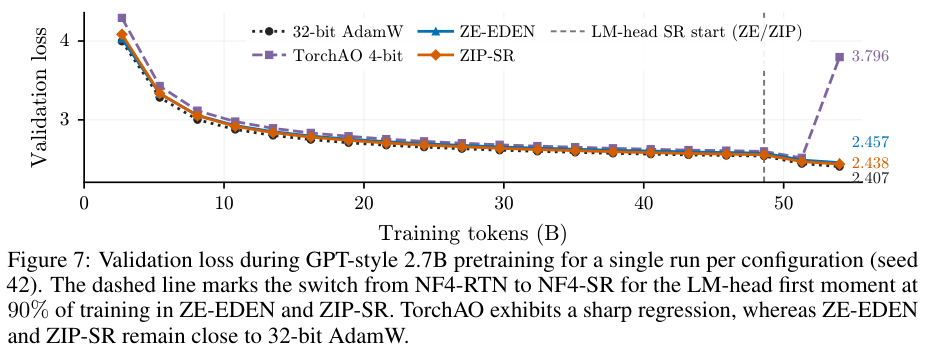
Figure 7 shows 2.7B validation curves and the LM-head rounding switch, not local WikiText outcomes. From the original paper; copyright remains with the authors.
Core equation
\(h(v)=1/(\sqrt{v/(1-\beta_2^t)}+\epsilon)\). ZIP-SR chooses the lower codepoint between \(a,b\) with probability \([h(v)-h(b)]/[h(a)-h(b)]\). ZE-EDEN scale correction is \(\|x\|^2/\max(\langle x,Q(x)\rangle,10^{-12}s^2)\). Update weights before quantizing the working moments.
Reported results
The paper reports 130M–2.7B pretraining and full-parameter SFT, narrowing validation-loss gaps to FP32 AdamW. No online A/B; local budgets differ.
Local reproduction
PYTHONPATH=src python scripts/run_adamw4bit_public.py \
  --data data/wikitext-2 --output runs/adamw4bit.json \
  --steps 200 --seeds 42,43,44 --device cuda
Official WikiText-2 train/valid/test; byte tokenizer, first million training bytes, 16 fixed 64-token snippets on validation and test. Match initialization, batches, learning rate, 200 steps, and independent LM head. Select on validation before opening test.
| Method | Mean validation loss | Persistent moment bytes |
|---|---|---|
| FP32 AdamW | 2.93307 | 1,095,680 |
| ZIP-SR | 3.12056 | 157,952 |
| ZE-EDEN | 2.97083 | 157,952 |
A100 state savings about 85.6%, with both methods worse on validation; FP32 was selected. Actual uint8 nibble packing, FP32 block scales and fallback below 4096 elements, BF16 restore regression, CPU/CUDA. Eager decode workspace and no fused kernel, so neither speed nor 85.6% total memory gain is claimed. Evolve can execute both and evaluate validation; its MicroLM ties embeddings/head, unlike this independent-head run. No FineWeb-Edu, complete TorchAO ablations, or large SFT. Metrics, GPU receipt.